
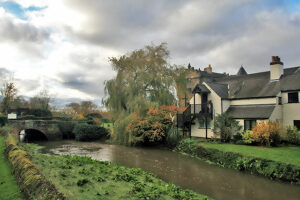
The third Sapere Books’ Writers’ Retreat took place at The Priest House Hotel, Castle Donington between the 28th and 31st of October this year.
Adele Jordan, author of the Kit Scarlett Tudor Mysteries and the Shadow Cutpurses Tudor Thriller Series, helped to organise a full programme over the four days.
In Adele’s words:
“For a lot of writers, it’s a solitary world. Whether you are struggling to complete your manuscript or are in love with your story and find it hard to step away, it can’t be denied that for many writers a lot of time is spent in a staring contest with your computer screen, and sometimes we need to step away from that screen.
“For the last three years, a group of authors from Sapere Books have come together to create their own writing retreat, and this year saw our biggest yet. Fourteen authors, who write across various historical genres, came together to talk about all things writing.
“From romance to crime, we plundered the depths — from the importance of accuracy in military fiction, to how we plan and approach clue-filled detective stories. What transpired was not only a shared enthusiasm for our craft, but the reassurance we sometimes need that we are not alone — that there are others out there with the same passion who are keen to inspire and be inspired themselves.
“This year, we had some special sessions led by writers in the group. Highlights included an insightful look into the editing process by Neil Denby, author of the Quintus Roman Thrillers Series, and a debate on the accurate use of poisons in fiction and the importance of research by Linda Stratmann, author of The Early Casebook of Sherlock Holmes Series.
“Amy Durant, Sapere Books’ Publishing Director, led a popular Q&A session with authors attending the retreat. We also covered what makes a good title, how to grab your reader’s attention from the very first line, the complications around weaving a narrative with more than one viewpoint, and a friendly critique session where people were invited to bring their own work for discussion.
“Following inspiring chats, some political debates, good food and a very comfortable bar, I was delighted to see so many of the writers come away with big smiles on their faces. Thank you to everyone who came this year and to Amy Durant too for sparing the time to talk to us. Here’s hoping next year’s Writers’ Retreat is not only just as good, but the biggest and best yet!”
Some comments from the attendees:
Ros Rendle, author of The Strong Family Historical Saga and the Moondreams House Romances: ‘Thanks to all attendees at the authors’ retreat week for making it so useful and fun. Particular thanks to Adele Jordan for all the organising, the excellent programme and for keeping us on track with such diplomacy.’
Michael Fowler, author of the DS Hunter Kerr Investigations and Dr Hamlet Mottrell Investigations: ‘[The retreat] has turned the plot of my next book completely around. And it was nice to catch up with colleagues from previous retreats, as well as meet up with new ones.’
Linda Stratmann, author of The Early Casebook of Sherlock Holmes Series: ‘The sessions really stimulated the little grey cells of the brain, and I got some insights which had me rushing off to do some writing!’
C V Chauhan, author of the Inspector Sharma Thrillers Series: ‘It was a fantastic four days! Thanks everyone and a big thank you to Adele for leading and managing the four days so well.’
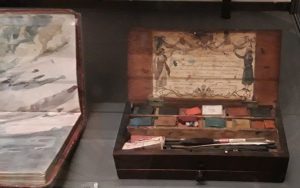 That said, there’s nothing like seeing real artefacts. Not so easy, you might think, living as we do two hundred years after the time in question. And here’s where I feel particularly lucky. I live in London with easy access to its plethora of galleries and museums. A while ago I visited the Victoria and Albert Museum and amongst its treasures I found things that not only helped with my work in progress at the time but which also affirmed why I love this period so much. One of my characters in another book is a keen artist, and this Watercolour Box circa 1820 is a particularly treasured image.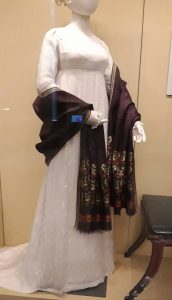
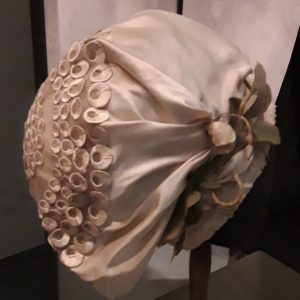 You can see how easy it is to get carried away by research when it can be so enjoyable. I’ll leave you with one more image before I tear myself away – I have another book to write!