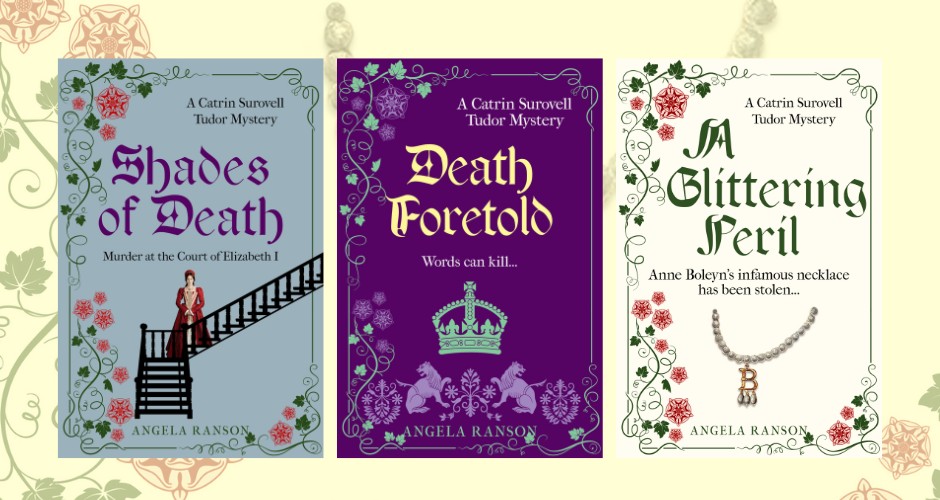
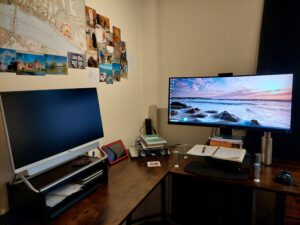
I write in my study, which doubles as a playroom for my two cats. I love having their energy and curiosity as the backdrop for my writing. This is especially true because I write about a world long dead — Tudor England — and try with every scene to bring it back to life.
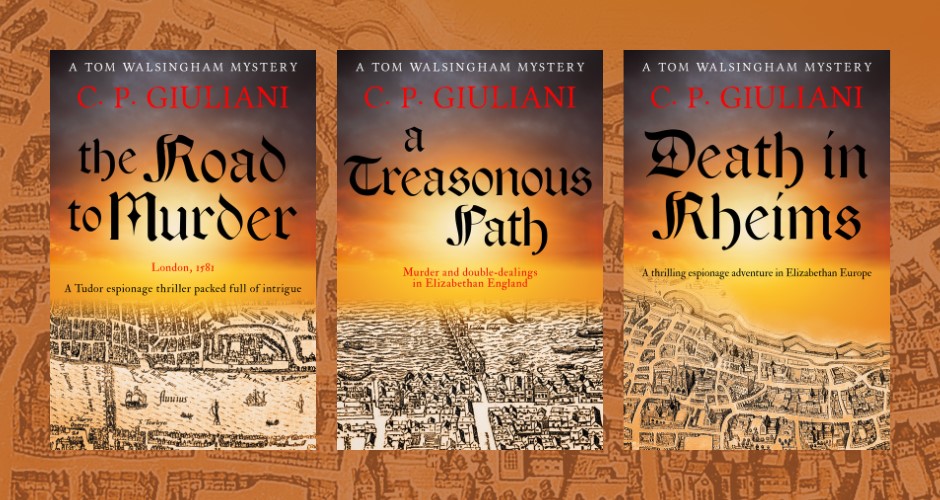
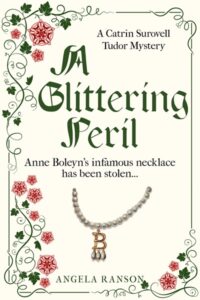
My books centre around the early years in the reign of Elizabeth I (the 1560s), which I studied when I earned my doctorate in sixteenth-century English history. I live in York, within a stone’s throw of King’s Manor. This was the building where Henry VIII stayed in 1536, and his suite of rooms is now one of the University of York’s libraries. If you stand at the back of the building, you can see a tiny window that leads to nowhere: it originally let some light into Henry’s specially-made toilet, or garderobe.
I love that York has these little historical treasures; I go looking for them whenever I have the opportunity. That isn’t as often as I would like, because I write between the hours dedicated to two jobs at the university. Writing is what I do to relax, to escape from the trials of daily life. Thus, you’ll often see me writing while I eat my supper, or early on a Saturday morning when I’m still in my pyjamas. Turns out, those are the hours when dreams come true.
“For a lot of writers, it’s a solitary world. Whether you are struggling to complete your manuscript or are in love with your story and find it hard to step away, it can’t be denied that for many writers a lot of time is spent in a staring contest with your computer screen, and sometimes we need to step away from that screen.
“For the last three years, a group of authors from Sapere Books have come together to create their own writing retreat, and this year saw our biggest yet. Fourteen authors, who write across various historical genres, came together to talk about all things writing.
“From romance to crime, we plundered the depths — from the importance of accuracy in military fiction, to how we plan and approach clue-filled detective stories. What transpired was not only a shared enthusiasm for our craft, but the reassurance we sometimes need that we are not alone — that there are others out there with the same passion who are keen to inspire and be inspired themselves.
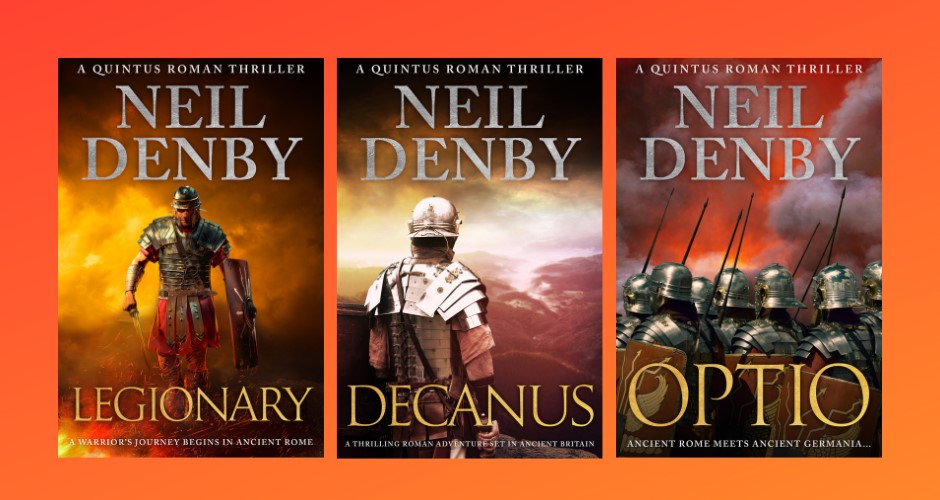
“This year, we had some special sessions led by writers in the group. Highlights included an insightful look into the editing process by Neil Denby, author of the Quintus Roman Thrillers Series, and a debate on the accurate use of poisons in fiction and the importance of research by Linda Stratmann, author of The Early Casebook of Sherlock Holmes Series.
Adele Jordan
“Amy Durant, Sapere Books’ Publishing Director, led a popular Q&A session with authors attending the retreat. We also covered what makes a good title, how to grab your reader’s attention from the very first line, the complications around weaving a narrative with more than one viewpoint, and a friendly critique session where people were invited to bring their own work for discussion.
“Following inspiring chats, some political debates, good food and a very comfortable bar, I was delighted to see so many of the writers come away with big smiles on their faces. Thank you to everyone who came this year and to Amy Durant too for sparing the time to talk to us. Here’s hoping next year’s Writers’ Retreat is not only just as good, but the biggest and best yet!”
Some comments from the attendees:
Ros Rendle, author of The Strong Family Historical Saga and the Moondreams House Romances: ‘Thanks to all attendees at the authors’ retreat week for making it so useful and fun. Particular thanks to Adele Jordan for all the organising, the excellent programme and for keeping us on track with such diplomacy.’
Michael Fowler, author of the DS Hunter Kerr Investigations and Dr Hamlet Mottrell Investigations: ‘[The retreat] has turned the plot of my next book completely around. And it was nice to catch up with colleagues from previous retreats, as well as meet up with new ones.’
Linda Stratmann, author of The Early Casebook of Sherlock Holmes Series: ‘The sessions really stimulated the little grey cells of the brain, and I got some insights which had me rushing off to do some writing!’
C V Chauhan, author of the Inspector Sharma Thrillers Series: ‘It was a fantastic four days! Thanks everyone and a big thank you to Adele for leading and managing the four days so well.’
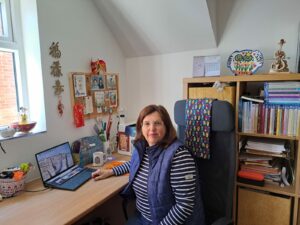
Staring out of my study window I see a brick wall. Not a theoretical one that means I have writer’s block, which I do not actually believe in as a professional writer, but a literal brick wall.
This may not appear to be the most inspirational of vistas, but I am fine with it.
Inside my study I am surrounded by my writing workspace; my research books, my trusty printer and personal items that make me smile.
Centre stage is my lovely laptop with its two screens. One is usually displaying research sites and email tabs, the other Word documents — my current WIP.
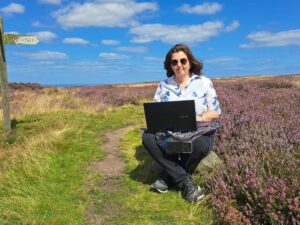
Castleton Walk, Commondale.
The brick wall rarely gets a glance because, once my laptop is on, I dive into my inner vistas. The beautiful scenery of North Yorkshire’s open moorland and coastline with its sweeping bays and rugged headlands. These are the settings against which my romantic adventures play out. Hence the Yorkshire Saga Series and my many novellas.
It is a world I am familiar with because I grew up in a bay town on the northeast coast and have happy memories of running with my dog along the open expanses of fine sandy beach, climbing the dunes which were covered with needle-sharp marram grass.
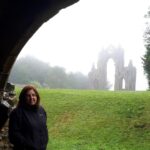
Gisborough Priory.
The area is steeped in history, from the old abbeys and market towns to the beautiful city of York. I still return regularly to explore the area: the monk’s trods that cross the moorland, the fishermen’s cottages that line the harbours and the old inns of the bay towns such as Whitby, Staithes and Robin Hood’s Bay. Then there are the manor houses and halls, each with a story to tell — inspiration for my next adventure is found in all. The darker era of smuggling provides further scope to add drama and menace.
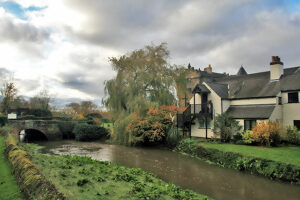
The beauty of having a laptop is that it is mobile. I have written in cafés, on trains, on picnic tables by the sea, and in hotels — but the real work, the editing, polishing and research, happens at my desk, ignoring the blank brick wall.
I have a flexible routine, writing every day. Life happens, events happen, but the one thing that is constant is the desire to write, which never goes away — or not yet — and I hope never will so long as readers enjoy my adventures.
What better motivation is there for an author to continue to write?
Alistair Forrest is the author of the action-packed Roman adventures Sea of Flames, Libertas and Vipers of Rome. He is currently working on a new series, The Britannia Conspiracy, set in the period during Caesar’s invasion of Gaul.
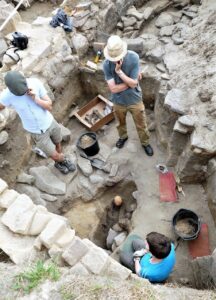
A 3,000-year-old skeleton. Photo: David Nash
Every year I climb into old jeans, don an Indiana Jones-style hat, and dash a hundred yards down the road to assist in an archaeological dig.
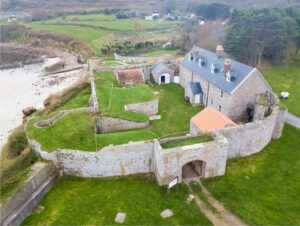
I live on the island of Alderney, which just happens to have an ancient Iron Age settlement, on top of which is a Roman village. Next to this is one of Europe’s best-preserved Roman forts, which was built to protect trade routes between Europe and Britain.
I’ve got to know both of the lead archaeologists — Dr Phil de Jersey and Dr Jason Monaghan — and confess that I’d like to know what they know, as long as it fits my ideas for a new historical fiction series.
So far I’ve struck lucky.
We know for sure that Iron Age folk lived and loved on this tiny island a few miles off the Normandy coast. We’ve found the skeletons, complete with bronze torcs and jewellery.
Our team, Dig Alderney, is bent (both literally and figuratively) on scraping away aeons of history to find the story behind these settlements. And at every layer we have been able to confirm that the Romans first came to this Channel Island in around 56 or 55BC when Julius Caesar was conquering Gaul and had set his sights on Britain, just across the English Channel.
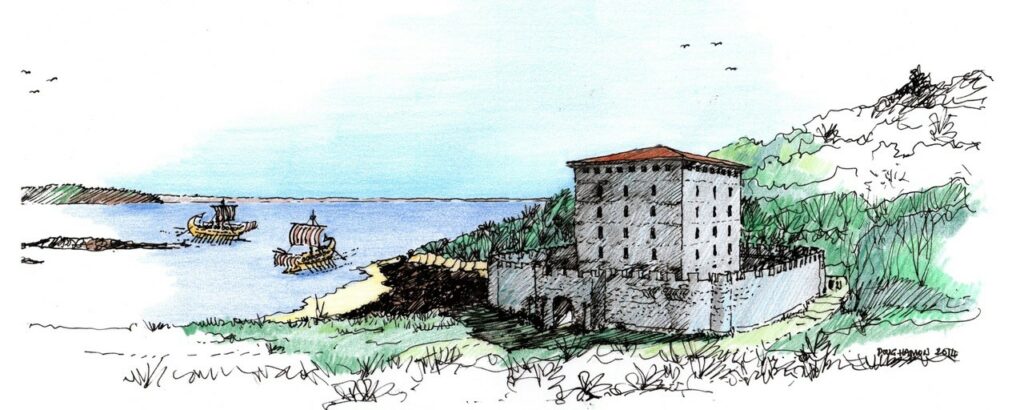
Artist Doug Hamon’s impression of the Roman fort.
Later, the Romans built a fort which has stood intact since the 4th century. Sadly, the huge central tower has long gone, its stonework no doubt used to build medieval houses in the vicinity, and part of the south wall tumbled onto my local beach who knows when, where its parts can still be seen to this day.
The area is crowded with archaeological features. Some relate to German activity (Alderney was occupied during the Second World War) or Victorian fortifications inside and around the fort. Modern roads partly conceal what we know is an Iron Age cemetery discovered in 2019.
Two skeletons were discovered back then. That’s when I got involved after arriving on the island to write, and I was given backroom jobs like pot-washing, shovelling and making sandwiches. Just to be there was a privilege!
This is now a long-term project to learn more about the Roman and Iron Age settlement on Longis Common, a few yards from my home. How extensive is the Iron Age cemetery, and where was the village in which these people lived?
We hope to discover how far the Roman buildings extend, and if this was the site of an earlier Roman fort that predated the 4th century one, or the vicus municipal administration settlement that grew up close to a fort, or a purely civilian village?
Of course, I already know the answers because they’re in my head, as you would expect from an adventurous historical fiction author.
Alderney’s Roman fort today. Photo: Alan Perks
I know I’m on to a winner. Take this exuberant comment by Dr Monaghan: “Finds include pottery, metalwork, glass, building materials, human bones and food remains including animal bones. The finds need to uncover more about the people who lived and were buried there. We want to learn about their lifestyle and how ancient Alderney was connected to the wider world.”
I’d call it making the facts fit a good story, and I’m already well into book two of The Britannia Conspiracy series. This series begins with coded messages from Julius Caesar to attend a secret conference on this island to plan his expeditions to Britain.
Should it be a full-on invasion, or a trade expedition? Either way, he’s in for some surprises, especially as far as the local Celts are concerned!
We invent friends in our heads, decide how they speak, what they wear, where they go, then spend countless hours conversing with them. No two writers share the same head-friends, oddly, despite running in the same social circles. Neither do any two writers develop a story the same way.
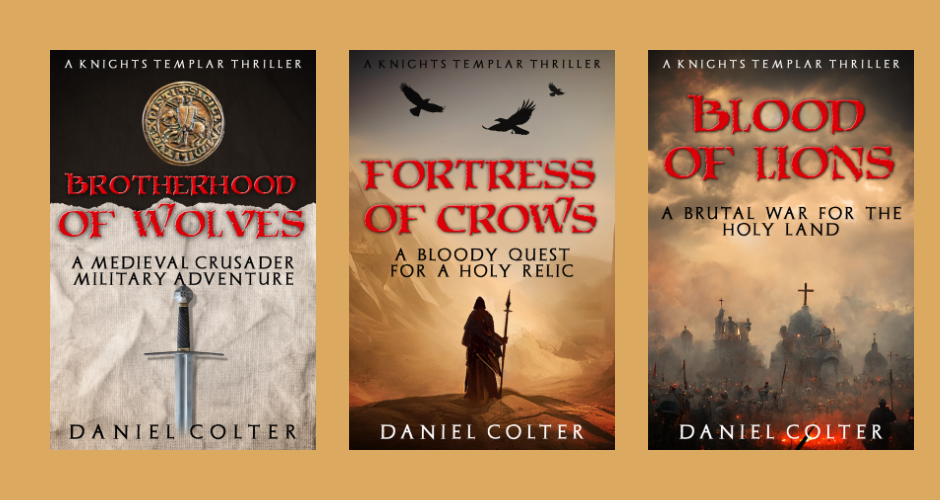
Specific routines keep us on track, or don’t (looking at you, internet), and each work proceeds at its own pace. Most writers are one of two species: a plotter or a pantser. A plotter maps out each scene, chapter, and verse before putting fingers to keyboard. Pantsers fly by the seat of their pants, beginning with an idea, then writing towards a vaguely defined ending. I mapped out my first novel, Brotherhood of Wolves, but tossed the map aside by chapter 3. I found pantsing more rewarding, and still do, because much of the fun (and frustration) is writing myself into a corner and finding a path out.
My novels are historical fiction, where history provides setting, culture, and place. History can also frame the plot. Story is given precedent over history, however, because the goal is to entertain, not to educate. One or more characters are historical persons and the fictional protagonist lives within their orbit. Historical fiction should stay true to history and the fiction takes flight where history grows murky — which it usually does, especially the further back in time one travels. The murk is where the fun begins, in my opinion, and its where the what if fleshes out the story, where the pantser finds out what happens to his head-friends.
Writers are also strange creatures.
Some writers have habits, like a dog that circles exactly three and a half times before lying down, and these rituals are intended to fuel creativity. Isabel Allende started her first novel on January 8, 1981, and that day became a ceremonial start date for all her subsequent works. The poet Friedrich Schiller kept rotten apples in his desk and, when his mind needed a jolt, he would give one a sniff.
My writing rituals are more mundane and less … smelly. I start with two (not one, not three) cups of coffee. I keep a stuffie of Curious George on my desk, in honour of Curious George Rides a Bike, the first book I read cover-to-cover. I say hello to George each morning.
Ritual also comes from my father. He was a painter and writer and used a second-hand desk as his art space. I acquired that desk, set to rehabbing it, but foolishly sanded the top to expose wood veneer over composite. I left his dried paint splashes along the edges, though, and I touch them when I write. They make me think of him, and thinking of him puts me in a creative mood. I told him I had begun writing historical fiction, his favourite genre, but he passed away before reading Brotherhood of Wolves. I often wonder what he would think of my series, and suspect he would be pleased (except for the part where I ruined his desk).
In this behind-the-scenes blog series, Sapere Books authors offer an intriguing insight into how, where and why they write.
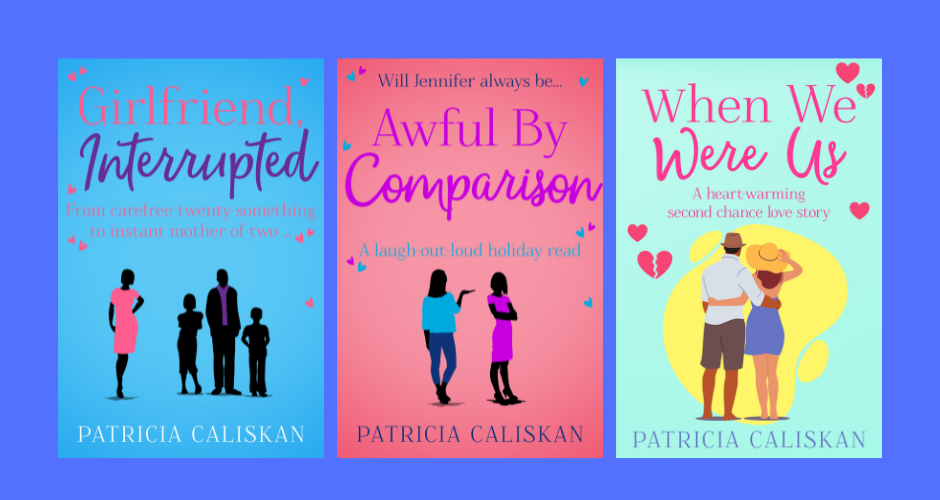
Today, we are delighted to spotlight contemporary romance author Patricia Caliskan.
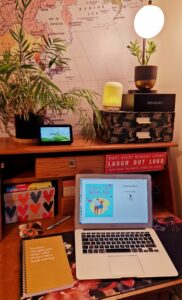
I wrote my third novel, When We Were Us, at my bureau, which has become my writing enclave. Something about opening the bureau desktop gives me a sense of immediacy which speeds the writing along. I write upstairs, free from distractions, except for my dogs who stop by to visit, but basically closed off from everything except the world I’m creating.
Patricia’s bureau
I never thought I had any writing rituals until people began asking the question. I realised that I have rituals in general. All three of my novels were largely written at night. Once the demands of the day are over, night-time is not only the perfect fit in a practical sense but allows me the space I need to daydream on behalf of my characters, and fully immerse my thoughts in the world of the book.
I’m a huge advocate of those tiny details which promote wellbeing, even when I’m not writing. So, before I get back to my latest manuscript, I mix essential oils for my diffuser, which works like magic for changing up the mood, and I set a timer to monitor my working hours.
I find having scheduled time slots super helpful. I can show up and do the work and know exactly how much time I’ve spent on the novel, which is reassuring when I’m trying to find enough time to work on a project.
I switch on my moon light, as I call it, a perfect orb of white light, and always freshen up my perfume before I write. I think of perfume as a superpower. A favourite scent signals that we’ve got work to do and someplace else to be.
I usually start by reading over where I left off to reacclimatise. I try not to spend too much time agonising over a word choice or a sentence formation until I’m at the editing stage. I have a natural tendency to edit as I go, wanting the work to be as close to the final manuscript as possible, which can hinder the drafting process.
When it comes to first drafts, I remind myself of my own advice: to just get it all down. I need solitude to do that, and sitting at my bureau, I feel enclosed in the world of the book. When it comes to editing, I usually end up inadvertently making a playlist to score parts of the novel or characters, which I find helpful with tone and pace. Once I have a completed manuscript, I print the work out and read it aloud, because if the writing doesn’t sound right, it isn’t right, and needs reworking.
Writing fiction requires both discipline and detachment, and my little bureau space provides just that!
Living on a French hilltop, with a medieval castle at the bottom of our garden, Roman remains beside a river in the valley, and with the Hennessey Cognac estate on one side, Martell on the other — I couldn’t ask for a lovelier or more tranquil setting.
Okay, there are diggers outside at the moment, replacing water pipes in the very same trenches the electricity people dug (then filled in) exactly one week before. But usually the loudest sound is birdsong, and the mewing of buzzards circling overhead. Just the ticket when you come home bursting with ideas that need to be turned into stories without distractions. From Sicily to Arizona, Sweden to Nova Scotia, I find inspiration everywhere.
Sweden? That was when we were walking a little out-and-back coastal path — worryingly easy to imagine two people going out, but only one of them coming back.
Nova Scotia? Who wouldn’t be inspired by the biggest disaster no one’s ever heard of, when a French ship carrying enough explosives to end the First World War collided with a Norwegian ship coming the wrong way up the channel? The explosion took close to 2,000 lives, injured 9,000 more, destroyed everything in a half-mile radius, spiked a tsunami, and scattered debris several miles inland.
Sicily drew me back to ancient history, inspiring the second book in the Claudia Seferius series, Virgin Territory, as well as Blind Eye — set in Ancient Greece this time, rather than Rome — and debunked the myth of the Cyclops.
As always, Arizona never fails to deliver, especially when my story ‘The Wickedest Town in the West’ scooped an Ellery Queen’s Mystery Magazine award, of which I am ridiculously proud.
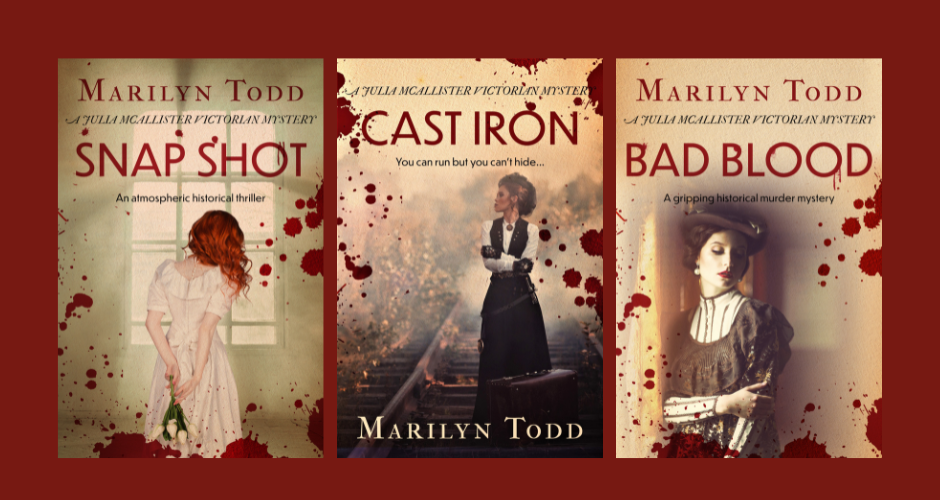
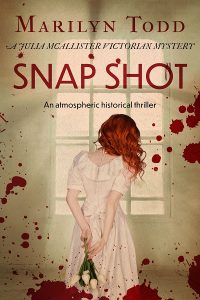
But while we travel a lot, not everything I write is inspired by breathtaking scenery, adventures and legends. My first series with Sapere Books, which kicked off with Snap Shot, was influenced by the emerging science of forensic evidence at the end of the nineteenth century, and the importance of studying crime scenes. Hence Britain’s first crime scene photographer, Julia McAllister.
My new Firefly series, coming soon with Sapere, tackles the inequalities women faced in Edwardian times, especially domestic violence, which was banned between the hours of 10 p.m. and 7 a.m. because the noise interrupted other people’s sleep. Battling the system is Kitty Sullivan, who runs a gentleman’s club with a fleet of … let’s say exotic dancers, to fund a women’s refuge. Environments that, unsurprisingly, provoke dangerous situations, which Kitty faces down with charm, wit and, of course, a silver Derringer.
After all, there’s no point in having double standards, if you don’t live up to both of them.
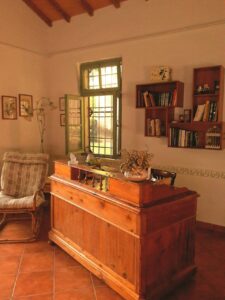
Every year, as soon as summer comes, I move my writing to the garden house. It’s not really cooler, as temperature goes, but it feels summery and pleasant. I love the tall ceiling, the terracotta floor, the desk that used to belong to my great-grandfather, and the view onto the garden. There’s a little pond outside the French windows, and the birds bathing or drinking are, I confess, something of a distraction — but they also provide a cheerful break whenever I find myself stuck. A paragraph refusing to take the right shape? A character mutinying? A dull passage? I step away from the desk and watch while the blackbirds play in the water — and, more often than not, a solution will suggest itself.
For all its rustic pleasantness, the garden house has decent Wi-Fi — which is rather essential when my pile of reference books is not enough to confirm some detail — and is equipped with an electric kettle to make cup after cup of tea, which is a fundamental of my writing method.
In truth, beyond the insane amounts of tea, I have little in the way of a writing routine. Working in theatre means that my hours are flexible. Sometimes I write in the morning, sometimes very late at night, sometimes both; sometimes I must snatch the odd hour here and there, between a rehearsal session and a meeting with the techs. One thing I do is to always keep a notebook with me. Through the years, I’ve learnt to keep a dedicated notebook for each project, beside a general one for everything and anything: notes, stray ideas, snatches of dialogue overheard or imagined, lists, questions… It’s the general notebook that I carry around, so I can jot down anything that occurs to me — to be transferred to the relevant one later. This means that I do some of my writing at the theatre, at the vet’s, as I stand in a queue at the Post Office…
My family, friends and colleagues have developed a high degree of amused tolerance for my ‘Notebook Moments’, when I drop whatever I’m doing to take a note; strangers are occasionally a little put out until I explain that, for one thing, I’m prone to forgetting what I don’t write down and, for another, sometimes an idea will present itself in a very iridescent shape, little more than a flicker of colour under the surface of the water — and will need to be recorded quickly and thought through in writing, at least a little, if it’s to be of any use.
So to recap, I’m absent-minded, easily distracted, forgetful, and can’t keep a routine… I suppose it’s no wonder that a quiet, pleasant place like the garden house is important to my writing process.
I’ve always written stories, even as a child, then I progressed from childhood scribbles to more serious attempts at literary glory on an old upright Olivetti typewriter (one of those with a red and black ribbon, if you’re old enough to remember) when my handwriting graduated from ‘untidy’ to ‘execrable’.
Reluctantly I then honoured my mother’s wish, and my father’s insistence, and got a ‘real job’ as a criminal trial lawyer, which was about as relaxing as standing on one leg on the top outer ledge of The Shard in London, without the reassurance of a safety harness. To relieve the stress I decided to start working on a novel — but what should I choose for a genre?
A good friend of mine who already earned a precarious living as a novelist was insistent that one should always write about things that one knows, and by this stage I knew two things outside my professional straightjacket — some history from my schooldays, and the streets of my home town, Nottingham. During the final years of my working life I spent stolen moments imagining the lives of those living in Nottingham during the Luddite Riots, and In Ludd’s Name was eventually published by a boutique publishing house owned by an old school friend.
Bitten by the bug, and buoyed up by having finally been published, I grew ambitious, and searched the history books for possible storylines, most notably from that most colourful of periods of English history, the Tudor era. The literary world seemed to be awash with Henry VIII, Anne Boleyn, Elizabeth I and even ‘Bloody Mary’, but two seminal characters from that era seemed never to have received much attention from novelists.
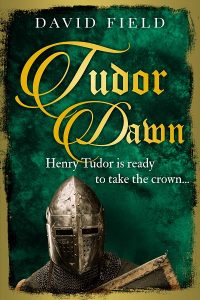
First was the progenitor of the Tudors, the boy from Wales, Henry VII, and I climbed inside his head to bring to the pages that followed his boyhood imprisonment in a bleak castle in South Wales, his youthful exile in Brittany, his triumphant return at the head of a ramshackle army that deposed Richard III at Bosworth, and his love match with Elizabeth of York that brought the Wars of the Roses to an end in the nursery rather than on the battlefield. To my delight, and secret surprise, I found a publisher — Sapere Books — and Tudor Dawn was launched.
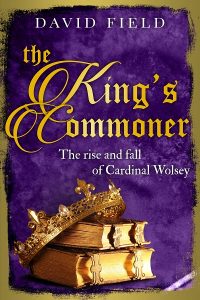
Then — unbounded joy and amazement! — Sapere wanted another one, so this time I focused on a butcher’s son from Ipswich who rose from obscurity to become Archbishop of York, Papal Legate for life, Lord Chancellor and the diplomacy coach of choice of Henry VIII. Cardinal Thomas Wolsey’s spectacular downfall was just as dramatic, and The King’s Commonerwas published, as testament to the fact that I had a second novel in me.
Dozens of titles have since been published, all by Sapere Books, and all ‘historical’ in genre. As one of the characters in Alan Bennett’s delightful creation, The History Boys, says of history — ‘It’s just one ******* thing after another’, and so it has been for me.
Inspiration can come at any time of the day or night, but I find that the small hours are awash with ideas — plot lines, character development, a resolution to a particularly tricky scenario — so it is important that I keep a notepad and pencil by the bed. It may be old-fashioned but it is also reliable and has the advantage of not involving bright screens.
Frustratingly, come morning, I cannot always decipher what I have written down, but sometimes there are gems. These may be character or plot evolution, or perhaps just phrases, but I know I would have forgotten them completely if I had not made a note.
While out walking — an excellent way to clear the brain of fog — I defer to modern technology and record voice notes on my mobile phone. The same principle applies — if there is no immediate record, the thoughts can be lost.
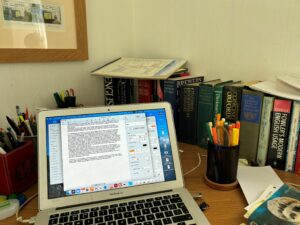
These brief lines are later transferred to a laptop. This is strategically placed in a corner of my study so that I am not distracted by the view outside the window. A row of reference books and one of my favourite possessions, an original Steve Bell cartoon, are all that I have for company. It also helps if I can visualise a character or a place, so I keep a sketchpad on my desk where I can create basic images — maps, plans, sometimes the progress of marches or battles. These drawings help to maintain consistency and authenticity.
This is my primary space, where the words are typed up. I add to them, enhance them, contextualise them, read them back. I often discover that I have used a particular word or phrase twice or more. Or if there is something I’m not sure about, I look it up. The reference books help to straighten out facts and also to find alternative words. Roget’s and Brewer’s and Fowler’s and Chambers provide a wealth of information unmatched by an American-leaning internet. I admit to slipping down rabbit holes of etymology and semantics, but find it strangely satisfying.
I always have to read what has been written, in context with the book so far. Traditionally that would have meant printing the manuscript out and sitting down with a pencil. Happily, that is no longer the case. Instead (thanks to everything going up into the Cloud) I can now read and review on my iPad. This means I can lounge in a chair, or sit outside, or read whilst travelling. So it is more a case of recreating the experience of the reader to see how and if things work.
Of course, there are edits, and actual printouts sometimes, but that is basically it: pencils and pads and technology.
Oh technology, where were you when I had all those essays to write at school?
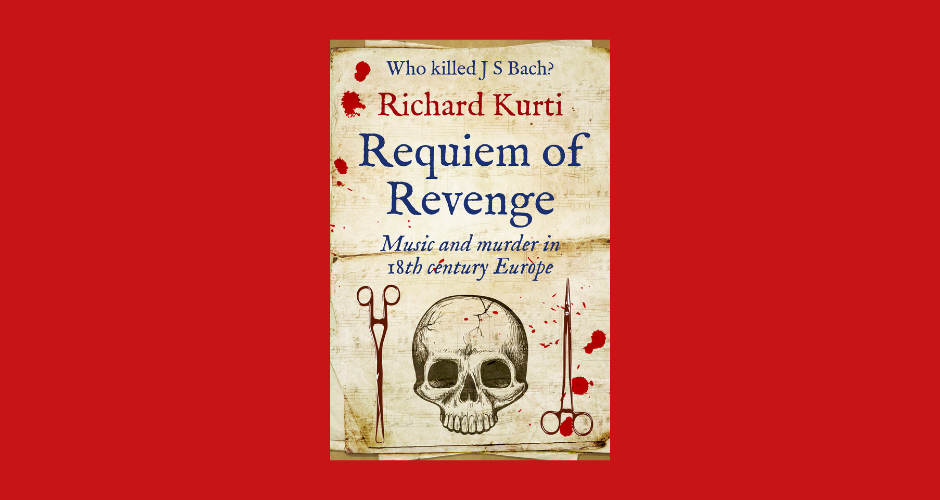
Despite being the story of a man who leaves a trail of chaos and suffering in his wake, Requiem of Revenge began as a search for inner peace.
I always listen to music when I write, often choosing film scores that resonate with the tone of the story I’m working on. But as populist leaders took power in country after country and the world seemed to retreat from democracy, my mood slumped. Instinctively, I turned to the music of Bach and Handel.
The richness of their music was incredibly healing, and I clung to the thought that whatever dark times they endured, both composers were still able to produce works of incredible beauty. And then I wondered, What exactly did they live through?
I started reading about the lives of Bach and Handel. They were both born in 1685 in Germany, barely 90 miles apart; they spent their lives as composers and musicians, yet they never met. Although they are now recognised as being the greatest composers of their age, both men had very different lives. Handel moved to London, where he enjoyed wealth and fame, while Bach spent much of his life working in Leipzig, scraping a living as the director of church music.
Bach certainly knew of Handel and greatly admired him; he is even quoted as saying “[Handel] is the only person I would wish to see before I die, and the only person I would wish to be.”
And then, as I was rummaging around in the footnotes of history, I discovered an extraordinary coincidence: both composers were destroyed by the same fraudulent English eye surgeon, ‘Chevalier’ John Taylor.
I dug deeper into the Chevalier’s life, and realised there was a shocking resonance across the centuries: the charlatans who were wreaking havoc in the modern world seemed to be cut from the same cloth as the man who destroyed the genius of Bach and Handel 250 years ago.
Perhaps telling the story of one liar and cheat could shed light on how liars and cheats are able to triumph across the world?
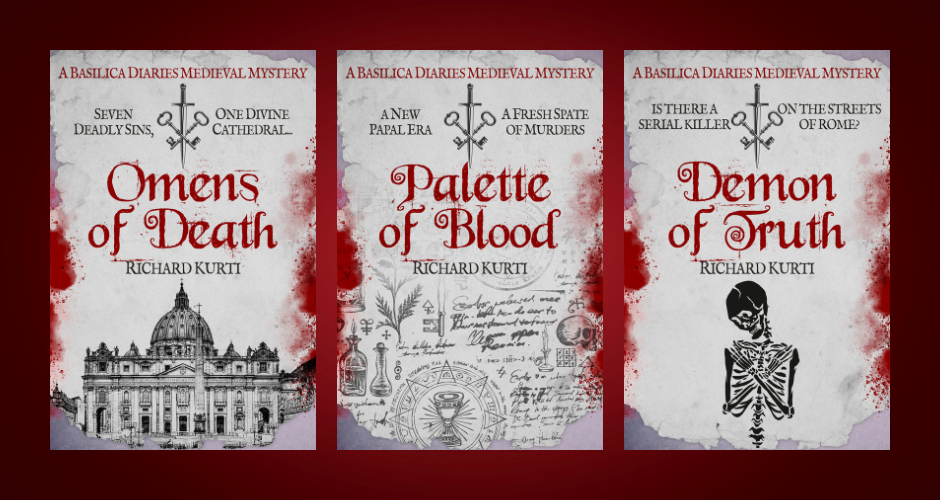
Richard Kurti is the author of the Basilica Diaries Medieval Mysteries series: historical thrillers set in fifteenth- and sixteenth-century Rome and featuring a brother and sister investigative duo.
Donato Bramante (1444-1514) was the brilliant architect who designed St Peter’s Basilica in Rome and oversaw the initial stages of construction. If you could put him in a time machine, bring him forward five hundred years, and lay out the current problems of the HS2 railway line before him, I doubt he would be very surprised. Bramante discovered the hard way that huge, ambitious construction projects that test the limits of technology always run into the same dilemmas and have the same questions hanging over them:
Why build it at all?
Isn’t the existing structure good enough?
What philosophy should drive the new project?
How can you prevent the costs ballooning out of control?
Will the public lose interest and turn against you?
How will you cope with unforeseen complications?
How will you prevent corrupt builders skimming off vast sums for their own personal enrichment?
Take a moment to think about building something like St Peter’s without the use of computers, high-powered machinery or sophisticated scientific instruments. It took one hundred and twenty years, and Bramante was long dead by the time it was completed, but its construction was still a lot quicker than Notre Dame Cathedral in Paris, or York Minster. And once built, these cathedrals have stood the test of time. How many railway lines will still be operating half a millennia after they were constructed?
The triumph of this superhuman achievement inspired me to write a series of novels centred on the construction of St Peter’s. Each murder mystery swirls around a different theme linked to the vast building project. Omens of Death explores the morality of building St Peter’s in the first place; Palette of Blood focuses on the vicious battle between artists competing to design it; and the newest book, Demon of Truth, shows what happens when you make a catastrophic discovery mid-construction.
Although the novels are fictional thrillers, I spent a lot of time doing research to find elements that grounded the stories in the sixteenth century, but also resonated with the dilemmas of the modern world.
So, the next time you find yourself on a rail replacement bus service, why not download some Basilica Diaries to while away the time?
 My books centre around the early years in the reign of Elizabeth I (the 1560s), which I studied when I earned my doctorate in sixteenth-century English history. I live in York, within a stone’s throw of King’s Manor. This was the building where Henry VIII stayed in 1536, and his suite of rooms is now one of the University of York’s libraries. If you stand at the back of the building, you can see a tiny window that leads to nowhere: it originally let some light into Henry’s specially-made toilet, or garderobe.
 The beauty of having a laptop is that it is mobile. I have written in cafés, on trains, on picnic tables by the sea, and in hotels — but the real work, the editing, polishing and research, happens at my desk, ignoring the blank brick wall.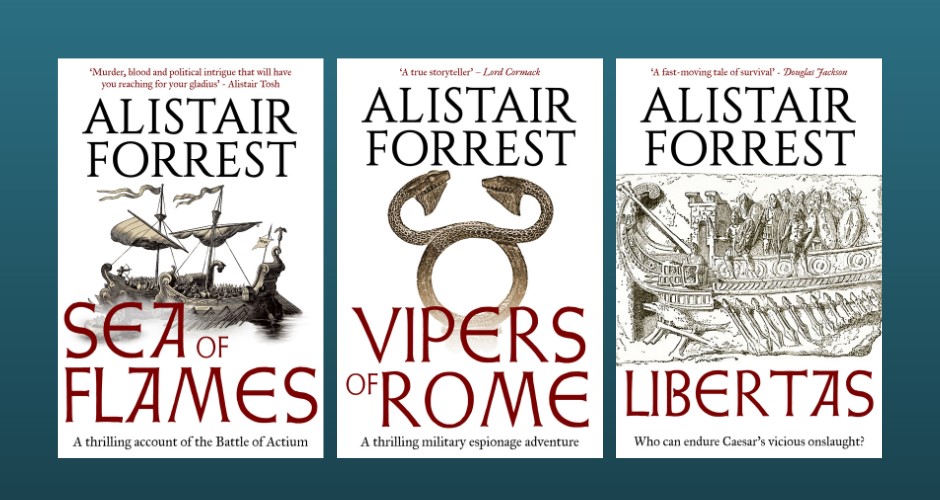
 My writing rituals are more mundane and less … smelly. I start with two (not one, not three) cups of coffee. I keep a stuffie of Curious George on my desk, in honour of Curious George Rides a Bike, the first book I read cover-to-cover. I say hello to George each morning.