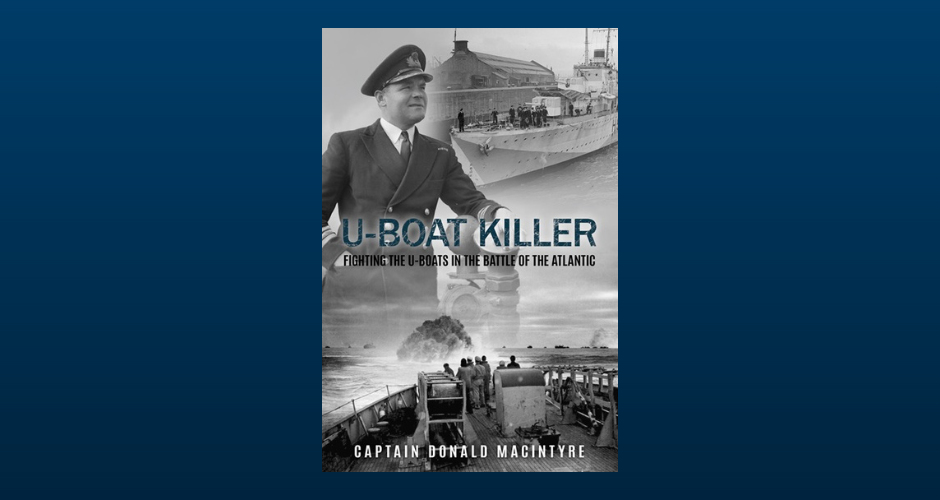
Between 1940 and 1944, Donald Macintyre was among the most successful submarine hunters in any Allied navy, transforming the Battle of the Atlantic with his successes against the U-boat menace. To commemorate the eightieth anniversary of the end of World War Two, Donald’s daughter, Dani, shares a personal memory from her father’s life after the conflict.
In 1960, when Dad was employed by MGM as Nautical Advisor on Mutiny on the Bounty starring Marlon Brando and Trevor Howard, he left my mother in charge of the pig farm. I can only suppose that she felt annoyed to be left with this responsibility, because she sold all the pigs and demanded a flight to California!
Dad complied, and I was able to join them for a fascinating holiday, mainly spent in Culver City’s MGM Studios every day. I watched the crew film scenes of a half replica of the Bounty on rollers, with wind and water machines simulating a storm on the high seas. To my joy I also spent time with the crew of Rawhide, a Western TV series. They made a fourteen-year-old girl feel very welcome!
If you have ever watched Mutiny on the Bounty, you might have noticed that in one scene Marlon Brando comes out of his cabin wearing a ridiculous red velvet smoking jacket. When Dad was asked to approve this costume change, he said it would never have been acceptable in those days. Hollywood being Hollywood thought it made handsome Marlon irresistible, so they kept it in. This made Dad wonder what he was being paid for, apart from sitting and playing cards with Gordon Jackson in Tahiti!
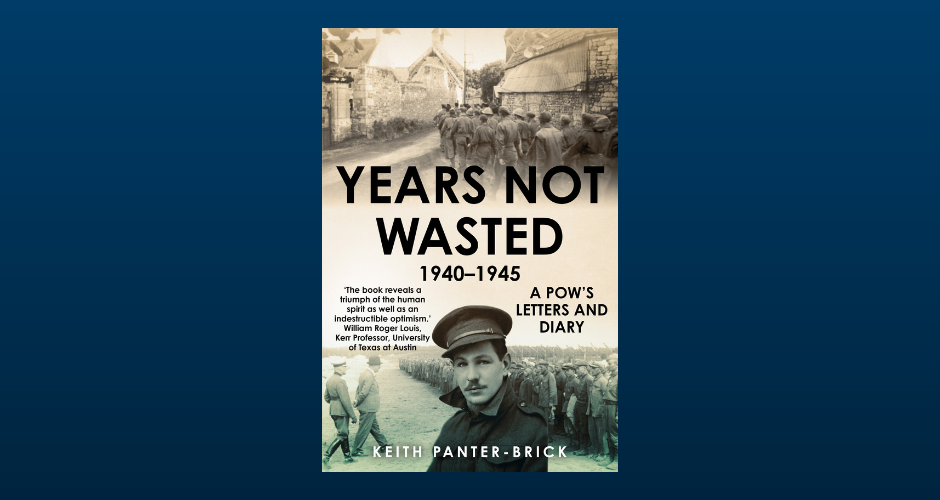
Keith Panter-Brick joined the Territorial Army in March 1939, at the age of eighteen. When war broke out six months later, he was sent to France, where he was entrenched ahead of the Maginot Line in spring 1940. Following the devastating German blitzkrieg, he was captured in May 1940 and spent the next five years as a prisoner of war.To commemorate the eightieth anniversary of the end of World War Two, Keith’s friend and colleague, Paul Jankowski — Raymond Ginger Professor Emeritus of History at Brandeis University — reflects on Keith’s harrowing wartime memoir, Years Not Wasted, below.
“We were totally outclassed,” Keith Panter-Brick told me in the early 2000s. He was speaking of May 1940, when the German land and air forces overwhelmed the Allied forces in Belgium and northern France. Taken prisoner that month, he spent the next five years — the first half of his twenties — in German prisoner of war camps (Stalags) in occupied Poland. The mental honesty, scrupulous accuracy, and personal humility in his brief comment captured much of the man, the scholar, and the friend I would first meet some fifty years later.
The same qualities would reappear in his memoir, Years Not Wasted. When he returned home to Merseyside, England, in 1945, all he had was his diary, along with the many letters that had somehow reached his family. He would return to them many years later in his memoir, retelling and perhaps reliving the captivity that he and other captured Western soldiers had to endure. They contended with conditions worse than those of the officers, but far better than those of the Soviet and Polish prisoners, most of whom perished in one of the great war crimes of the Second World War. Neither self-pity nor heroics coarsen his narrative. He writes of malnutrition and bitter cold, but also of Red Cross parcels, of boredom but also release, of submission but also resistance and, in his case, attempts at escape — once in 1944 from the camp itself, and again in 1945 from the virtual death-march out of it.
It is a recollection mixing scrupulous honesty with vivid detail, on one level a document about captivity in wartime, on another a spiritual memoir of inner freedom wrested from adversity, before its physical reality was finally restored.
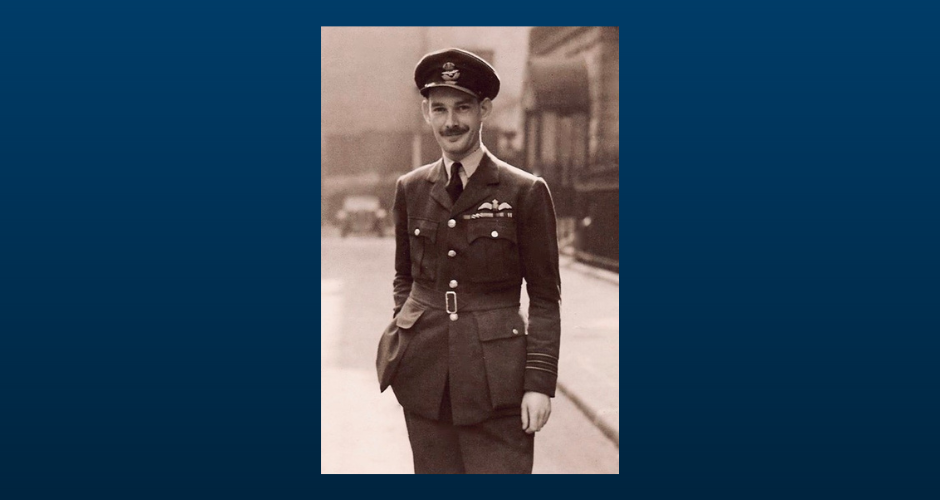
In September 1939 the twenty-year-old John Wooldridge, then a Sergeant Pilot, took part in the British air raid on Kiel, the first raid of World War Two. Having brought his damaged aircraft home safely, he was awarded the Distinguished Flying Medal. Commissioned in August 1940, he rapidly rose to the rank of Flight Commander, flying Lancasters as a Flight Lieutenant. In the middle of 1942, for his part in the 1,000-bomber raid on Cologne, he was awarded the Distinguished Flying Cross.By the end of the War, he had flown 97 missions over enemy territory. To commemorate the eightieth anniversary of the end of World War Two, John’s daughter and son, Susan and Hugh, share their memories of him below.
John Wooldridge
On 9th and 10th May 1944, our father, Wing Commander John Wooldridge DSO, DFC*, DFM, returning from New York where his music was being performed at Carnegie Hall, flew over the Atlantic in a Mosquito, taking off from Goose Bay, Canada and landing six and a half hours later in Ballykelly, Northern Ireland. In so doing, he broke the then speed record for crossing the Atlantic.
The Air Ministry, unsure what to do with this daring twenty-five-year-old, told him to lie low but, within a couple of days, they’d been outflanked by the Press and the story was all over the newspapers. As our father writes in his diary for Sunday 14th May: Ye gods, what a splash! Headlines, pictures…
Meanwhile, on Monday 15th May in a London hairdresser, our mother, the distinguished British actress Margaretta Scott, was having her hair done. Whilst under the dryer, she read the story in the London Evening Standard of this amazing trans-Atlantic flight. But what really caught her eye was that the pilot was also a composer of serious music, who had composed a work for Narrator and Orchestra called The Constellations.
‘That’s my boy!’ she cried, as Sir Henry Wood had recently asked her to find a new work for Narrator and Orchestra for his upcoming Promenade Concerts, and she felt that The Constellations might be just the job.
Our mother immediately approached the Air Ministry, but they refused to give out the personal details of the record-breaking flyer.
The story would have ended there if, a couple of days later, at Denham Film Studios where she was making the film Fanny by Gaslight, our mother had not given a lift to a film publicist who, on their journey back to London, had boasted that he’d just been given a camembert cheese flown across the Atlantic by a friend, one John Wooldridge.
‘Bring him to tea!’ she cried. And the next Sunday, there was our father on her doorstep — and that was it! For the next fourteen years until our father’s sudden death in a car crash in 1958, our mother and father were as inseparable as their young family and busy work schedules would allow.
In the 1950s, Margaretta Scott continued to star in plays and films whilst John Wooldridge wrote his music and plays and films. One of his most important films was the 1953 film starring Dirk Bogarde, Appointment in London, about a Royal Air Force Bomber Command squadron, for which he wrote both the screenplay and the music score. To this day it continues to be screened to great acclaim and serves as a memorial to Bomber Command by one of their own.
We are only passers by — through this world of sorrow
Here today a little while and gone tomorrow
Only once we come this way
We can’t come back
Let us make this world a little brighter
Scattering our seeds of friendship in the wayside grass
Some day they may bloom and cheer some poor pilgrim with a heavy load
Of doubt and fear
Life is just a journey, doesn’t it seem madness
The envy and enmity, the sorrow and the sadness
All the world’s great wealth for which men fight and kill and lie … is it worth it
when you think…
we are only passers by
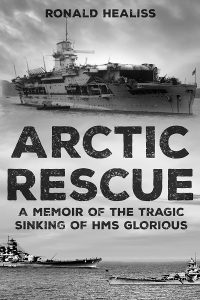
Ronald Healiss wrote Passers By just a day or two before he passed away on 25th December 1980 (yes, at noon on Christmas Day! His Liverpudlian humour would no doubt have led him to think it was nice timing!). Ronald had been one the few survivors of the most tragic events of World War Two, the sinking of HMS Glorious and her two escorting destroyers, Acasta and Ardent, which cost the lives over 1,500 men.
Although he managed to record his memories of this horrific ordeal in his book, ARCTIC RESCUE, he rarely talked about his experiences and could never be found on Remembrance Sunday while other members of the family watched the commemoration at the Cenotaph on television.
In the years after his death, Passers By, which was dedicated to the deceased crew of the three ships, has been read out at a number of Remembrance Services held by the HMS Glorious, Ardent & Acasta Association at HMS Drake, Plymouth, and is being shared with you now to commemorate the lives that were lost.
 my mother in charge of the pig farm. I can only suppose that she felt annoyed to be left with this responsibility, because she sold all the pigs and demanded a flight to California!