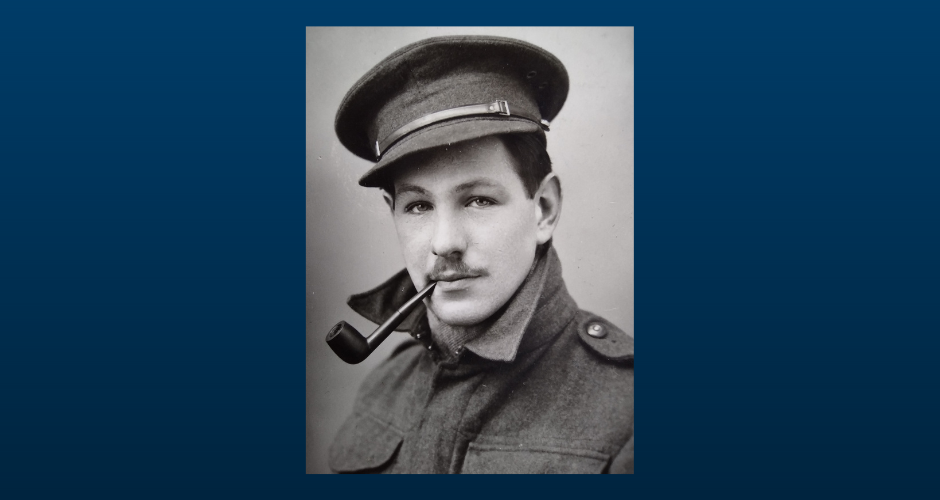
Keith Panter-Brick joined the Territorial Army in March 1939, at the age of eighteen. When war broke out six months later, he was sent to France, where he was entrenched ahead of the Maginot Line in spring 1940. Following the devastating German blitzkrieg, he was captured in May 1940 and spent the next five years as a prisoner of war. To commemorate the eightieth anniversary of the end of World War Two, Keith’s daughter Catherine — Professor of Anthropology, Health, and Global Affairs at Yale University — shares her memories of her father below.
“Each day life is hanging in the balance.” That was the phrase with which my father ended his book, Years Not Wasted. I think that everyone with a lived experience of war will understand that sentence: the notion that you may or may not live, may or may not be free, may or may not return.
Keith Panter-Brick was a prisoner of war in Poland from 1940 to 1945. He was captured at Isières when he was just nineteen. Under the Geneva Convention, ordinary soldiers were obliged to work — and were put to hard labour in POW camps. If he ever survived the cold, hunger, exhaustion, and brutality of war, Keith promised himself that he would study philosophy and go to university, the first of his family to do so. Admitted to Keble College, Oxford, he joined a postwar student delegation to Heidelberg for cultural exchange and reconciliation. There he met my mother, a student from Alsace-Lorraine on a French delegation to Heidelberg. The two fell in love — my father courted in German, their only common language at the time — and in that short week, they decided to marry. They built a family, rooted in the practice of non-violence and cross-cultural understanding.
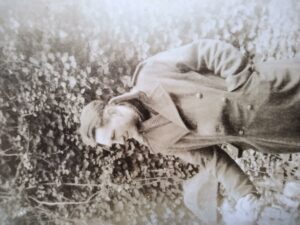 My father’s book began decades later, assembled from scraps of his diary, postcards, and letters sent through the Red Cross, all of which he had kept hidden away in a shoebox. On page seven of the first edition, you’ll find his death certificate — the Office of the Cheshire Regiment officially reported him killed in action in May 1940. It took months for news of his survival to reach home. That certificate became for me the most vivid proof that life indeed is hanging in the balance.
Years Not Wasted isn’t a grand officer’s tale. It’s a soldier’s story, grounded in hard labour, frostbitten marches, and everyday endurance. Because he learnt passable German, Keith was once included in an escape attempt with RAF officers, only to be recaptured in Gdansk, at the dockside when attempting to board a Swedish vessel. He survived the Great March out of Poland in the most brutal of winters, thanks to a pair of good boots made in his father’s bootmaker shop. Even years later, my sister Brigitte, now a regular walker in the forests of Lorraine, measures distances in fractions of “Great March kilometres.” In my own teaching and research, I focus on the biological and social signatures of war across generations, and on pathways to peace. My son Jannik chose to study POW trade and barter systems for his Masters’ dissertation at Cambridge. Each of us carries a trace of my father’s war experience.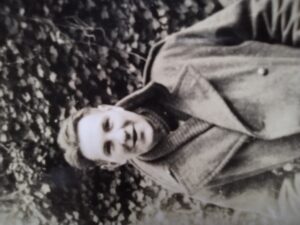
My father was impetuous. Once, while we were travelling from Nigeria to Cameroon, he filmed a bull elephant that decided to charge us on a dusty road. He stood in front of the car with the hand-held camera, while we huddled in the back. He once flagged down the pilot of a plane by running onto the runway, not wanting to miss his actual flight. But he became, over the years, immensely patient. Whilst a professor at the London School of Economics, he turned to gardening, building stone walls, and restructuring the house we purchased in Lorraine — a house that still has “2 OFF” (“must house two German officers”) carved in the front doorway. My father taught me to value ordinary things in everyday life: raking leaves, washing dishes, being attentive to other people. He never forgot what it meant to be hungry. He told me that being alive is a gift from God, and that good health is a blessing one can only really understand after one has lost it.
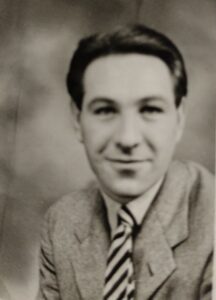 In 2025, we republished Years Not Wasted. It’s more than a memoir — it’s a witness statement. It honours ordinary soldiers who endured extraordinary hardship. It is a uniquely authentic book, told in the way it was recorded in letters and a diary at the time, rather than reconstructed from fallible memory. It was written to share the knowledge “soon acquired once war has started that the cost, in lives, in grief, in suffering, is immeasurable, and unacceptable however much one did accept it at the time.” It’s a call to remember how people like my father built their lives after war, choosing patience over bitterness, solidarity over division, peace over conflict. For my father, it was always about taking one step at a time, drawing from patience and reflection. That is the lesson I carry forward.