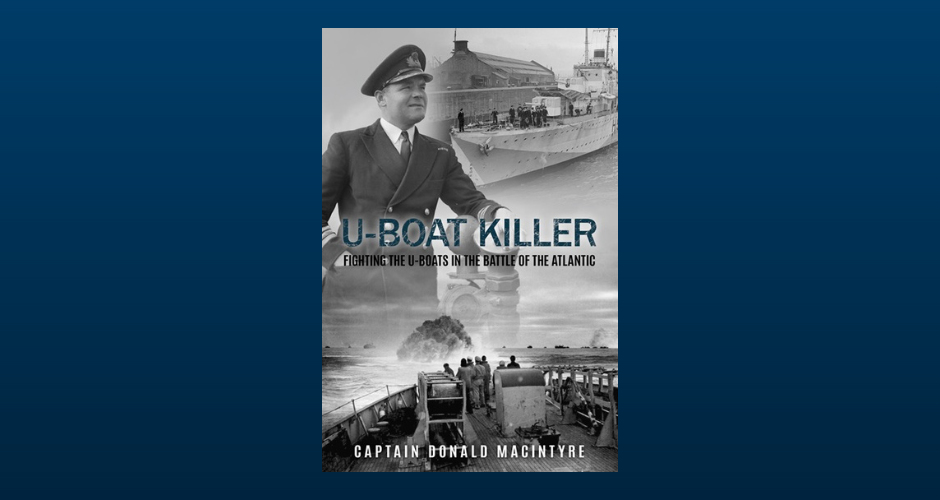
Between 1940 and 1944, Donald Macintyre was among the most successful submarine hunters in any Allied navy, transforming the Battle of the Atlantic with his successes against the U-boat menace. To commemorate the eightieth anniversary of the end of World War Two, Donald’s daughter, Dani, shares a personal memory from her father’s life after the conflict.
In 1960, when Dad was employed by MGM as Nautical Advisor on Mutiny on the Bounty starring Marlon Brando and Trevor Howard, he left my mother in charge of the pig farm. I can only suppose that she felt annoyed to be left with this responsibility, because she sold all the pigs and demanded a flight to California!
Dad complied, and I was able to join them for a fascinating holiday, mainly spent in Culver City’s MGM Studios every day. I watched the crew film scenes of a half replica of the Bounty on rollers, with wind and water machines simulating a storm on the high seas. To my joy I also spent time with the crew of Rawhide, a Western TV series. They made a fourteen-year-old girl feel very welcome!
If you have ever watched Mutiny on the Bounty, you might have noticed that in one scene Marlon Brando comes out of his cabin wearing a ridiculous red velvet smoking jacket. When Dad was asked to approve this costume change, he said it would never have been acceptable in those days. Hollywood being Hollywood thought it made handsome Marlon irresistible, so they kept it in. This made Dad wonder what he was being paid for, apart from sitting and playing cards with Gordon Jackson in Tahiti!
Canadian paratrooper Leo Heaps (1923–1995) was seconded to the British Army during the Second World War and participated in the Battle of Arnhem. He was captured by the Germans and upon his escape, his work with the Dutch Resistance to help rescue hundreds of Allied soldiers behind enemy lines resulted in his being awarded the Royal Military Cross for “outstanding gallantry”. To commemorate the eightieth anniversary of the end of the Second World War, Leo’s son Adrian reflects on his father’s life in 1945.
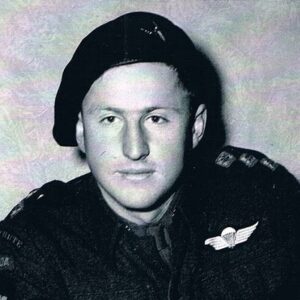
Leo Heaps
In 1945, Leo Heaps was just twenty-two, a young Canadian whose experiences in the Second World War shaped him into the complex figure I knew.
Born in Winnipeg in 1923, growing up as the son of Abraham Albert Heaps, a prominent Parliamentarian, wasn’t easy, but Leo forged his own path. Educated at Queen’s University, the University of California, and McGill, he was restless by 1944, bored with the Canadian Infantry Holding Unit. His commanders underestimated him, calling him “not of officer caliber, no initiative, not aggressive enough.” Sarcastic and defiant, he failed to qualify for the Infantry. His father urged him to work on his aunt’s farm, an exemption from service, but Leo sought action. He volunteered for the CANLOAN program, seconding Canadian officers to the British Army, a choice that plunged him into Operation Market Garden.
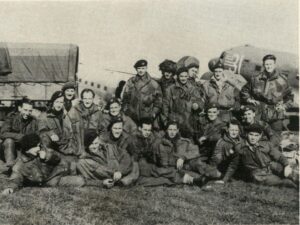
Leo (upper right) before his first jump into Arnhem
In September 1944, Leo joined the British 1st Airborne Division, commanding the 1st Parachute Battalion’s Transport — without ever having jumped before. He described his first drop on 17 September 1944 with vivid clarity: “I floated down gently from heaven at 1:30 p.m. on Sunday… The sun shone, the fields of Wolfheze were bathed in warm light and the green meadow bloomed with large bursts of yellow sunflowers.” That beauty was short-lived. The Battle of Arnhem, part of a failed plan to seize Rhine bridges, ended in defeat. Captured by the Germans, Leo didn’t stay a prisoner for long. With the help of the Dutch Resistance, he escaped, hiding in a chicken coop at Ennyshoeve. There, he met members of the Resistance risking their lives for Allied evaders.
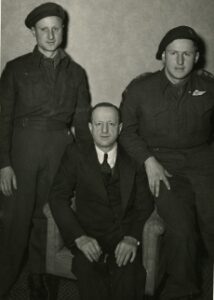
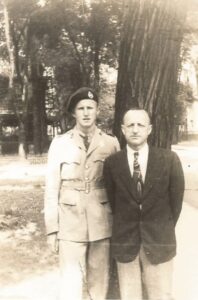
Leo with his father and brother David
His work with the Dutch Resistance earned him the Military Cross, a rare honour for a Canadian in British service. His brother, David, also received the Military Cross, making them the only Jewish brothers during the Second World War to win the decoration. Leo’s role in Operation Pegasus, the escape of over 100 Allied soldiers across the Rhine, was a triumph he chronicled in his book The Grey Goose of Arnhem. He called it “the most amazing mass escape of World War II.”
But some memories were harder to share. In April 1945, Leo was among the first to enter Bergen-Belsen concentration camp after the Germans fled, leaving behind a typhoid outbreak and unimaginable suffering. As a Jewish soldier, the sight of skeletal survivors, the stench of death, and the chaos of the camp struck him profoundly. In Escape from Arnhem (1945) he described the eerie silence broken by the groans of the starving, the piles of unburied bodies, and the desperate eyes of those clinging to life. The scale of the horror overwhelmed him. He rarely spoke of Belsen, but when he did, his voice was subdued. I can picture him there, a young man of twenty-two, confronting a darkness that no one could fully process.
Leo with his father following his decoration
By May 1945, Leo was no longer the kid who frustrated his commanders, but a decorated veteran, a survivor of capture, combat, and collaborator with the Dutch underground. However, the war left its mark on Leo in what we now recognise as PTSD. The loss of friends killed by the Germans ushered a quiet guilt for those surviving when so many didn’t. Yet Leo channelled his unease into action, as if movement could keep the ghosts at bay. His writing, his adventures, his relentless drive — they were, in part, his way of coping with a war that never fully left him.
In 1994, my son and I accompanied Leo to Arnhem for the fiftieth anniversary, as one of forty Canadian veterans. I often wonder what he felt in those sunflower fields, thinking of his lost comrades and his own life’s pursuits. Some of these feelings can be found in his records and letters in the Ontario (Canada) Jewish Archives, which offer a glimpse of the man and the many moments beyond his stories.
Leo died in 1995, leaving a legacy I’m still unravelling. In 1945, he emerged from the war not just as a survivor but as a storyteller who gave voice to the unsung. His books are a testament to a war that left its scars, but also of the man who became my father.
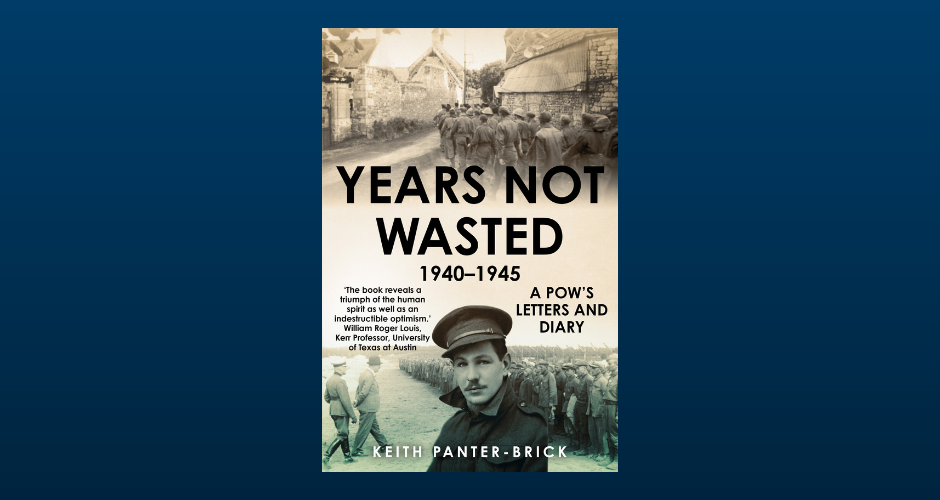
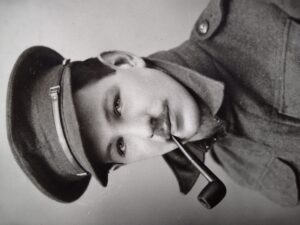
Keith Panter-Brick joined the Territorial Army in March 1939, at the age of eighteen. When war broke out six months later, he was sent to France, where he was entrenched ahead of the Maginot Line in spring 1940. Following the devastating German blitzkrieg, he was captured in May 1940 and spent the next five years as a prisoner of war.To commemorate the eightieth anniversary of the end of World War Two, Keith’s friend and colleague, Paul Jankowski — Raymond Ginger Professor Emeritus of History at Brandeis University — reflects on Keith’s harrowing wartime memoir, Years Not Wasted, below.
“We were totally outclassed,” Keith Panter-Brick told me in the early 2000s. He was speaking of May 1940, when the German land and air forces overwhelmed the Allied forces in Belgium and northern France. Taken prisoner that month, he spent the next five years — the first half of his twenties — in German prisoner of war camps (Stalags) in occupied Poland. The mental honesty, scrupulous accuracy, and personal humility in his brief comment captured much of the man, the scholar, and the friend I would first meet some fifty years later.
The same qualities would reappear in his memoir, Years Not Wasted. When he returned home to Merseyside, England, in 1945, all he had was his diary, along with the many letters that had somehow reached his family. He would return to them many years later in his memoir, retelling and perhaps reliving the captivity that he and other captured Western soldiers had to endure. They contended with conditions worse than those of the officers, but far better than those of the Soviet and Polish prisoners, most of whom perished in one of the great war crimes of the Second World War. Neither self-pity nor heroics coarsen his narrative. He writes of malnutrition and bitter cold, but also of Red Cross parcels, of boredom but also release, of submission but also resistance and, in his case, attempts at escape — once in 1944 from the camp itself, and again in 1945 from the virtual death-march out of it.
It is a recollection mixing scrupulous honesty with vivid detail, on one level a document about captivity in wartime, on another a spiritual memoir of inner freedom wrested from adversity, before its physical reality was finally restored.
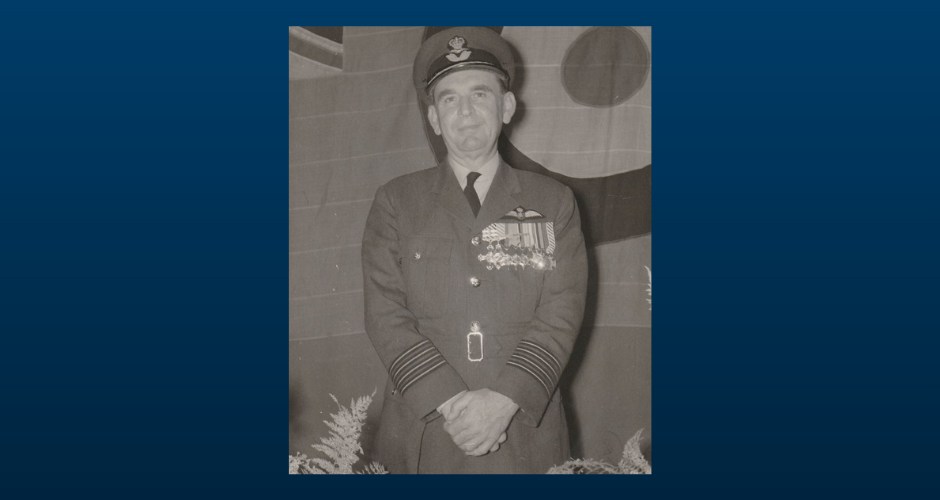
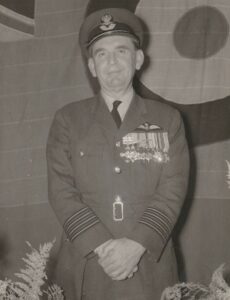
Group Captain Bobby Oxspring, author of Spitfire Command, saw action in many of the most famous battles of the Second World War, including Dunkirk and the Battle of Britain. To commemorate the eightieth anniversary of the end of World War Two, his great-grandson, Daniel, shares his reflections on Bobby’s life below.
Flying ace Robert (Bobby) Wardlow Oxspring held the rank of squadron leader when World War Two ended in May 1945. Throughout April 1945, he was confident that the war was soon to conclude. His mood on VE Day as an optimistic family man would have no doubt been a mixture of pride and reflection. He would have been proud of his achievements: he’d been made leader of the 141 Wing at Deanland only the year before, and had been awarded a Distinguished Flying Cross and Two Bars as a flying ace. He would have been reflecting on his numerous wartime adventures, from the Battle of Britain to his time in North Africa, Italy and many other countries. Bobby’s mood on VE Day likely matched the mood of many of ‘The Few’, and I have no doubt he would have felt joy at the war’s conclusion.
For me, the great-grandson of Bobby Oxspring, my great-grandfather has had a huge influence on my life — not only as a proud figure to look up to, exemplifying courage and bravery, but also through his stories. His career after VE Day did not lose momentum. He received a permanent commission as a flight lieutenant on 1st September 1945 and was promoted further to substantive squadron leader on 1st August 1947. One incredible achievement, however, was his award of an Air Force Cross. This was for leading number 54 Squadron of the RAF Vampires to Canada and the US, the very first jet aircraft to cross the Atlantic.
After VE Day, he never stopped being admirable. He undertook further tours, even across Italy, and eventually became Station Commander of RAF Gatow in Berlin. At Churchill’s funeral, he walked at the very front.
I have been to RAF Cranwell to see some of my great-grandfather’s personal scrapbooks and was even fortunate enough to sit in the cockpit of his recovered plane in the Dumfries and Galloway Museum in Scotland. These are only a few of the moments I have taken to reflect on his life.
On VE Day I am almost certain that one thought would have prevailed in his mind: his admiration and respect for the mighty Spitfire, and his pride at having flown it.
Keith Panter-Brick joined the Territorial Army in March 1939, at the age of eighteen. When war broke out six months later, he was sent to France, where he was entrenched ahead of the Maginot Line in spring 1940. Following the devastating German blitzkrieg, he was captured in May 1940 and spent the next five years as a prisoner of war. To commemorate the eightieth anniversary of the end of World War Two, Keith’s daughter Catherine —Professor of Anthropology, Health, and Global Affairs at Yale University — shares her memories of her father below.
“Each day life is hanging in the balance.” That was the phrase with which my father ended his book, Years Not Wasted. I think that everyone with a lived experience of war will understand that sentence: the notion that you may or may not live, may or may not be free, may or may not return.
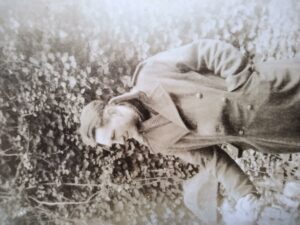
Keith Panter-Brick was a prisoner of war in Poland from 1940 to 1945. He was captured at Isières when he was just nineteen. Under the Geneva Convention, ordinary soldiers were obliged to work — and were put to hard labour in POW camps. If he ever survived the cold, hunger, exhaustion, and brutality of war, Keith promised himself that he would study philosophy and go to university, the first of his family to do so. Admitted to Keble College, Oxford, he joined a postwar student delegation to Heidelberg for cultural exchange and reconciliation. There he met my mother, a student from Alsace-Lorraine on a French delegation to Heidelberg. The two fell in love — my father courted in German, their only common language at the time — and in that short week, they decided to marry. They built a family, rooted in the practice of non-violence and cross-cultural understanding.
My father’s book began decades later, assembled from scraps of his diary, postcards, and letters sent through the Red Cross, all of which he had kept hidden away in a shoebox. On page seven of the first edition, you’ll find his death certificate — the Office of the Cheshire Regiment officially reported him killed in action in May 1940. It took months for news of his survival to reach home. That certificate became for me the most vivid proof that life indeed is hanging in the balance.
Years Not Wasted isn’t a grand officer’s tale. It’s a soldier’s story, grounded in hard labour, frostbitten marches, and everyday endurance. Because he learnt passable German, Keith was once included in an escape attempt with RAF officers, only to be recaptured in Gdansk, at the dockside when attempting to board a Swedish vessel. He survived the Great March out of Poland in the most brutal of winters, thanks to a pair of good boots made in his father’s bootmaker shop. Even years later, my sister Brigitte, now a regular walker in the forests of Lorraine, measures distances in fractions of “Great March kilometres.” In my own teaching and research, I focus on the biological and social signatures of war across generations, and on pathways to peace. My son Jannik chose to study POW trade and barter systems for his Masters’ dissertation at Cambridge. Each of us carries a trace of my father’s war experience.
My father was impetuous. Once, while we were travelling from Nigeria to Cameroon, he filmed a bull elephant that decided to charge us on a dusty road. He stood in front of the car with the hand-held camera, while we huddled in the back. He once flagged down the pilot of a plane by running onto the runway, not wanting to miss his actual flight. But he became, over the years, immensely patient. Whilst a professor at the London School of Economics, he turned to gardening, building stone walls, and restructuring the house we purchased in Lorraine — a house that still has “2 OFF” (“must house two German officers”) carved in the front doorway. My father taught me to value ordinary things in everyday life: raking leaves, washing dishes, being attentive to other people. He never forgot what it meant to be hungry. He told me that being alive is a gift from God, and that good health is a blessing one can only really understand after one has lost it.
In 2025, we republished Years Not Wasted. It’s more than a memoir — it’s a witness statement. It honours ordinary soldiers who endured extraordinary hardship. It is a uniquely authentic book, told in the way it was recorded in letters and a diary at the time, rather than reconstructed from fallible memory. It was written to share the knowledge “soon acquired once war has started that the cost, in lives, in grief, in suffering, is immeasurable, and unacceptable however much one did accept it at the time.” It’s a call to remember how people like my father built their lives after war, choosing patience over bitterness, solidarity over division, peace over conflict. For my father, it was always about taking one step at a time, drawing from patience and reflection. That is the lesson I carry forward.
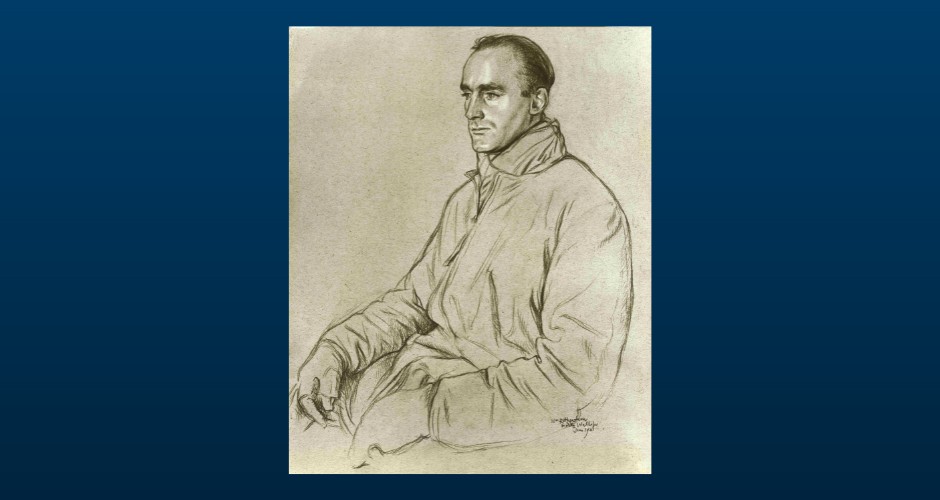
Air Commodore Roderick Chisholm, CBE, DSO, DFC & Bar (1911–1994), author of Cover of Darkness, was a night fighter pilot, flying ace and a highly decorated British airman of the Second World War. To commemorate the eightieth anniversary of the end of the Second World War, his son Julian reflects on his father’s life in 1945.
Roderick Aeneas Chisholm by Sir William Rothenstein. Image used with permission from Museums Sheffield
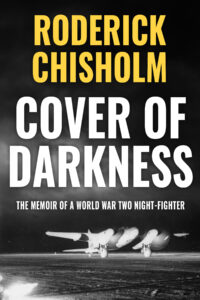
In 1930 Roderick Chisholm joined 604 Squadron of the Royal Auxiliary Air Force. He learnt to fly and was commissioned as an officer. He left the squadron in 1935 when his work took him to Iran. Before rejoining his squadron in late June 1940, he took a refresher course to become a night fighter pilot and fly the squadron’s Blenheims. During the war, while flying Beaufighters and Mosquitos, he shot down nine enemy aircraft with the assistance of his airborne observers and the ground controllers, he commanded the Night Fighter Interception Unit at Ford, and was the second-in-command of Bomber Command’s 100 Group, which was charged with defending RAF bombers over enemy territory. He recorded his wartime experiences in Cover of Darkness, which was first published in 1953.
Immediately after hostilities ended, Roderick led a team of twelve charged with gaining as much intelligence as possible about the impact of 100 Group’s radar-assisted night fighters, Mosquitos, and Radio Counter Measures. The team did their work at the final base of the Luftwaffe in Schleswig, just before it was disbanded and its personnel transferred to POW camps. They carried out interrogations of Luftwaffe night fighter commanders and pilots, observers, flight controllers and technicians, held technical discussions, and examined the vast number of German aircraft parked on the airfields. The team gained confirmation of the effectiveness of 100 Group’s efforts, and had the satisfaction that as a result RAF losses were significantly reduced. The Mosquito had an awesome reputation amongst the German airmen.
Major Schnauffer was one of the pilots whose interrogation Roderick witnessed. Schnauffer was a brave and skilful night fighter pilot who was credited with shooting down no less than 124 bombers in defence of his country. He wore uniform, and on the last day the Germans were allowed to wear medals, he wore the highest order of the Iron Cross around his neck. The exchanges with the Germans were generally civilised and friendly, but my father could not ignore that they were Nazis, and that nearby were camps for Russian prisoners living in ghastly conditions, and mini-Belsens for Jews and other displaced persons.
Roderick’s mission complete, he flew back to Norfolk. While doing so, he envisioned a future Europe in which frontiers would mean no more and individual nationalities were less important, as per the multi-national squadrons of the Battle of Britain. After the collapse of France in 1940, British, French, Belgian, Czech, Polish and other nationalities had flown in harmony in polyglot fighter squadrons. Their aims were identical, and their understanding effective thanks to the basic English of the radio. Sadly, later, as national squadrons were formed, national identities asserted themselves and the unity achieved in the Battle of Britain became compromised.
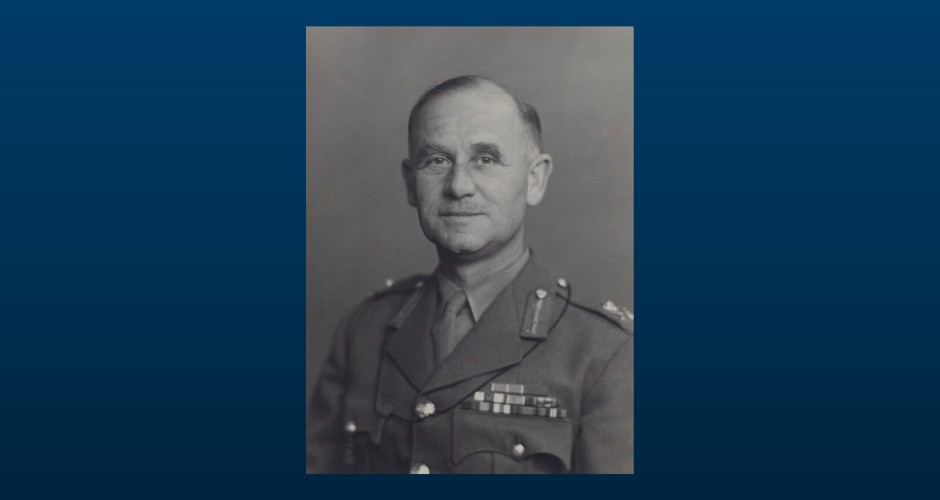
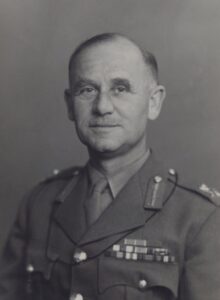
Major-General Hubert Essame, CBE, DSO, MC (1896–1976) was a British Army officer who fought in the First and Second World Wars. Following his retirement from the army, Hubert lectured in military history at King’s College London, and published several books and articles. He was also an advisor to television producers for military programmes. To commemorate the eightieth anniversary of the end of the Second World War, his granddaughter Antonia shares her memories of him below.
Hubert Essame
Brigadier, later Major-General, Hubert Essame led 214 Independent Infantry Brigade, part of 43rd Wessex Division, in the capture of Mont Pincon, the key to Normandy, as well as of Hill 112, the successful yet most costly single battalion action of the Overlord campaign.
He was a sharp-witted and determined man remembered by the actor and raconteur Dirk Bogarde, his one-time liaison officer, for his “brilliant blue eyes and tongue like a whip”. He had a caustic sense of humour and was a formidable leader from the front.
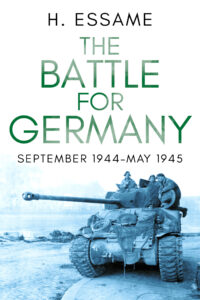
Soon after the war, Hubert wrote the Division’s official history, The 43rd Wessex Division at War, 1944-45, and later Battle for Normandy, Normandy Bridgehead, The Battle for Germany, and a biography of General Patton. His perspective as a leader of troops into battle, alongside his use of a wide-ranging variety of sources as a historian, makes for a great read even for those who know about Operation Overlord.
His 214 Independent Infantry Brigade, which together with 129 and 130 Brigade and their supporting arms formed Major General Ivor Thomas’s 43rd Wessex Division, were in turn part of the XXX Corps commanded by Lieutenant-General Sir Brian Horrocks all the way from Normandy to Bremerhaven.
The Wessex Division story spans the stormy Overlord crossing and later the crucial Battle for Hill 112. This point south-west of Caen was defined by Eberbach, commander of Panzer Group West, as the “pivotal point of the whole position” and it saw the first of the grim battles of attrition immediately following Caen’s fall. The battle involved heavy casualties and tested the 43rd Division against some of the most seasoned German divisions, well dug in and skilfully hidden.
Road and rail lines lay at right angles to the direction of advance. The bocage of tiny, often boggy fields with sunken lanes and thick hedges reduced visibility for artillery and impeded all movement. And it was high summer. Hubert describes vividly how he crawled forward in the August heat to assess Mont Pincon’s southern slopes before its eventual capture by the Division and 8th Armoured Brigade.
Hubert was a writer whose extraordinarily immediate account includes, for example, the information he gained from German prisoners, subsequent revelations about Hitler’s orders to his generals, and his own point of view at the head of 214 Brigade. His perspective sheds light on some of the huge challenges of the campaign, such as that of establishing a key bridgehead over the Seine at Vernon despite the civilian population’s determination to celebrate as though the campaign was already won.
214 Brigade fought on through northern France and the Netherlands, including Operation Market Garden, and were among the first Allied troops to enter Germany. They played a key part in the turning of the tide in the Reichswald. I am proud that ‘Brigadier Twinkletoes’ was my grandfather and attempt to read across from his high standards of resolve and determination to the greyer demands of the here and now.
 my mother in charge of the pig farm. I can only suppose that she felt annoyed to be left with this responsibility, because she sold all the pigs and demanded a flight to California!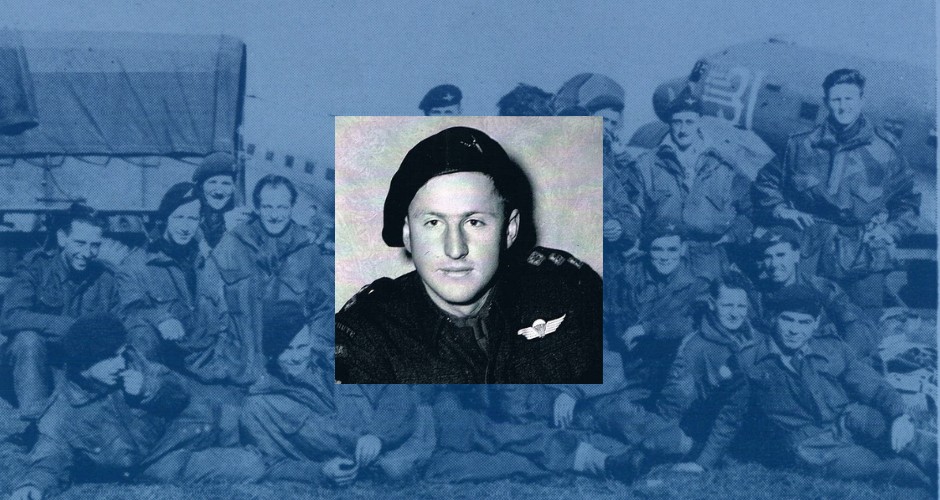
 1945, he was confident that the war was soon to conclude. His mood on VE Day as an optimistic family man would have no doubt been a mixture of pride and reflection. He would have been proud of his achievements: he’d been made leader of the 141 Wing at Deanland only the year before, and had been awarded a Distinguished Flying Cross and Two Bars as a flying ace. He would have been reflecting on his numerous wartime adventures, from the Battle of Britain to his time in North Africa, Italy and many other countries. Bobby’s mood on VE Day likely matched the mood of many of ‘The Few’, and I have no doubt he would have felt joy at the war’s conclusion.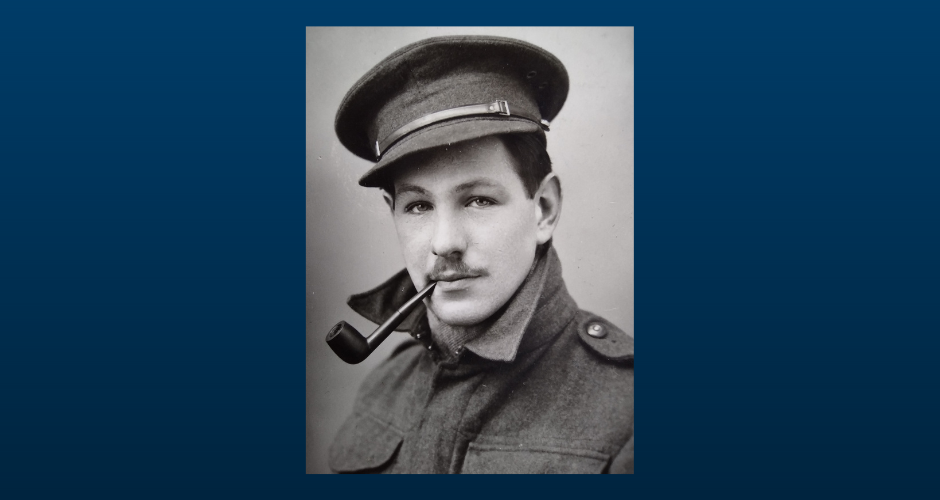
 My father’s book began decades later, assembled from scraps of his diary, postcards, and letters sent through the Red Cross, all of which he had kept hidden away in a shoebox. On page seven of the first edition, you’ll find his death certificate — the Office of the Cheshire Regiment officially reported him killed in action in May 1940. It took months for news of his survival to reach home. That certificate became for me the most vivid proof that life indeed is hanging in the balance.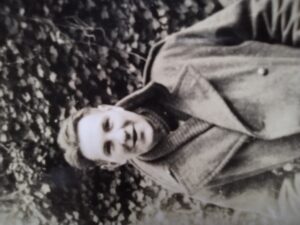
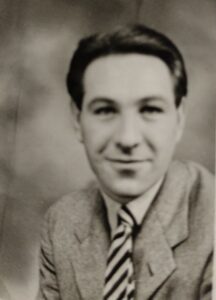 In 2025, we republished Years Not Wasted. It’s more than a memoir — it’s a witness statement. It honours ordinary soldiers who endured extraordinary hardship. It is a uniquely authentic book, told in the way it was recorded in letters and a diary at the time, rather than reconstructed from fallible memory. It was written to share the knowledge “soon acquired once war has started that the cost, in lives, in grief, in suffering, is immeasurable, and unacceptable however much one did accept it at the time.” It’s a call to remember how people like my father built their lives after war, choosing patience over bitterness, solidarity over division, peace over conflict. For my father, it was always about taking one step at a time, drawing from patience and reflection. That is the lesson I carry forward.