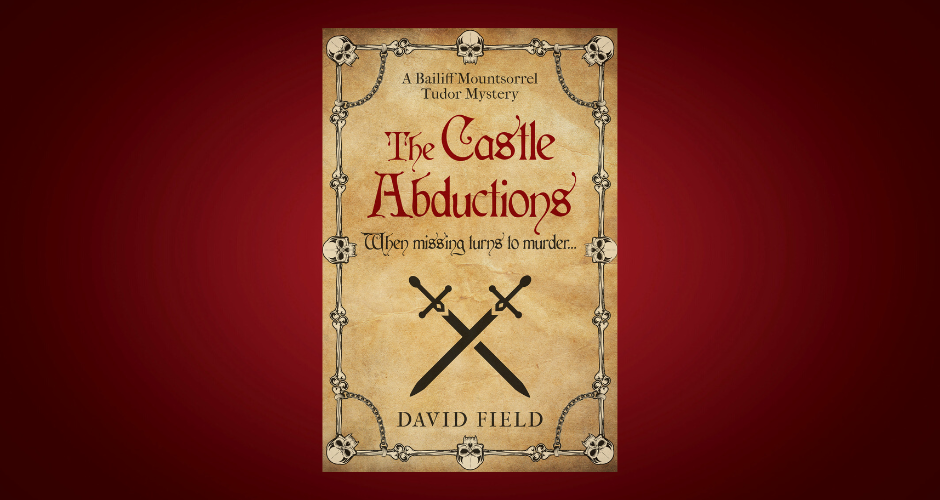
Tudor Law and Order by David Field

David Field is the author of numerous historical series, including the Bailiff Mountsorrel Tudor Mystery Series: private investigation crime novels set during the reign of Elizabeth I and beyond.
My new series features the exploits of two sheriffs’ bailiffs during the Tudor and later the Stuart eras. For me it was a labour of love because it involved researching the history of Nottingham, where I was born and raised during the immediate post-war years.

In my novels, Edward Mountsorrel and Francis Barton are colleagues in adjoining jurisdictions who have become close friends. Their work involves enforcing the law and investigating crime, under the direction of their respective employers, the Sheriff of Nottinghamshire and the Sheriff of Nottingham. The fact that there are two separate sheriffs, one for the county and the other for the town, arises from a quirk of Nottingham’s history that also explodes one of the elements of the legend of Robin Hood, Nottingham’s most famous alleged resident.

A central character in the Robin Hood myth is the dastardly Sheriff of Nottingham, but the truth is that he did not exist until 1449, at least two hundred years after Robin is said to have lurked in Sherwood Forest, to the north of the town. A charter in that year, granted by Henry VI, made Nottingham its own county, with its own sheriff and its own jurisdiction, not to mention its own courthouse. And therein lies another set of intriguing and quirky facts.

While the town continued to conduct its legal affairs in the old Guildhall in Weekday Cross, the county needed a place to do the same, conveniently located within the town itself. It therefore constructed what for many years was known as the Shire Hall, sitting proudly in the middle of one of the town’s most affluent streets, High Pavement. It was a small chunk of the county located within the town, and given that the boundary line ran through the centre of the original courtroom, the judge could be found seated in the town while the prisoner before him was located in the county. This august building is now the National Justice Museum, a popular destination for tourists.

Hopefully this will make up for several guaranteed disappointments for any tourist visiting Nottingham hoping to step into the Medieval world of Robin Hood. The city does indeed possess a castle, which features heavily in the first book in my forthcoming series, but the current edifice is now in its third manifestation. The original eleventh-century version constructed on the orders of William the Conqueror was destroyed at the behest of its own governor, Colonel John Hutchinson, at the end of the English Civil War, before Oliver Cromwell could get his hands on it. The reconstruction was then burned down by a mob during the Reform Bill Riots of 1831, and the current building — which is now a civic museum that houses old bicycles, coin collections and Japanese armour — became little better than a middle-class boarding house of dull Victorian architecture before being bought up for a song by the embarrassed city fathers.

At least the vandals couldn’t do much to diminish the grandeur of the rock on which the castle stands, a block of sandstone rising for one hundred and thirty feet above ground level. This is full of caves and passages where previous generations cut their way through the soft stone in order to create dwellings that were converted into dungeons when the castle was first constructed. At its foot sits a vintage hostelry, now known as The Ye Olde Trip to Jerusalem, that was once the castle’s in-house brewery before it became an alehouse, linked to the castle above by a series of tunnels through the sandstone. This alehouse would have been there during the time in which my novels are set, so I’ve made use of it in the first instalment, in which young women are abducted from there.

I enjoyed researching the history of my birthplace, and I think it shows in my new series, which hopefully captures the rough-and-tumble nature of law enforcement in a Tudor township.
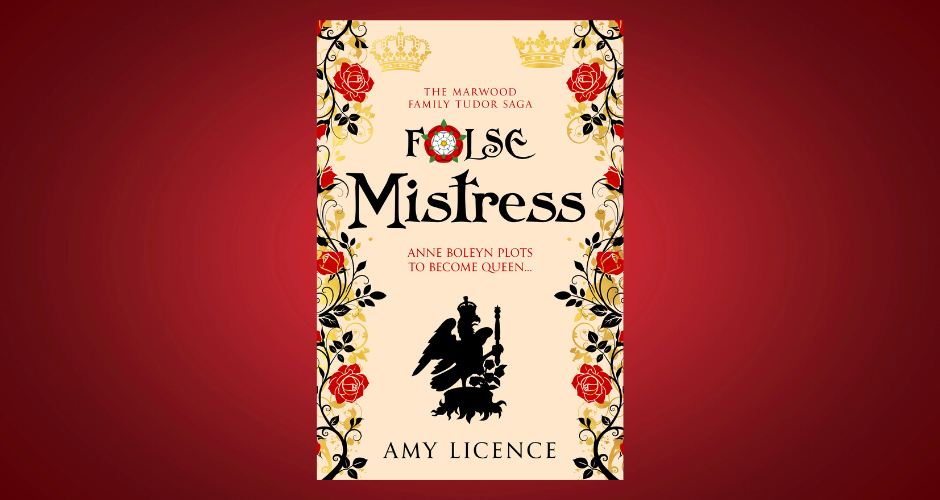
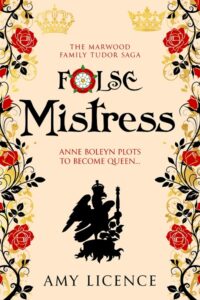
Happy Publication Day to Amy Licence!

Congratulations to Amy Licence, whose absorbing Tudor saga, False Mistress, is out now!

False Mistress is the third book in the Marwood Family Tudor Saga Series.

1528

Thomasin Marwood is one of Queen Catherine’s ladies-in-waiting at the court of Henry VIII, and she does not trust Lady Anne Boleyn.

But when an accident forces Thomasin and her family to take refuge at the Boleyn family home at Hever Castle, Thomasin is entrusted with an unexpected mission by Anne’s mother.

At court, Catherine’s attempts to regain the attentions of her husband are rebuffed, with his sights clearly set on a new queen.

And with Thomasin’s own heart in turmoil with the reappearance of a former love, she struggles to find a way to fulfil her obligation to Lady Boleyn without betraying Queen Catherine.

In despair, Catherine’s allies launch a desperate plot to distract the king. A false mistress is chosen from among her circle, to draw Henry away from Anne and lead her back to the Queen.

It is a dangerous task, to beguile the king into bed and incur Anne’s wrath. Not every woman could do it.

Will Thomasin find herself caught up in the plot? Can she retain her position at court?

Or will she be forced to change her allegiances…?

Mary Tudor – Sinned Against or Sinning? by David Field

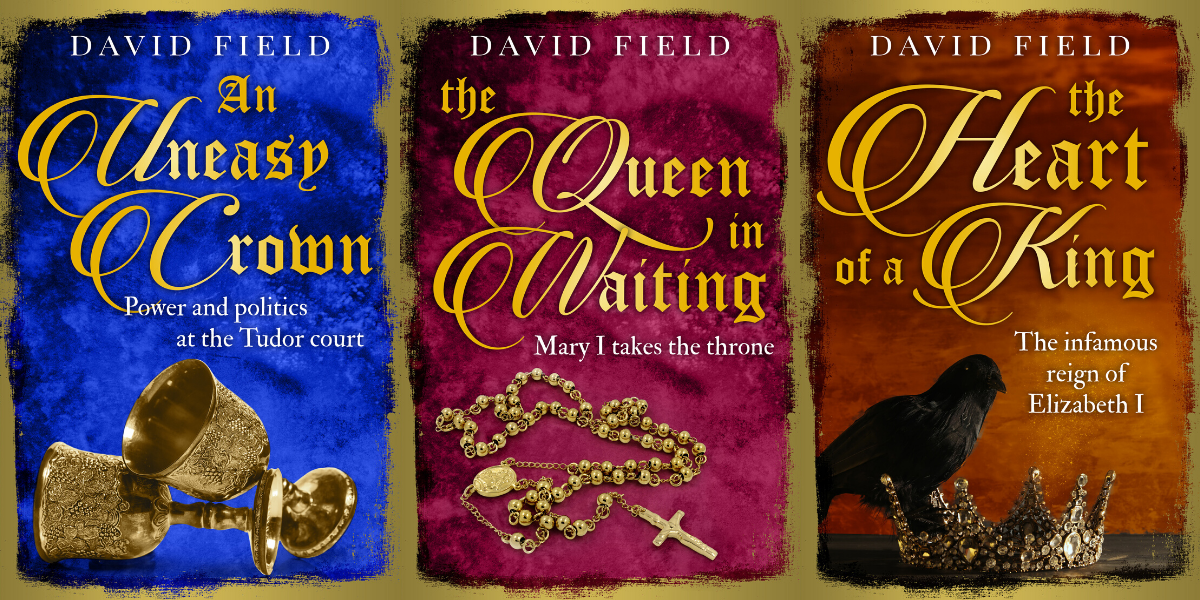
David Field is the author of The Tudor Saga Series. The Queen In Waiting is the fifth book in the series.

There were many victims during that turbulent period in English history that we call the Tudor era, and not all of them were obvious. ‘Popular’ history has a habit of creating fixed mental images of those who lived their lives in the maelstrom of Tudor Court politics, and it’s only when you examine the actual facts that the doubts begin to creep in. A  prime example of a Tudor ‘identity’ whose place in the ‘fake news’ of the period has set her character in concrete is Mary Tudor, the only child of Henry VIII and his first – and longest lasting – Queen, Katherine of Aragon. Mention Mary and the word ‘Bloody’ appears like magic before her name, conjured up by usage and with little regard to the circumstances that led her to burn Protestants at the stake.

Mary was born in February 1516, the only surviving child from her mother Katherine’s long and miserable litany of stillbirths and miscarriages. Katherine may well have suffered from gynaecological problems that Mary inherited, because Mary is recorded as having endured menstrual disorders as a young woman. These were no doubt the early warnings of the phantom pregnancies and uterine blockages that would deny her issue of her own, and lead ultimately to her death.

But in her very early years we are given a picture of a rosy-cheeked, chuckling little infant with her father’s distinctive red hair being bounced gleefully on Henry’s knee as he resolutely hid from the world his inner torment that Mary was not a boy. His obsession with begetting a male heir, more perhaps than any natural lust for Anne Boleyn, led to Katherine’s eclipse, and as she entered puberty Mary was forced to watch from very distant sidelines as her beloved mother suffered the public humiliation of the annulment of her marriage to Henry, and her replacement on the throne by ‘the night crow’ Anne Boleyn. Anne completed the insult by giving birth, in almost indecent haste, to Mary’s half-sister Elizabeth.

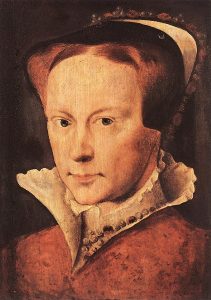
Mary Tudor

Humiliation was piled on humiliation as Mary was declared a bastard, and her place in the succession was taken by Elizabeth. The newly demoted ‘Lady Mary’ was stripped of her own former household and sent to live with Elizabeth in Hatfield House, Hertfordshire, denied access to her mother Katherine, who pined her way to a heartbroken death in a remote castle in Cambridgeshire. Mary was reported to have been ‘inconsolable’ at her mother’s death, and suffered from unspecified illnesses for several years during which she was estranged from her father.

The execution of Anne Boleyn and the bastardisation of Elizabeth would have been of little comfort to Mary once Henry’s new wife Jane Seymour gave birth to the heir apparent Edward, who, under the baleful influence of the Seymours who governed the nation as part of his Regency Council, proved to be far more aggressively Protestant than his late father, while Mary was equally determined to both pursue and promote the Catholic religion of her late mother. The two never saw eye to eye, and during a disastrous attempt at reconciliation during the Christmas of 1550, the thirty-four year old Mary was reduced to tears when rebuked by her thirteen year old half-brother, in front of the entire Court, for her fervent adherence to her faith.

The death of Edward was probably the greatest catalyst for Mary’s subsequent actions. It was learned that in his fear that England would slide back into Catholicism should Mary become Queen, Edward had bequeathed the throne to their distant cousin Jane Grey, from an obscure Leicestershire offshoot of the wider Tudor family. Not only that, but the Council of State initially supported Jane, and Mary was obliged to claim her throne by superior force of arms.

She was now 37, beyond the customary ‘sell by’ date of Tudor women, unmarried, childless, and suffering from gynaecological issues. She was probably both flattered and relieved to receive an offer of marriage from her second cousin Philip of Spain. There seems to be little doubt that for him it was a marriage of greed, furthering his ambition to rule most of Europe, but for Mary it seems to have been a love match. Then history repeated itself through a phantom pregnancy and a terrible slow decline with what may well have been ovarian cancer. One can only feel desperately sorry for the lonely old woman on her death bed when one reads that, on learning of Mary’s demise, Philip wrote to his sister that “I felt a reasonable regret for her death.”

Is it surprising that Mary Tudor was hardly a bundle of laughs during her lifetime? Her mother was publicly humiliated, she herself was bastardised by her loving father, her half brother ridiculed her faith, her Council of State preferred a country girl over her as Queen, and her younger sister was prettier, more socially accomplished, and more loved by the people, while her husband regarded sexual relations between them as some sort of public duty. Add to that her almost permanent ill-health, and it is difficult not to reach behind the public persona she left behind in order to give her a consoling cuddle.

In the latest novel in my Tudor series, The Queen in Waiting, I chose to depict the reign of Mary through the eyes of Elizabeth, another victim of their times. I could only describe the events of Elizabeth’s life through the actions of Mary, and they were harsh when considered without regard to the events that forged them. Sinned against or sinning? Your choice.


Order THE QUEEN IN WAITING here.

Or find out more about The Tudor Saga Series here.


Image credit: Portrait of Mary I of England and Ireland by Hans Eworth. (Public domain).

The History Spin Doctors by David Field

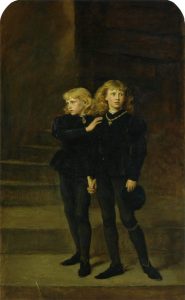
It’s a truism that history is a set of facts left to posterity by the winners, and for historical novelists like me there’s always another ‘take’ on every so-called ‘fact’ we’re taught at school.  A prime example of that is the enduring legend of ‘The Princes in the Tower’.

The first to get their stories organised were the Tudors who benefitted considerably from the unexplained disappearance from the Tower of London of the Yorkist royal heirs Edward, Prince of Wales, and Richard, Duke of York. 

When Henry Tudor defeated Richard of Gloucester in an obscure field in Leicestershire we now know as ‘Bosworth’ (even though that town didn’t exist then), there was no one left on the Yorkist side to challenge his claim to the throne, given that the princes were no more.  But it was essential to point the finger away from ‘the person most likely’ – the obvious suspect for the disappearances/deaths, and the Tudor propaganda machine swung into action.

Sir Thomas More possible lived to regret the assistance he gave to Henry VIII in perpetuating the myth that the person behind the disappearances of the princes from the Tower had been a close relative of theirs, namely their uncle.  But More was the first to point the written finger at Richard of Gloucester, particularly after Sir William Tyrell, during the reign of Henry Tudor, allegedly confessed to having done the job in the pay of Richard.  But tortured men will eventually say whatever their torturers want to hear, and the alleged confession came, second hand, through the mouth of the torturer.

Never one to miss an opportunity to ingratiate himself with a royal patron, that literary prostitute William Shakespeare built Thomas More’s accusation into a horror story of a crook-backed, slew-footed, psychopathic freak who did away with anyone who stood between him and the throne.  Actors such as Laurence Olivier and Benedict Cumberbatch then provided us all with a visual image to go with the verbal hype.  The net result of all this ‘fake news’ was that we all grew up believing that Richard III had done for the two little boys under his guardianship.
But spin the wheel 180 degrees, and there was someone else who benefitted equally from a sudden absence of Yorkist claimants to the English throne.  He had an alibi, of course, because at the most likely date of the crime – the Summer of 1483 – he, Henry Tudor, was in exile in Britanny.

But back home in England, ‘Mummy’, the formidable, wily, scheming Margaret Beaufort, was preparing the runway for her favourite son’s safe landing with an invasion force.  She also had a useful second son – Henry’s half-brother the Duke of Buckingham – who was Lord High Constable of England, with responsibilities that included security at the Tower of London.  Go figure, as they say.

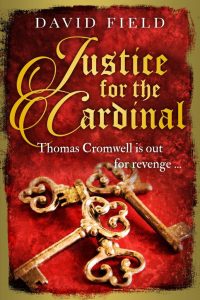
Having written a novel from the Tudor perspective (The Flowering of the Tudor Rose), and having suffered death by blog from dedicated ‘Ricardians’, I took up the case for the defence in Justice for the Cardinal, due for publication by Sapere Books later this year.  The central character in this novel is Richard Ashton, grandson of the Duke of York who escaped from the Tower, only to be executed under his assumed name of ‘Perkin Warbeck’ by a paranoid Henry VII.

‘You pays your money . . . .’, as the old saying goes.   The jury will forever remain out on who really ordered the murder of the princes.  In the meantime, we historical novelists can play on both halves of the pitch.