Sapere Books Sign Four Historical Sagas by Deborah Swift

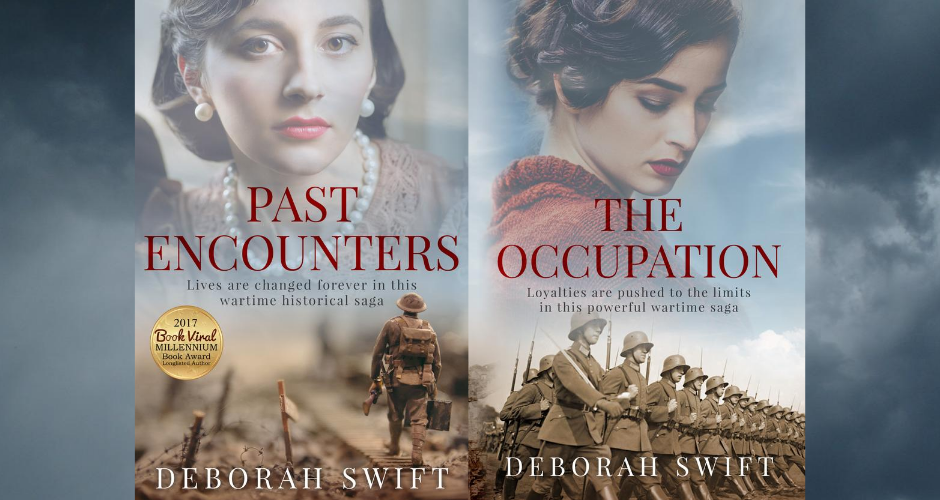
Following the publication of Deborah Swift’s extraordinary wartime sagas – PAST ENCOUNTERS and THE OCCUPATION – editorial director Amy Durant has signed four more of her books.

In Deborah’s words:

“I’m really thrilled to have signed with Sapere Books for my third WW2 novel, THE LIFELINE, in which a teacher flees Nazi-occupied Norway and escapes to Scotland on a small fishing boat, in an operation known as The Shetland Bus.

“Not only that, but I’ve signed with Sapere for three more historical novels set further back in time. The first, THE POISON KEEPER tells the story of Giulia Tofana, the woman who, according to legend, poisoned six hundred men in 17th Century Italy. The deadly poison Aqua Tofana bears her name. Italy in the 17th Century is a fascinating brew of baroque religion, art and culture, and the legacy of the ‘Camorra,’ the 17th Century Mafia. THE POISON KEEPER is set in Naples under the smoking shadow of Mount Vesuvius. There will be two further books in the Italian series; the other two books will be set in Venice and Rome.

“I was delighted to be offered a home for four new books (four books!) with Sapere, as not only do they offer very good royalty rates to authors, but they have a really strong, supportive author community.”

Amy commented: “Deborah is a wonderful storyteller, and I am extremely happy she has chosen to continue partnering with Sapere Books for her next four novels. Fans of her first two Second World War novels won’t have to wait much longer for her third wartime-era book; THE LIFELINE will be available to preorder soon.”


Click here to order PAST ENCOUNTERS

Click here to order THE OCCUPATION

Sign up to Deborah’s newsletter to stay up to date with her book news and latest releases.
The Inspiration for THE OCCUPATION by Deborah Swift

Deborah Swift is the author of PAST ENCOUNTERS and THE OCCUPATION.

During World War Two, the Channel Islands were the only part of the British Isles to be occupied by the Germans. I saw a picture online of a British ‘bobby’ or policeman talking to a Nazi soldier, and it sparked my interest. Jersey is a tiny island, only eight miles long, so I was fascinated to find out how the population managed to keep up their morale, when as many as fifteen thousand (yes, you read that right) Germans had taken over. What happened to the Jews on the island, or to the other groups that the Nazis considered ‘undesirable’? How did it feel to be invaded by a foreign army?

The story became much more interesting and involved the more I uncovered. At the beginning of the war, Jersey had been ‘stood down’ for military action, as nobody believed the Germans would want such a small territory. Men of fighting age had been sent elsewhere, so it was a population of women and farmers. When the invasion came, it was a total surprise and there were no defences in place. After a brief bombing campaign, the German army just walked in. Before long, white ‘surrender’ flags were fluttering from Jersey houses.

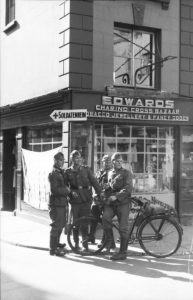
German soldiers standing in King Street, St Helier, Jersey

This was the beginning of Nazi rule on the islands, which was supposed to be a ‘peaceful’ occupation. Of course, when you are invaded it might look peaceful, but underneath the tensions soon began to show. The oppressive Nazi force vastly outnumbered the British people left on the island. Those that remained had to find ways to resist, and ways to outwit the unwanted intruders in their traditional way of life. German rule took over – people had to speak German, cars had to drive on the right, many things that had been allowed before, such as owning a car or a radio, were ‘verboten’ – forbidden. The Germans began a vast building programme to fortify the island, which they intended to use at a military base to attack England. The vast concrete fortifications were built by slave labour.

My story is based on several true accounts, although I have welded them together and compressed them into a fictional narrative. Céline and Rachel’s story was inspired by the true Jersey story of Dorothea Weber, who hid her Jewish friend Hedwig Bercu from the Germans. More on this surprising real life story can be found here.

Fred’s story in The Occupation is based on a number of accounts of life in the Germany army, and in the French Resistance. I was interested to examine the idea of occupation from the point of view of both the occupier, and the occupied. What always interests me in fiction is the conflicts that arise because of the circumstances of war, where one nation is pitted against another, and people who might have been quite amicable before the conflict are forced to swear allegiance to a sharp division between one side and another, when in reality, and in people, many shades of grey exist.

For an overview on the occupation of Jersey, the BBC history site has several pages on this topic. For more on Deborah’s books, find her at www.deborahswift.com or on Twitter @swiftstory.


CLICK HERE TO ORDER THE OCCUPATION


Image Credit: Bundesarchiv, Bild 101I-228-0326-34A / Dey / CC-BY-SA 3.0. Accessed via Wikimedia Commons.