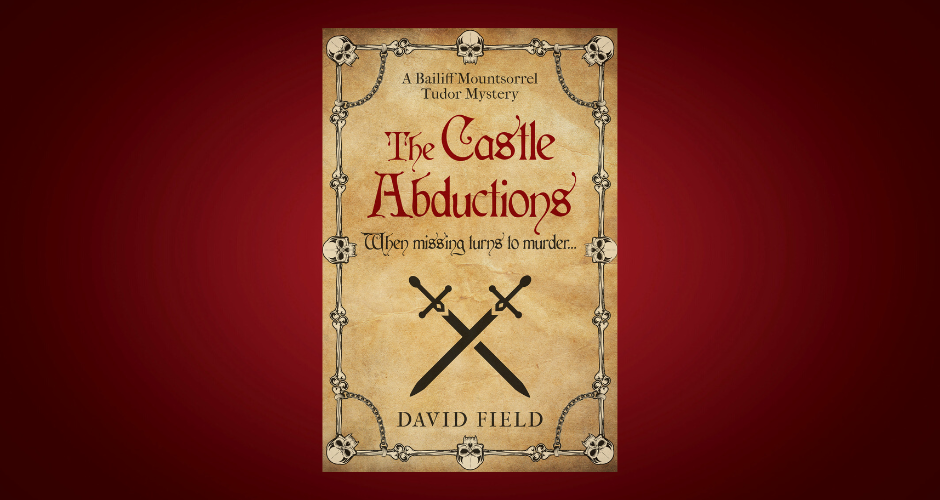
David Field is the author of numerous historical series, including the Bailiff Mountsorrel Tudor Mystery Series: private investigation crime novels set during the reign of Elizabeth I and beyond.
My new series features the exploits of two sheriffs’ bailiffs during the Tudor and later the Stuart eras. For me it was a labour of love because it involved researching the history of Nottingham, where I was born and raised during the immediate post-war years.
In my novels, Edward Mountsorrel and Francis Barton are colleagues in adjoining jurisdictions who have become close friends. Their work involves enforcing the law and investigating crime, under the direction of their respective employers, the Sheriff of Nottinghamshire and the Sheriff of Nottingham. The fact that there are two separate sheriffs, one for the county and the other for the town, arises from a quirk of Nottingham’s history that also explodes one of the elements of the legend of Robin Hood, Nottingham’s most famous alleged resident.
A central character in the Robin Hood myth is the dastardly Sheriff of Nottingham, but the truth is that he did not exist until 1449, at least two hundred years after Robin is said to have lurked in Sherwood Forest, to the north of the town. A charter in that year, granted by Henry VI, made Nottingham its own county, with its own sheriff and its own jurisdiction, not to mention its own courthouse. And therein lies another set of intriguing and quirky facts.
While the town continued to conduct its legal affairs in the old Guildhall in Weekday Cross, the county needed a place to do the same, conveniently located within the town itself. It therefore constructed what for many years was known as the Shire Hall, sitting proudly in the middle of one of the town’s most affluent streets, High Pavement. It was a small chunk of the county located within the town, and given that the boundary line ran through the centre of the original courtroom, the judge could be found seated in the town while the prisoner before him was located in the county. This august building is now the National Justice Museum, a popular destination for tourists.
Hopefully this will make up for several guaranteed disappointments for any tourist visiting Nottingham hoping to step into the Medieval world of Robin Hood. The city does indeed possess a castle, which features heavily in the first book in my forthcoming series, but the current edifice is now in its third manifestation. The original eleventh-century version constructed on the orders of William the Conqueror was destroyed at the behest of its own governor, Colonel John Hutchinson, at the end of the English Civil War, before Oliver Cromwell could get his hands on it. The reconstruction was then burned down by a mob during the Reform Bill Riots of 1831, and the current building — which is now a civic museum that houses old bicycles, coin collections and Japanese armour — became little better than a middle-class boarding house of dull Victorian architecture before being bought up for a song by the embarrassed city fathers.
At least the vandals couldn’t do much to diminish the grandeur of the rock on which the castle stands, a block of sandstone rising for one hundred and thirty feet above ground level. This is full of caves and passages where previous generations cut their way through the soft stone in order to create dwellings that were converted into dungeons when the castle was first constructed. At its foot sits a vintage hostelry, now known as The Ye Olde Trip to Jerusalem, that was once the castle’s in-house brewery before it became an alehouse, linked to the castle above by a series of tunnels through the sandstone. This alehouse would have been there during the time in which my novels are set, so I’ve made use of it in the first instalment, in which young women are abducted from there.
I enjoyed researching the history of my birthplace, and I think it shows in my new series, which hopefully captures the rough-and-tumble nature of law enforcement in a Tudor township.