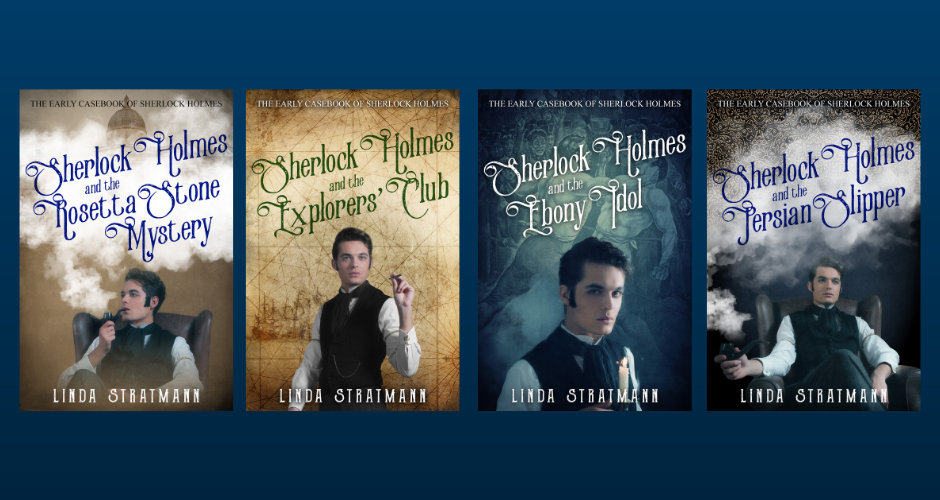
Congratulations to Linda Stratmann!

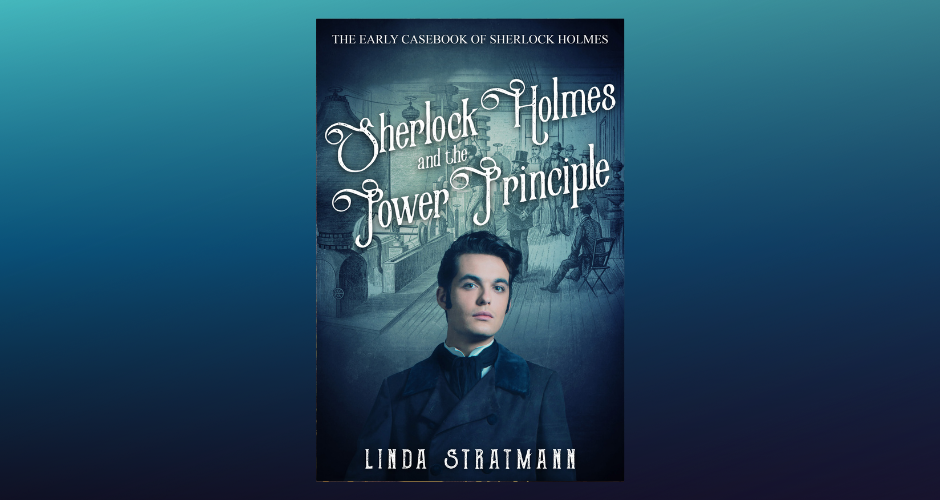
Congratulations to Linda Stratmann, whose absorbing Victorian mystery, Sherlock Holmes and the Power Principle, is out now!

Sherlock Holmes and the Power Principle is the ninth book in the Early Casebook of Sherlock Holmes series.

1878

Sherlock Holmes and his good friend Mr Stamford are close to completing their education at London’s St Bartholomew’s Medical College, and Holmes is keen to begin a serious career as a detective.

So when a solicitor contacts him about a new case, he quickly accepts.

Mr Ineson is concerned for his client, the widow Mrs Beauregard, who is considering investing most of her considerable assets in a new company called Baumann Motors Ltd.

In an age of industry, machines are rapidly transforming the Victorian world, and fortunes can be made – or lost – by speculating on the latest enterprise.

The Baumann motor promises to change the world transport, make manufactured goods cheaper and allow trains to run without the need for coal.

But it has not been tested, and Ineson is worried that Mrs Beauregard has fallen for the charm of its inventor.

Holmes and Stamford attend a demonstration under the pretence of being interested in investing to try and discover if the motor is as miraculous as it sounds. But soon they are involved in an even deadlier mystery…

With Holmes’ reputation as a highly intelligent and intuitive detective at stake, can he discover the truth about the highly secretive company? Or will this case prove too challenging for even the most astute of men?

Sapere Books Sign New Cosy Crime Series by Amy Licence

Following the success of The Marwood Family Tudor Saga, we are delighted to announce that we have signed a new Sherlock Holmes-inspired cosy crime series by Amy Licence.

In Amy’s words:

“Tucked away in a sleepy Sussex village, Sherlock Holmes’ great-great niece Charlotte Holmes wants nothing more than to run her antiquarian bookshop in peace and quiet. Divorced, and with her grown-up children having flown the nest, she’s looking forward to reading her way through the shelves, attending quiz nights with best friend Nell, and going out for dinner with handsome lecturer Toby. But then a young woman unexpectedly turns up in answer to an advert she placed for a housemate, whose name just happens to be Scarlet Watson. It seems too much of a coincidence, but when the landlady of the local pub is murdered, the pair team up to solve the crime, and Scarlet’s infectious enthusiasm wins Charlotte over. But is the new arrival all she seems? What secrets is Scarlet hiding?

A Study in Scarlet is the first book in my new cosy crime series, inspired by the Sherlock Holmes stories. I’ve always loved reading detective fiction and, as an English teacher, I have been reading the Holmes stories with my classes for twenty years. I felt it was a perfect addition to the genre, imagining a modern setting for some familiar devices, swapping the gender of the detective, and keeping a literary twist — my heroine loves reading! Each book is based on one of the original stories and Holmes fans will love spotting the overlap and solving the crime.

“I’m delighted to be branching out with Sapere Books into another genre that I’ve always loved. Books two and three in the series are already planned and ready to be written, with more sleepy village intrigue, plus some local festival glamour, but always remaining true to the Holmes genre.”

Discover more about Amy here.

Sapere Books Signs Three New Sherlock Holmes Mysteries by Linda Stratmann

We’re thrilled to announce that we have signed three new instalments of the Early Casebook of Sherlock Holmes series by Linda Stratmann.

The series follows a young Sherlock Holmes and his acquaintance, medical student Mr Stamford, as they unravel mysteries and unmask devious killers.

In Linda’s words:

“I am delighted to continue the adventures of a youthful Holmes, before he met Dr Watson. A little about what to expect next: in the Halloween-themed Widow’s Key, an unexpected legacy creates a furore, with deadly mysteries to uncover.  In The Aeronauts, murder is sky-high, and escaped balloons cause peril both aloft and below. The Ghost of Lodge Thirteen finds Holmes and Stamford in Brighton. Richard Scarletti has been accused of murder, and his sister Mina (from the Mina Scarletti Mysteries) and Holmes form a powerful detective alliance.”

To keep up to date with Linda’s newest releases, visit her website and sign up to her newsletter.

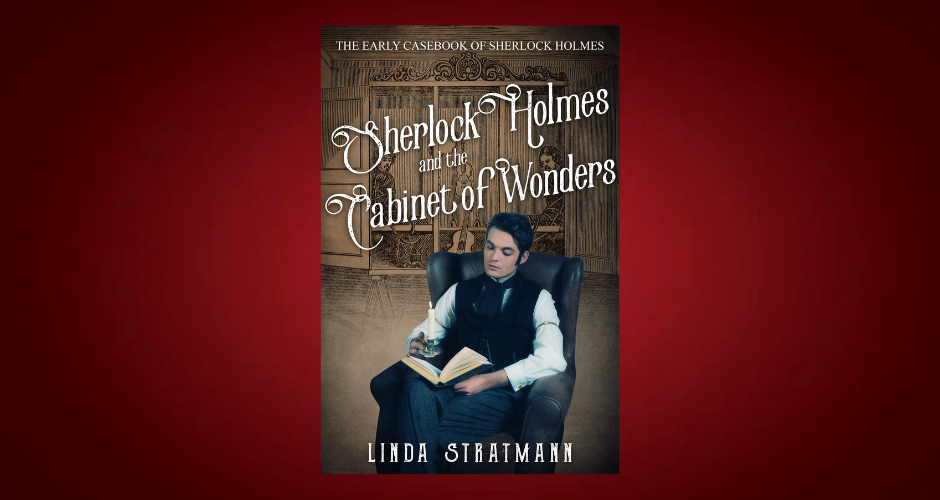
Sherlock Holmes and the Cabinet of Wonders is Out Now!

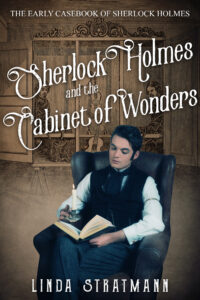
Congratulations to Linda Stratmann, whose absorbing Victorian mystery, Sherlock Holmes and the Cabinet of Wonders, is out now!

Sherlock Holmes and the Cabinet of Wonders is the eighth novel in the Early Casebook of Sherlock Holmes series.

1878

Sherlock Holmes is in a slump of despair and self-doubt following his recent encounter with his brother Mycroft and his good friend Mr Stamford is determined to snap him out of it.

When Stamford hears of a new show being put on at the Egyptian Hall Theatre, he brings Holmes with him for a night of diversion.

But for Holmes, the outing leads to something much more stimulating…

A few days later, a corpse is found inside the cabinet used for one of the conjuror’s acts at the theatre, and at first it appears the death was accidental.

But Holmes soon realises it was the result of something more sinister. And lurking beneath the surface of the magician’s code of conduct is a murky world of false identities and professional jealousy.

There are secrets in the world of illusion that people would kill to keep hidden…

And if they are not careful, Holmes and Stamford could be the next targets…

Yorick vs Psycho, or The Child in a Box by Linda Stratmann

 Linda Stratmann is the author of the Mina Scarletti Mysteries and the Early Casebook of Sherlock Holmes series.

One of the great joys of historical research is discovering untold and fascinating true stories. This is one I found during my reading for Sherlock Holmes and the Cabinet of Wonders, which inspired part of the plot.
On 8 January 1878 an unusual statement was printed on the front page of The Scotsman newspaper. The title was ‘YORICK — WHAT IS IT?’ and the author, announcing ‘challenge accepted’, was one of the most accomplished and famous magicians of his day. John Nevil Maskelyne was a mechanical genius, the constructor of a whist-playing automaton called Psycho. He was the lessee of the Egyptian Hall theatre in Piccadilly, known as ‘England’s Home of Mystery’, where he performed illusions and debunked spirit mediums. He was also, judging by the tone of the piece in The Scotsman, extremely annoyed. His ire was aimed at two men: William Alexander, under whose management a rival of Psycho called Yorick was being exhibited, and the conjuror Boz who took the stage.

After briefly holding the licence of the York Hotel in Weston-super-Mare, Alexander had decided on a new career, promoting conjurors and illusionists. It is not known what previous experience he might have had, but he brought to his profession the ability to manufacture glowing endorsements, shameless theft of other men’s material, and a complete ignorance of the laws of libel.

‘Boz’ was born William Arthur Weston, in Brighton, in 1847. His father was a gunsmith and his mother a dyer. In common with many youthful enthusiasts of the art of conjuring, he had become fascinated with the American Davenport Brothers who toured England in 1864-5, bringing with them a miraculous cabinet. When the brothers were securely tied in the cabinet, all kinds of manifestations were produced, both musical and visual, which many onlookers believed to be the work of spirits. Weston, convinced that their act was trickery, determined to work out how it was done. He chanced to meet George William Buck, a skilled and successful professional conjurer born in 1836, who worked under the name Herr Dobler. The two discovered a mutual interest and pooled their information. After collaborating to perform an exposé of the Davenports’ methods, Dobler hired Weston as his assistant, and they went on tour. In 1866, however, Weston’s father died, and he was obliged to return to Brighton and the trade of dyeing. The flame of ambition still burned, and Weston hoped for an opportunity to take to the stage again.

This eventually came about when he met William Alexander, who by 1875 was managing the career of Herr Dobler. Coincidentally, Alexander had just spotted a new money-spinner, and all he needed was a man with some stage experience who could play a part and was happy to comply with his unusual promotional methods. He terminated his arrangement with Dobler and engaged Weston, who was now advertised as ‘Boz’.

Before long, posters were appearing under the heading ‘Alexander’s Sensations’, advertising Boz and the astonishing Yorick, a whist-playing automaton. The glowing reviews of this extraordinary device were probably written either by Alexander or Weston. Herr Dobler was especially shocked to see that the advertisements were using his playbills and lithographs and were posted in towns where he was appearing. Worse still, Weston was now claiming that he alone had devised the method of exposing the Davenports, and taught it to Dobler, who had been profiting ever since from his work. When Dobler objected, he was accused of being an impostor, taking the name and reputation of another man, a conjuror named Ludwig Dobler who had died in 1864.

Dobler sued both Alexander and Weston for libel and they made a counterclaim against him. The case came before the Bristol assizes in July 1877, where Dobler’s counsel pointed out that English conjurors often performed under foreign names to enhance their attractiveness, ‘for foreigners were supposed to be more clever than English people.’ The case was stopped with the agreement that the imputations would be withdrawn on both sides, and the offensive advertisements not repeated.

Boz and Alexander had suffered little from this spat. They continued their career as before, the advertisements and reviews becoming even more exuberant, the claims more fantastical, and the audiences larger. Their confidence was misplaced, since they had reckoned without John Nevil Maskelyne.

Maskelyne, born in 1839, had been apprenticed to a watchmaker. He became fascinated by stage illusions and seances when he was asked to repair a mysterious mechanical device. The owner was unusually coy about describing its function, and Maskelyne realised that it was used by mediums to fake spirit rapping. After he and his friend George Cooke successfully replicated the Davenport Brothers’ act without the aid of spirits, they commenced a career as conjurers and illusionists and first appeared at the Egyptian Hall in 1873.

Maskelyne had spent more than two years devising and assembling his whist-playing automaton Psycho, the workings of which were a closely guarded secret. He was therefore highly displeased to see Alexander’s advertisements claiming that the young pretender Yorick, which as illustrated on a handbill appeared identical to Psycho, was superior in both construction and operation. However, he had strong suspicions that Yorick, whatever wonders it might perform, was not an automaton.

Yorick and Boz had commenced their glittering career early in 1877 at Weston-super-Mare. Yorick, billed as ‘the most perfect automatic clairvoyant in the world’ was said not only to play whist but also perform mental arithmetic, read, write and spell. It could even, so it was claimed, submit to the test of a naked sword being passed through its body in four distinct places, and being taken to pieces in full view of the audience. There is no evidence that these tests were ever applied.

Yorick moved on to Bristol, the advertisements now boldly claiming that Psycho had been superseded. The tour was in full flow, with bookings pouring in: Liverpool, Manchester and Leicester were to follow.

It was during the Edinburgh appearances in December 1877 that Maskelyne’s patience expired. He and Cooke published newspaper announcements cautioning the public against a ‘gross imposition’ by conjurors exhibiting ‘a trick consisting of a child concealed in an Octagon Box about 24 inches wide and 12 inches deep upon which the bust of a figure is placed’. It was the child, not machinery, that caused the figure to move. Maskelyne did not mind sincere imitations but objected to crude copies said to be superior to Psycho, in an attempt to injure his hard-earned reputation.  At the Egyptian Hall, members of the audience were invited to come up onto the stage and examine the interior of Psycho and the box on which it sat, but, he said, the exhibitors of ‘spurious imitations’ could allow no-one to examine theirs.

On 4 January, The Scotsman published Alexander’s response. He claimed that audience members were permitted to examine Yorick, which he insisted was a genuine automaton on the same principle as Psycho. He challenged Maskelyne and Cooke, who he now alleged were simply the exhibitors of a figure made by another man named Clark [sic], to disprove his claims. The wager was worth £100, the loser to hand this sum to the Edinburgh Infirmary.

Maskelyne eagerly accepted the challenge in his statement of 8 January. He had always acknowledged that a friend of his called Clarke had assisted with the theory and early development of Psycho, but he alone had built the mechanism. Crucially, he now revealed the whole of Yorick’s secret. For the last two years, copies of Psycho had been made and sold in London. Although claimed to be genuine automata, they were designed so that their movements could be controlled by a child concealed in the apparatus. Mr Alexander had purchased one and engaged a little boy to work it, and Mr Weston, as Boz, to present it to the public. It was then advertised as the most wonderful automaton in the world, costing £1,000 to construct. During the performance, Boz told his audience that Yorick operated on the same principle as Psycho but was superior. He even claimed that he was the inventor and Mr Maskelyne the imitator.

Maskelyne now issued a devastating counterchallenge. He proposed to send a representative to Edinburgh who would spare no labour or expense to prove that he had just cause for his caution to the public. He offered to place £200 with a committee of Edinburgh gentlemen, to be paid to the infirmary if his statement was shown to be untrue. If it was true, then Mr Alexander was to pay £100 to the infirmary. The loser of the wager was to pay all the expenses of obtaining the evidence and advertising the result in The Scotsman.

William Alexander now knew that the man he had taunted was willing to do everything in his considerable power to defend his reputation. Maskelyne repeated his challenge, which was never accepted.

Alexander continued to expand his operation. He obtained a second figure worked by a child, which he presented as the original Yorick. In February 1878 he had a new sensation to announce. Extraordinarily, he had partnered again with Herr Dobler — the same man who had previously sued him for libel — who would be appearing with a marvellous automaton, similar to Psycho, dressed as a king and called Rex. This association did not last long. Dobler returned to his former act and sued Alexander for unpaid wages.

The performances of Boz and Yorick continued, the advertisements now carefully avoiding libel, but the secret was out, and bookings dried up before the end of 1878.

The magical career of Arthur Weston was in decline. On 1 April 1880, in Dunfermline where he had an engagement as ‘Signor Boz’, he was found dead in his lodgings. He had tied a piece of wetted silk (variously described as a handkerchief or a cravat) about his neck, and twisted it tightly with a poker, thus garrotting himself, a highly unusual form of suicide. He was thirty-three years of age and left a widow and two children.

Herr Dobler continued to perform as a popular and respected conjuror. He died in 1904. William Alexander remains an obscure figure. It is to be hoped that he decided to abandon his dubious career as a promoter of talent.


Sources

Family records on Ancestry.co.uk

White Magic: The Story of Maskelynes by Jasper Maskelyne

Newspaper reports and advertisements, principally The Scotsman and the Era*.

Also the Western Daily Press and Glasgow Evening Citizen.

*Regarding the Era’s report of the libel trial, on Sunday, 5 August 1877 p. 4, titled ‘Rival Conjurers’. Some statements are untrue, when checked against other records. Weston’s father was not a dyer but a journeyman gunsmith and William Alexander was licensee of the York Hotel under that name.
Sherlock Holmes and the Mycroft Incident is Published Today

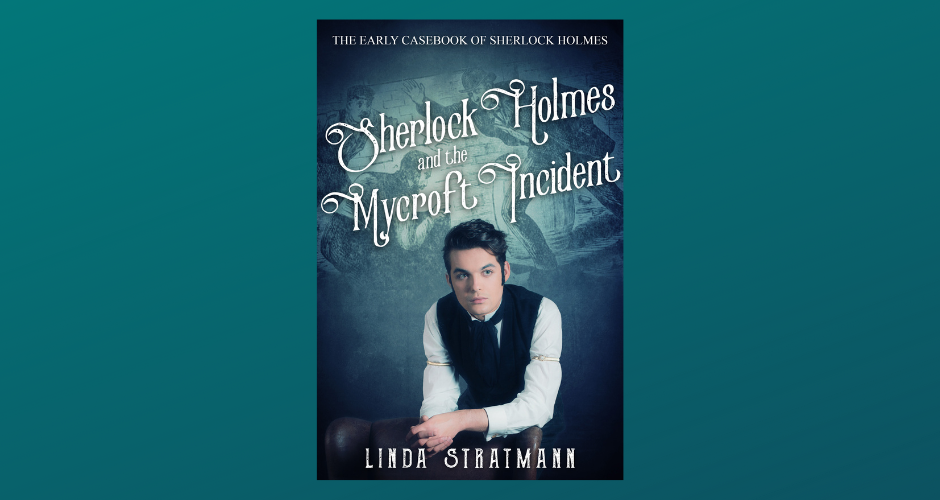
Congratulations to Linda Stratmann, whose absorbing historical mystery, Sherlock Holmes and the Mycroft Incident, is published today!

Sherlock Holmes and the Mycroft Incident is the seventh Victorian crime thriller in the Early Casebook of Sherlock Holmes series.

1877

A trusted government courier, Anthony Cloudsdale, has gone missing after delivering some secret documents.

The police are questioning everyone who works at Whitehall, and their attention has been drawn to a young clerk, Joshua Emmett, who is in need of funds and might have been vulnerable to bribery.

Emmett is an old schoolfriend of Mycroft Holmes and Mycroft approaches his private-investigator brother, Sherlock Holmes for help.

Holmes and Mycroft collaborate with the assistance of Holmes’ trusted friend Mr Stamford, but each time they discover new information about Cloudsdale’s disappearance, it appears to provide evidence of Emmett’s involvement.

And when a body is found in the Thames, Emmett is arrested.

But is the body Cloudsdale’s? Can Sherlock prove Emmett’s innocence?

Or is Mycroft trying to protect a guilty man…?

Sapere Books Sign New Early Casebook of Sherlock Holmes Books by Linda Stratmann

We are thrilled to announce that we have signed three new instalments of the Early Casebook of Sherlock Holmes series by Linda Stratmann.

Book 1 in the Early Casebook of Sherlock Holmes series

The series follows the adventures of Sherlock Holmes and his acquaintance Mr Stamford during their years at St Bartholomew’s Medical College.

In Linda’s words:

“I am delighted to have signed with Sapere for three more books in the Early Casebook of Sherlock Holmes series, my chronicle of his youthful adventures.  In these next three we will meet a young Mycroft, enter the world of theatrical illusions, and encounter a devious confidence trickster with a mysterious device.

“My grateful thanks are due to the dedicated team at Sapere Books, for their invaluable support, and the friendly encouragement of the growing family of Sapere authors.”

Sherlock Holmes and the Legend of the Great Auk is Published Today

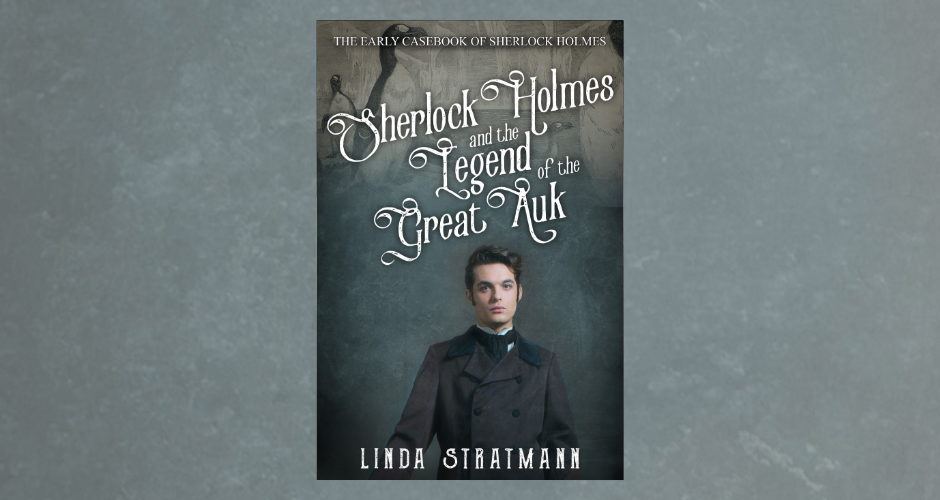
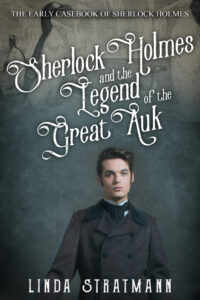
Congratulations to Linda Stratmann, whose atmospheric historical mystery, Sherlock Holmes and the Legend of the Great Auk, is published today!

Sherlock Holmes and the Legend of the Great Auk is the fifth Victorian crime thriller in the Early Casebook of Sherlock Holmes series.

London, 1877

The unveiling of a new specimen of the extinct Great Auk leads to accusations of fraud against the British Museum and a ferocious attack on the exhibit by ornithologist Charles Smith.

Sherlock Holmes is tasked with saving the reputation of the museum, but before long, Smith is found murdered.

Police think it was a random robbery gone wrong but when Holmes examines the crime scene, he is sure there is more to it.

Aided by his loyal friend Mr Stamford, Holmes is determined to discover if the museum has something to hide.

Is there more to the legend of the Great Auk? Why has this exhibit attracted so much controversy?

Could more lives be in danger…?

Sherlock Holmes and the Persian Slipper is Published Today

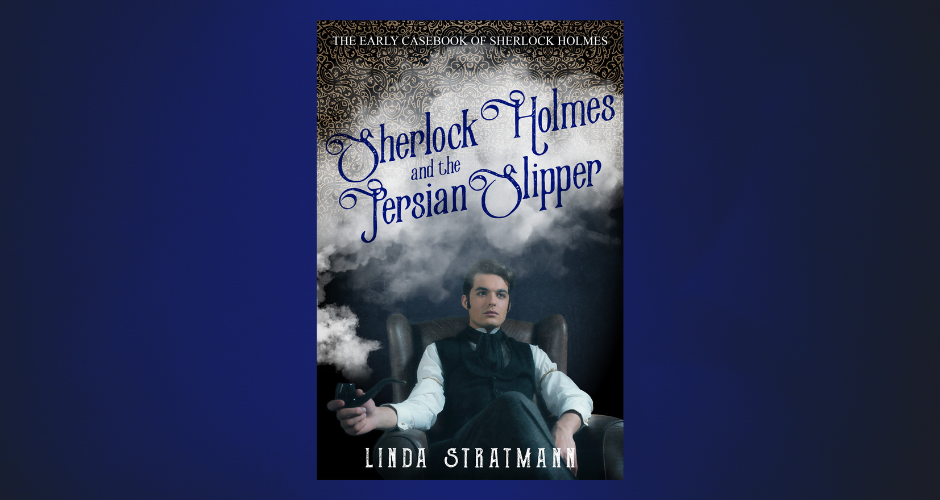
Congratulations to Linda Stratmann, whose eerie historical mystery, Sherlock Holmes and the Persian Slipper, is published today!

Sherlock Holmes and the Persian Slipper is the fourth Victorian crime thriller in the Early Casebook of Sherlock Holmes series.

London, 1877

When medical student Mr Stamford is visited by his cousin, Lily, he is disturbed by the sinister tale she relates.

Lily’s friend, Una, has recently inherited an old country house and settled down to married life in Coldwell, a small Essex village. However, Una’s letters to Lily indicate that she is alarmed by her new husband’s secretive behaviour — especially when she discovers a gun in his drawer, tucked inside a Persian slipper. Fearing for her friend’s safety, Lily asks Stamford to pay Una a visit.

To his dismay, Stamford arrives in Coldwell to find that Una’s husband, John Clark, has been found dead, lying in bed with a gunshot wound in his chest. Close examination reveals that the bullet was fired from Clark’s own gun, through the toe of the slipper.

Stamford loses no time in alerting his acquaintance, Sherlock Holmes — an artful young sleuth — hoping that he can shed some light on Clark’s death.

As Holmes and Stamford begin to probe Clark’s past, it soon becomes obvious that he had plenty to hide. And when Holmes hears of further suspicious disappearances, he starts to search for the connection between the sinister mysteries…

Sherlock Holmes and the Ebony Idol is Out Now

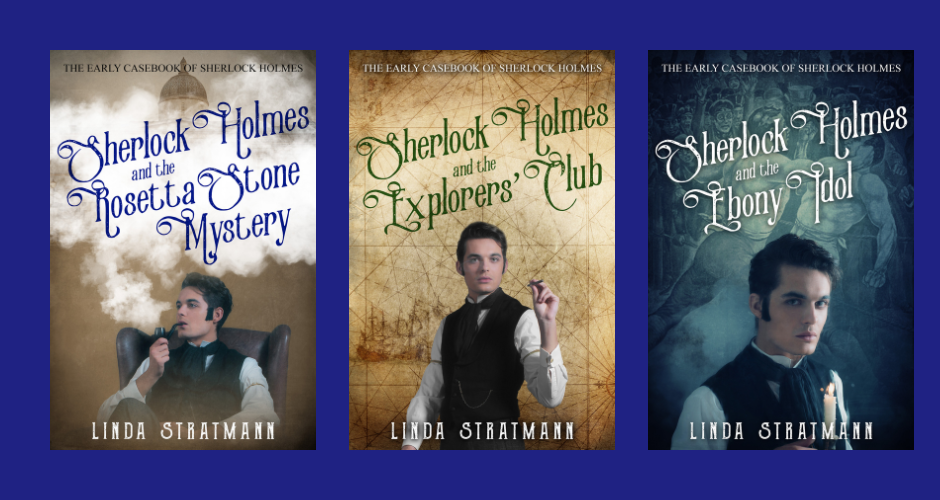
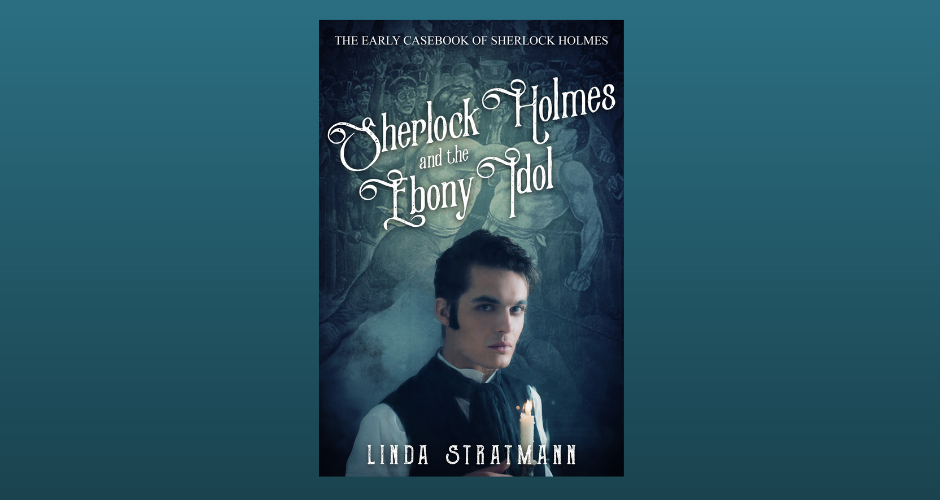
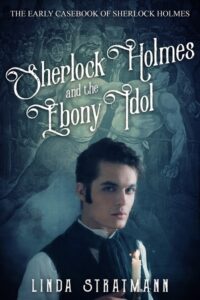
Congratulations to Linda Stratmann, whose gripping historical mystery, Sherlock Holmes and the Ebony Idol, is published today! Sherlock Holmes and the Ebony Idol is the third Victorian crime thriller in the Early Casebook of Sherlock Holmes series.

When a pugilist dies at a local boxing demonstration attended by medical student Mr Stamford and his acquaintance Sherlock Holmes, a post-mortem reveals the death is due to natural causes.

But when the corpse of another boxer is discovered clutching a small wooden carving – the ebony idol – Holmes begins to suspect that sinister forces are at work.

His suspicions seem confirmed when the companions hear about a previous death in the ring.

Tasked by the man’s widow to bring his killer to justice, Holmes and Stamford are swiftly drawn into their most curious case to date.


Click here to order Sherlock Holmes and the Ebony Idol

Sherlock Holmes and the Explorers’ Club Published Today

Congratulations to Linda Stratmann, whose fabulous historical mystery, Sherlock Holmes and the Explorers’ Club, is published today!

Sherlock Holmes and the Explorers’ Club is the second Victorian crime thriller in the Early Casebook of Sherlock Holmes series.

When the preserved foot of a dead man with extra toes arrives at St Bartholomew’s Medical College, the students are fascinated. However, despite this unusual feature being reported in the press, the man’s identity remains a mystery.

Intrigued by the puzzle, medical student Mr Stamford calls on his acquaintance Sherlock Holmes — an eccentric but brilliant young sleuth — to help him learn more about the deceased.

With only the man’s boots and a few possessions to examine, Holmes relishes the challenge. He soon finds a coded message hidden inside the man’s purse, which suggests a possible connection to criminals or spies.

Over the course of their investigations, Holmes’ and Stamford’s suspicions are strengthened when they learn of further shocking deaths. It soon becomes apparent that the men who died all belonged to the mysterious Explorers Club — and the lives of the remaining members may also be in danger.

Although the deaths look like accidents, Holmes is convinced that the men were murdered. And with conspiracy and intrigue lurking at every turn, he must now expose the secrets of the Explorers’ Club before the next member meets a grisly end…


Click here to order Sherlock Holmes and the Explorers’ Club

Sapere Books Sign a New Sherlock Holmes Series by Linda Stratmann

Following the publication of Linda Stratmann’s sensational Mina Scarletti Mysteries – Victorian crime novels with a courageous woman sleuth at the centre – editorial director Amy Durant has signed up her exciting new series, which follows a young Sherlock Holmes. The first instalment will be published next year.

In Linda’s words:

“22 year old Sherlock Holmes, realising that his destiny is to be the world’s first and best consulting detective, has abandoned conventional education and come to London to acquire the very particular and unusual skills and knowledge he needs for his chosen career. This is Holmes before Watson: youthful, fiery, determined, energetic, still learning his craft. This is the legend in the making, the story of how young Holmes became the Holmes we know.

“Sherlock Holmes is the epitome of the great detective, iconic and instantly recognisable. It was a tremendous thrill to be asked to create new adventures and explore those periods of Holmes’s life which Conan Doyle left to the imagination. It is a pleasure to continue working with the wonderfully supportive team at Sapere Books, and to be a part of the Sapere family of authors.”


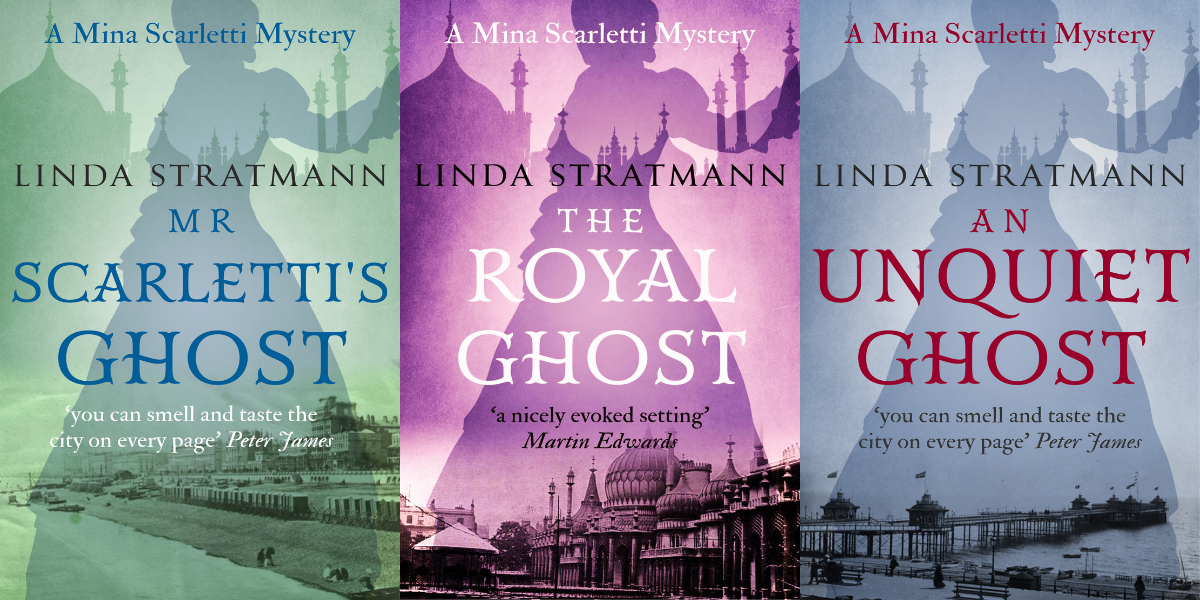
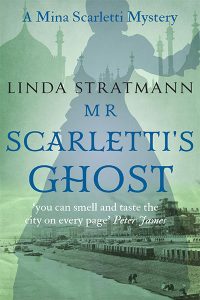
Click here to order MR SCARLETTI’S GHOST

Click here to find out more about the Mina Scarletti Mysteries