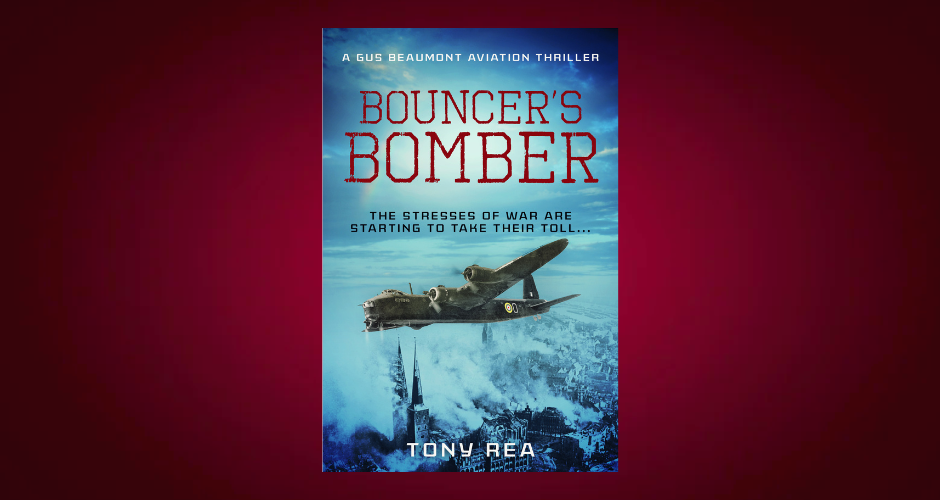
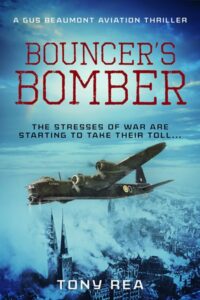
SOE pilot Gus ‘Bouncer’ Beaumont is beginning to feel the effects of an exhausting war. After making a bad navigational error he is taken off piloting duties and posted as liaison officer to a Free French bomber squadron.
But the pressure on him continues to build.
First there is the moral dilemma of bombing civilians, then the suicide of a comrade. And, to top off everything, he is accused of murdering a fellow RAF officer.
The murder investigation is dropped, but a cloud of suspicion hangs over Gus and the only way to clear his name is by tracking down the real killer.
Can Gus clear his name and mend his reputation? Will he return to fight in the skies?
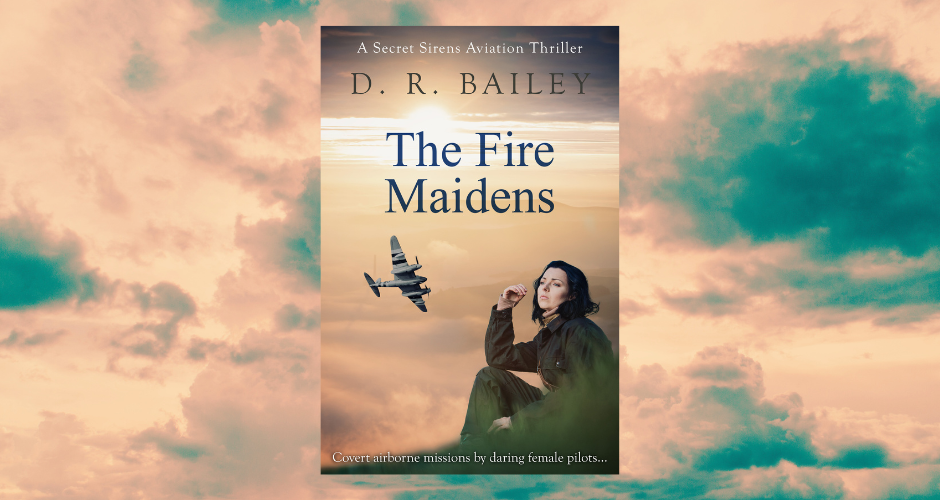
Sisters Anna and Jennifer Nightingale have been flying in top missions with the Secret Sirens all-female RAF unit for nearly a year.
Their squadron of twelve Mosquitos stages a raid on Rouen to divert the enemy’s attention from the Lancasters which are coming in to bomb the marshalling yards and port.
But while Jennifer makes it through the mission safely, Anna and her navigator, Maria, are forced to ditch into the Channel.
Luckily they are picked up by a British Destroyer. And on board is none other than Winston Churchill himself.
Impressed by the skill-level and bravery of the female pilots, Churchill is keen to learn more about their training.
He escorts them back to base where they are given a new mission: to attack the Nazi-occupied Mimoyecques Fortress.
The Allies know that the Fortress is being armed with high calibre guns capable of reaching London in a massive, unending bombardment. The Sirens need to drop bombs into the railway tunnel entrance of the Fortress as soon as possible before the unthinkable happens.
But with very little time to train, will the Sirens be able to pull off the task? Can they reach the Fortress unscathed?
Or will these Fire Maidens join the many thousands who have already lost their lives in this brutal war…?
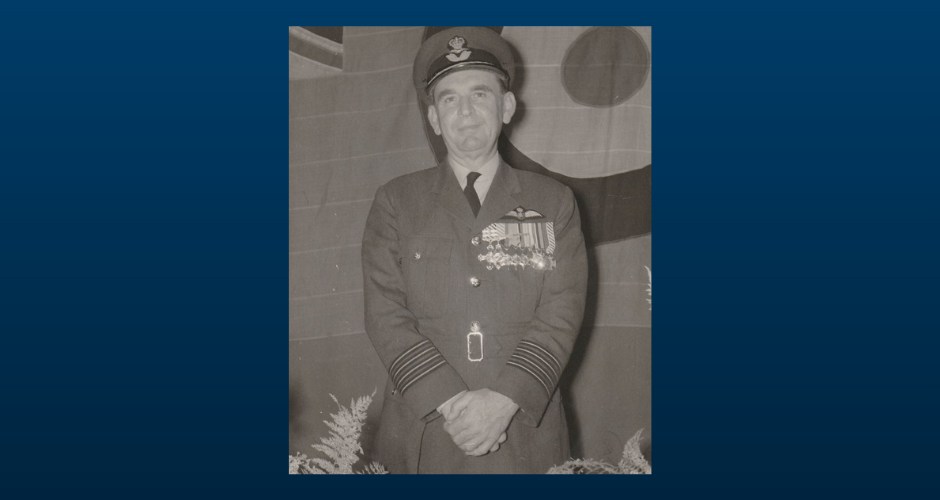
Group Captain Bobby Oxspring, author of Spitfire Command, saw action in many of the most famous battles of the Second World War, including Dunkirk and the Battle of Britain. To commemorate the eightieth anniversary of the end of World War Two, his great-grandson, Daniel, shares his reflections on Bobby’s life below.
Flying ace Robert (Bobby) Wardlow Oxspring held the rank of squadron leader when World War Two ended in May 1945. Throughout April 1945, he was confident that the war was soon to conclude. His mood on VE Day as an optimistic family man would have no doubt been a mixture of pride and reflection. He would have been proud of his achievements: he’d been made leader of the 141 Wing at Deanland only the year before, and had been awarded a Distinguished Flying Cross and Two Bars as a flying ace. He would have been reflecting on his numerous wartime adventures, from the Battle of Britain to his time in North Africa, Italy and many other countries. Bobby’s mood on VE Day likely matched the mood of many of ‘The Few’, and I have no doubt he would have felt joy at the war’s conclusion.
For me, the great-grandson of Bobby Oxspring, my great-grandfather has had a huge influence on my life — not only as a proud figure to look up to, exemplifying courage and bravery, but also through his stories. His career after VE Day did not lose momentum. He received a permanent commission as a flight lieutenant on 1st September 1945 and was promoted further to substantive squadron leader on 1st August 1947. One incredible achievement, however, was his award of an Air Force Cross. This was for leading number 54 Squadron of the RAF Vampires to Canada and the US, the very first jet aircraft to cross the Atlantic.
After VE Day, he never stopped being admirable. He undertook further tours, even across Italy, and eventually became Station Commander of RAF Gatow in Berlin. At Churchill’s funeral, he walked at the very front.
I have been to RAF Cranwell to see some of my great-grandfather’s personal scrapbooks and was even fortunate enough to sit in the cockpit of his recovered plane in the Dumfries and Galloway Museum in Scotland. These are only a few of the moments I have taken to reflect on his life.
On VE Day I am almost certain that one thought would have prevailed in his mind: his admiration and respect for the mighty Spitfire, and his pride at having flown it.
In September 1939 the twenty-year-old John Wooldridge, then a Sergeant Pilot, took part in the British air raid on Kiel, the first raid of World War Two. Having brought his damaged aircraft home safely, he was awarded the Distinguished Flying Medal. Commissioned in August 1940, he rapidly rose to the rank of Flight Commander, flying Lancasters as a Flight Lieutenant. In the middle of 1942, for his part in the 1,000-bomber raid on Cologne, he was awarded the Distinguished Flying Cross.By the end of the War, he had flown 97 missions over enemy territory. To commemorate the eightieth anniversary of the end of World War Two, John’s daughter and son, Susan and Hugh, share their memories of him below.
John Wooldridge
On 9th and 10th May 1944, our father, Wing Commander John Wooldridge DSO, DFC*, DFM, returning from New York where his music was being performed at Carnegie Hall, flew over the Atlantic in a Mosquito, taking off from Goose Bay, Canada and landing six and a half hours later in Ballykelly, Northern Ireland. In so doing, he broke the then speed record for crossing the Atlantic.
The Air Ministry, unsure what to do with this daring twenty-five-year-old, told him to lie low but, within a couple of days, they’d been outflanked by the Press and the story was all over the newspapers. As our father writes in his diary for Sunday 14th May: Ye gods, what a splash! Headlines, pictures…
Meanwhile, on Monday 15th May in a London hairdresser, our mother, the distinguished British actress Margaretta Scott, was having her hair done. Whilst under the dryer, she read the story in the London Evening Standard of this amazing trans-Atlantic flight. But what really caught her eye was that the pilot was also a composer of serious music, who had composed a work for Narrator and Orchestra called The Constellations.
‘That’s my boy!’ she cried, as Sir Henry Wood had recently asked her to find a new work for Narrator and Orchestra for his upcoming Promenade Concerts, and she felt that The Constellations might be just the job.
Our mother immediately approached the Air Ministry, but they refused to give out the personal details of the record-breaking flyer.
The story would have ended there if, a couple of days later, at Denham Film Studios where she was making the film Fanny by Gaslight, our mother had not given a lift to a film publicist who, on their journey back to London, had boasted that he’d just been given a camembert cheese flown across the Atlantic by a friend, one John Wooldridge.
‘Bring him to tea!’ she cried. And the next Sunday, there was our father on her doorstep — and that was it! For the next fourteen years until our father’s sudden death in a car crash in 1958, our mother and father were as inseparable as their young family and busy work schedules would allow.
In the 1950s, Margaretta Scott continued to star in plays and films whilst John Wooldridge wrote his music and plays and films. One of his most important films was the 1953 film starring Dirk Bogarde, Appointment in London, about a Royal Air Force Bomber Command squadron, for which he wrote both the screenplay and the music score. To this day it continues to be screened to great acclaim and serves as a memorial to Bomber Command by one of their own.
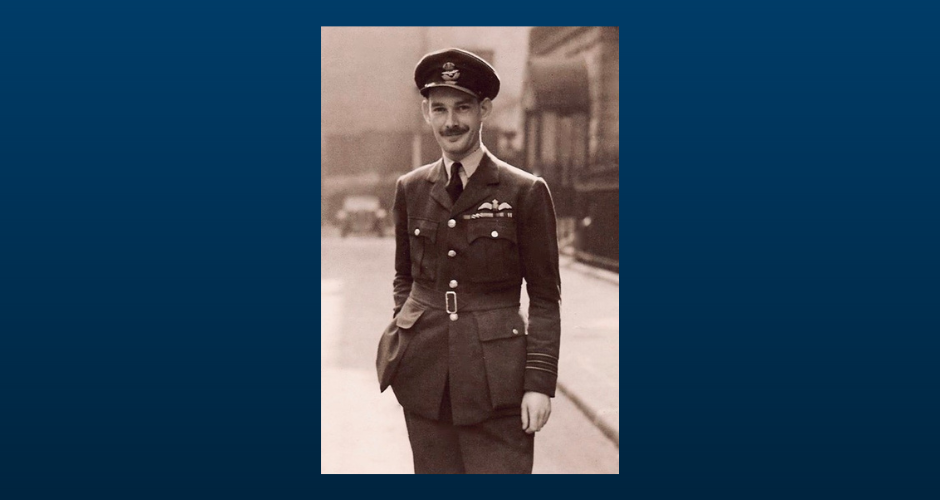
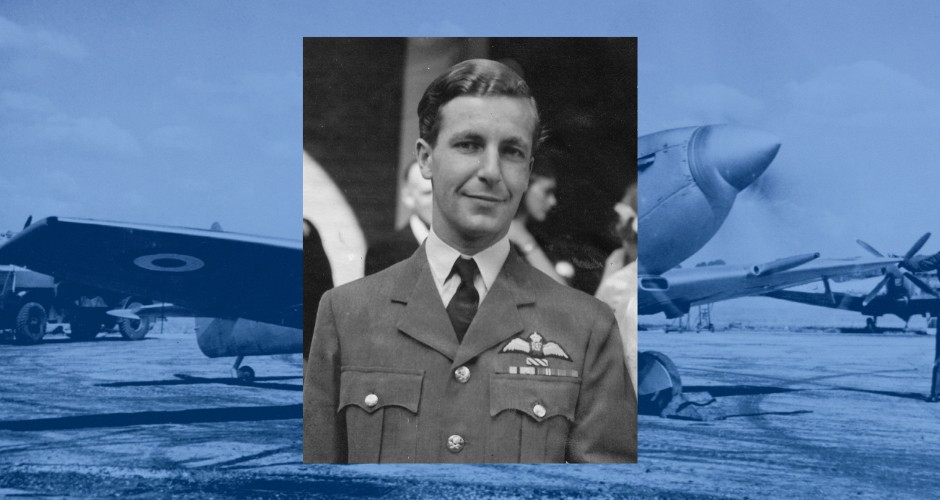
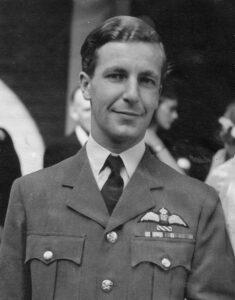
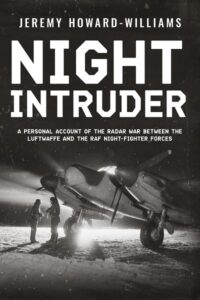
Jeremy Howard-Williams DFC (1922–1995), author of Night Intruder, had a distinguished career in the RAF as a night-fighter pilot during the Second World War and was awarded the Distinguished Flying Cross for gallantry. To commemorate the eightieth anniversary of the end of the Second World War, Jeremy’s son, Anthony Inglis Howard-Williams, reflects on the arrival of peace in 1945 and how it influenced his father’s life.
Jeremy Howard-Williams warming up the engines of a clipped wing Spitfire
When peace came to Europe in May 1945, Flight Lieutenant Jeremy Howard-Williams DFC was stationed at HQ, 11 Group Uxbridge. Three days before Germany’s unconditional surrender, a party was held to celebrate peace. Jeremy and his brother Peter did so by marching a guest — Flight Lieutenant Andrew from RAF Intelligence — between them up and down an anteroom. The junior flight lieutenant just happened to have been their pre-war boarding school housemaster, and the brothers had found it too good an opportunity to miss. When, years later, he was asked how the lieutenant had taken the ribbing, Jeremy replied, “with remarkable good humour!”
Jeremy at his wedding in 1951
Like so many in 1945, Jeremy was headed for an uncertain future. With peace came the pressing question: what happens now? For most, life outside of the forces beckoned. With millions demobilising, the assimilation of those who had been at war back into civilian society became one of the new post-war government’s biggest challenges. For those who did not want to leave the forces came a different challenge. With Jeremy’s father a retired RAF pilot, Peter a Battle of Britain day-fighter pilot and Jeremy a night-fighter pilot with the Fighter Interception Unit — an elite force at the forefront of the RAF’s early experiments with radar equipment — both brothers understandably wished to remain serving.
With the Royal Air Force downsizing, deployment meant less flying — not a very exciting prospect for a twenty-three-year-old war veteran. Jeremy had specifically joined the RAF in order to fly when the Nazis had tried to seize control of Western Europe. However, in the new modern era of the jet engine, aircraft were flying ever faster and higher. Now that was exciting!
In the end, both brothers remained in the RAF. Jeremy was first posted in an admin job to Singapore during the Malayan Emergency, where he met his wife, uniting two distinguished RAF families. He later worked as an assistant air attaché in the Paris and Berlin embassies. He did fly during these postings, but mainly a desk. He resigned in 1957.
Ultimately, Jeremy’s parents divorced and his father remarried into the Ratsey family, where Jeremy became sales manager for the famous sail-making firm Ratsey & Lapthorn in Cowes on the Isle of Wight. After leaving the company, he wrote many authoritative books on sailing, as well as Night Intruder, republished by Sapere Books, a personal account of his wartime service as a pilot and the radar war between the RAF and Luftwaffe night-fighter forces.
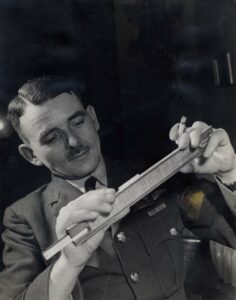
Sir Frank Whittle, author of Jet: The Story of a Pioneer, was a Royal Air Force pilot and aviation engineer known as the inventor of the jet engine. He obtained his first patent for a turbo-jet engine in 1930, and in 1936 co-founded Power Jets Ltd. In May 1941, his engine was fitted to a Gloster E.28/39 airframe — the plane’s maiden flight from RAF Cranwell in Lincolnshire heralded the beginning of the jet age. Frank retired from the RAF in 1948 with the rank of air commodore, and that same year he was knighted. He was awarded the Order of Merit in 1986. To commemorate the eightieth anniversary of the end of World War Two, his son Ian reflects on Sir Frank’s life in 1945.
Frank as a junior officer in 1929, when he proposed the turbojet
My father’s company, Power Jets, was nationalised in 1944. From then until 1946, he was on the board of the government company that emerged under a slightly different name. At the time, he was working on the design for the aft-fan engine that also incorporated the after-burner system he had patented in 1936 — the modified W2/700. This was expected to propel the experimental Miles aircraft (M52) intended to be the first in the world to go supersonic. He was also working on the development of what would have been the world’s first hi-bypass turbo-fan engine — the LR1. Both projects were cancelled by the government in 1946 — as was the M52. These decisions resulted in Frank resigning from the board and putting himself in the hands of the RAF to do whatever they would wish him to do.
Frank holding his slide rule
1945 was a year of change for my father. He was still a serving officer in the RAF, but Power Jets had become publicly owned and entirely dependent on government funding. He found himself subject to the needs of the large independent aero-engine manufacturers who objected to a government company in competition. However, on three occasions he briefly got away from it all and flew the Meteor jet fighter. Apart from the Wright brothers, he was the first person to pilot an aeroplane powered by an engine of his own design. At other times, he found himself sent off to deliver lectures at various venues to describe the impact and differences when changing from piston engine/propeller propulsion to jet propulsion.
As a little boy, I remember him coming home after flying the Meteor along the high-speed run at Herne Bay. “How fast did you go, Daddy?” I asked. “Oh, about 450,” he replied. “Is that all?” I said with some disgust, and turned away to do whatever it was that I was doing. I had expected him to tell me 600 miles per hour. When I asked him about this, many years later, he said he was quite crestfallen by my reaction. He also explained that, as he was flying at about 50 feet above the surface of the sea, he really was unable to pay much attention to his airspeed indicator — his attention was focussed on keeping the aeroplane steady and level. And anyway, he would have been speaking of knots, not mph!
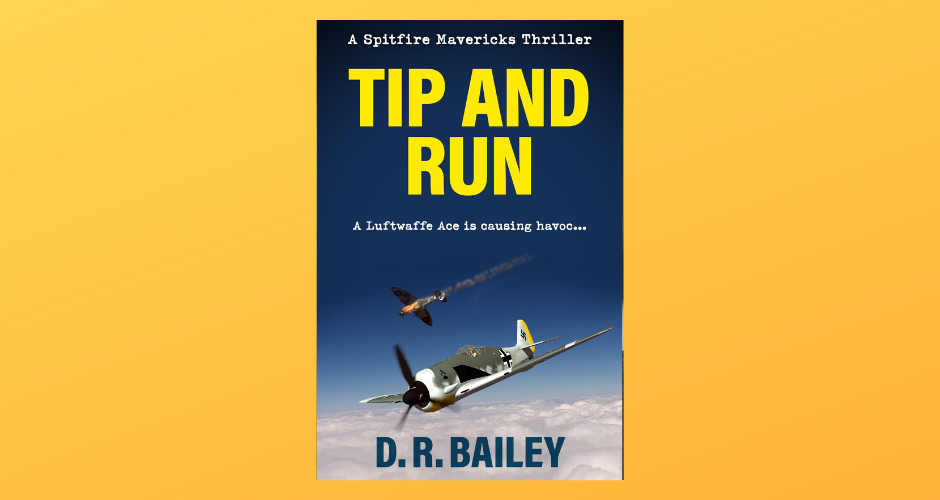
Congratulations to D. R. Bailey, whose exciting aviation adventure, Tip and Run, is out now!
Tip and Run is the sixth book in the Spitfire Mavericks Thrillers series: action-packed novels set during the second world war and featuring a team of vigilante pilots.
Winter, 1942
Flight Lieutenant Angus Mackennelly and his team of Mavericks are informed that a new kind of raid is being perpetrated by the Luftwaffe nicknamed a ‘Tip and Run’.
The planes arrive over the Channel, flying extremely low to avoid radar detection, drop bombs and make a quick getaway. These nuisance raids are designed to disrupt the allies and keep their defences on high alert.
Angus takes a trip to the site of the most recent bombing to see if he can discover more about it. And he makes an extraordinary find – a flat piece of stone with an Ace of Spades playing card attached. This was undoubtedly the calling card dropped by the pilot.
Angus is convinced that the same pilot will try again, and he makes it his personal mission to catch the ‘Ace Raider’.
So begins a deadly game of cat and mouse between the Mavericks and the Luftwaffe invaders.
Who will emerge victorious? Can Angus track down and defeat the raider?
Or will the German Ace lure the Mavericks to destruction…?
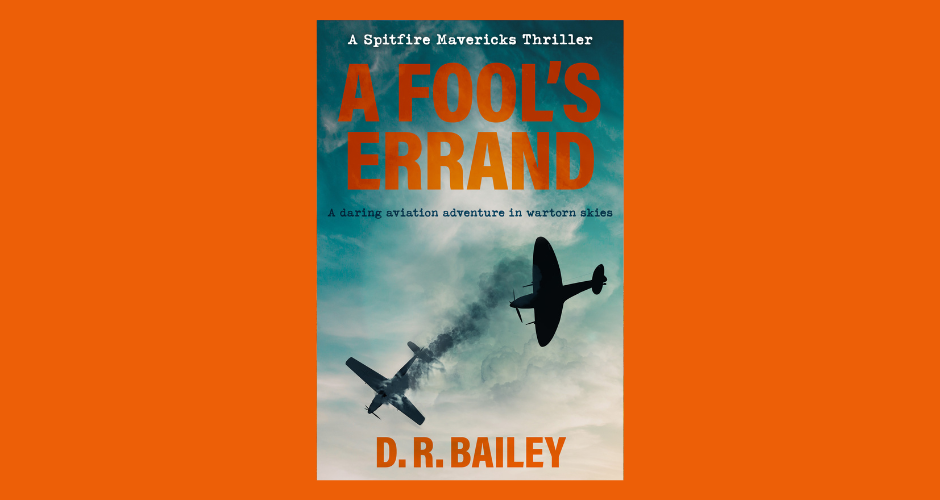
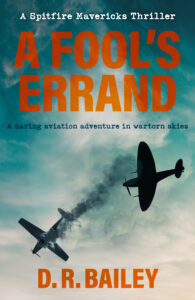
Congratulations to D. R. Bailey, whose page-turning World War II adventure, A Fool’s Errand, is published today!
A Fool’s Errand is the second book in the Spitfire Mavericks Thrillers series: action-packed aviation adventures set during the second world war and featuring a team of vigilante pilots.
1941
The Battle of Britain is over, and RAF Fighter Command turns its attention to France.
Flying Officer Angus Mackennelly and the rest of ‘Maverick’ Squadron 696 are engaged in tactics to lure the Luftwaffe into battle.
But Angus has grave misgivings about the orders he has been given, which are justified when he loses a brand-new pilot on their first incursion.
And the squadron is dealt another blow when one of their pilot officers is discovered dead in the hangar.
The inquest rules the death a suicide, but Angus is certain something more sinister has happened.
In between bouts of furious dogfights in the skies, Angus and his good friend Flying Officer Tomas Jezek work tirelessly to investigate the murder.
While they risk their lives fighting a deadly foe, could the real threat be coming from an enemy within? Are the Spitfire Mavericks being targeted by someone who is supposed to be on their side…?
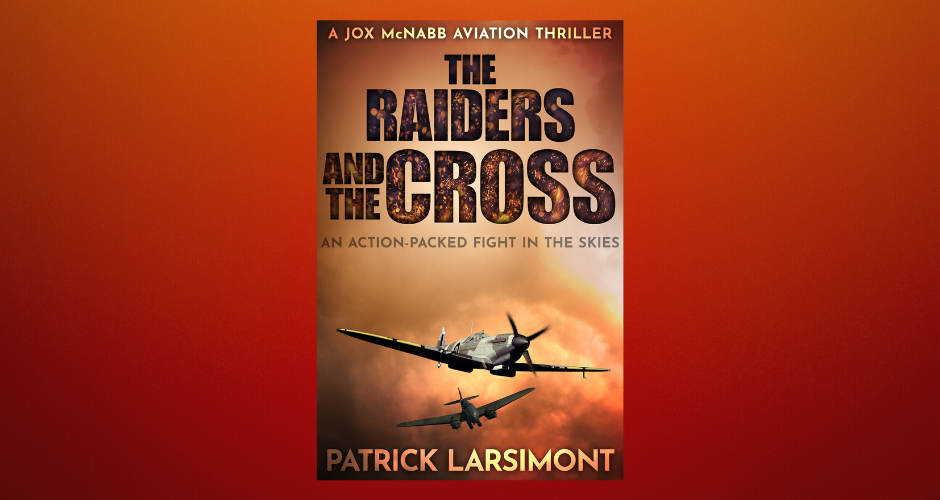
Congratulations to Patrick Larsimont, whose thrilling World War II adventure, The Raiders and the Cross, is out now!
The Raiders and the Cross is the second book in the Jox McNabb Aviation Thrillers series: action-packed, authentic historical adventures following a young RAF pilot during the Second World War.
Winter, 1940
Enemy raiders are bombing Britain’s cities relentlessly. Casualties are high and morale is at an all-time low.
Jox McNabb and the rest of No.111 Squadron train to become night fighters to take on the raiders inflicting such carnage on Britain’s cities.
But then tragedy strikes and Jox is devastated by the loss of those close to him.
Scarred physically and emotionally, he recovers slowly. Seeking a fresh start, he volunteers to serve in the turbulent skies of besieged Malta.
But this new location quickly becomes just as dangerous as the last.
Can Jox forget the tragedy that haunts him? Will he survive the murderous assault of the Luftwaffe?
And can a desperate Malta withstand the relentless onslaught?
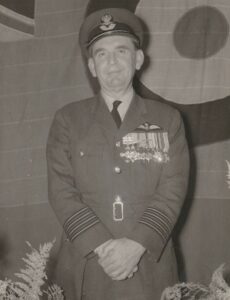 1945, he was confident that the war was soon to conclude. His mood on VE Day as an optimistic family man would have no doubt been a mixture of pride and reflection. He would have been proud of his achievements: he’d been made leader of the 141 Wing at Deanland only the year before, and had been awarded a Distinguished Flying Cross and Two Bars as a flying ace. He would have been reflecting on his numerous wartime adventures, from the Battle of Britain to his time in North Africa, Italy and many other countries. Bobby’s mood on VE Day likely matched the mood of many of ‘The Few’, and I have no doubt he would have felt joy at the war’s conclusion.