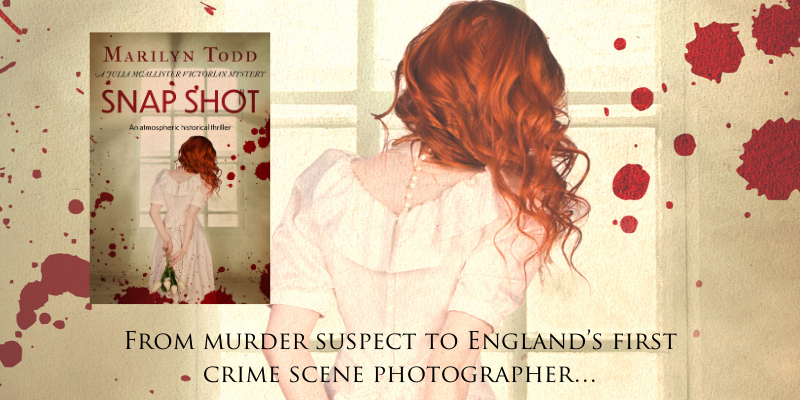
Intrigued by SNAP SHOT? Read the first chapter for free now!

 Chapter 1


‘This —’ The owner of the house cleared his throat and tried again. ‘This is highly irregular.’ He tapped the letter from Whitmore Photographic. ‘The proprietor assures me that he will personally be taking Flora’s portrait.’

Julia McAllister glanced at the four-year-old, sitting bolt upright in her best pink taffeta dress. A froth of ringlets cascaded over her shoulders, and the silver locket round her neck twinkled in the meagre light. With her favourite dolls cradled in her arms, three of them in each, you could be forgiven for thinking the little mite was still alive.

‘My employer, poor man, his health took a turn for the worse.’ Julia flashed a tortured smile. ‘His heart, I’m afraid. Notoriously unreliable.’

‘Yes, but even so.’ Her client’s eyebrows met when he frowned. ‘A woman?’

Julia slotted the plate holder into her camera. She bit her lip, and reminded herself that this was just a job, another routine portrait — that she should knuckle down, take the picture, forget the subject was a baby.

‘Mr. Whitmore would not have entrusted me with such a sensitive task,’ she assured the grieving father, ‘unless he had every confidence in my ability.’

‘For my part —’ his wife’s voice was little more than a croak — ‘I’m comforted that a member of my own sex is looking after Flora. Women,’ she added shakily, ‘are infinitely more sympathetic, so come, dear.’ She pulled her husband’s sleeve. ‘Let us leave Miss McAllister in peace.’

Mrs., Julia wanted to correct. It’s Mrs. McAllister. But the death of their only child was testing the couple’s strength, their marriage and, judging from the cross on the mantelpiece that had been laid flat, their faith in Jesus Christ. Like families everywhere, too much in life had been taken for granted. It was only when the flame was snuffed, in this case without warning, that it was driven home how little they had to remind them of their loved ones. They wanted this picture to cling to and cherish.

‘Rest assured,’ she said, ‘I will do your daughter proud.’

Alone in the parlour, Julia took a series of deep breaths and forced herself to block out the red flock walls that threatened to close in, the gagging scent of lilies, the silence of the grandfather clock, whose pendulum had been removed and wouldn’t be replaced until Flora lay in her grave. How sad. How desperately tragic. When your husband dies, you become a widow. When your parents die, you become an orphan. Yet there’s no word to describe someone who loses a child.

To calm her nerves, Julia followed her familiar ritual of running her hand over the Spanish mahogany case of her camera, inhaling the leathery tang of the bellows and fingering the handmade dovetail joints. (None of those factory-made monstrosities, thank you very much.) By the time she’d given the brass fittings one last unnecessary polish, she felt in control, and disappearing under the heavy dark cover, she examined the image. After all this time, she hadn’t grown used to seeing the world upside down, but there, now — a quick tweak to the focus, a slight tilt to the left, a touch of back swing and —

Mother of God!

The girl’s hand moved.

Nonsense. It must have been a trick of the candles, and that was the problem with having the curtains drawn and the mirrors draped in black. The shadows played havoc.

There! It moved again!

Julia sloughed the sheet from her shoulders and squinted. Impossible. Flora fell downstairs and snapped her neck. In fact, the only thing holding her upright was a metal clamp under her pretty lace collar, and a rope, artfully hidden by dolls, tying the girl to the chair. Julia should know. She’d put them there.

No, no, no. The dead don’t —

‘Ow!’ a voice squealed.

‘Were you trying to steal that locket?’ Julia grabbed the young boy hiding behind the body.

‘Lemme go, you’re pinching!’

‘Did you think I wouldn’t spot a third hand? A third hand, I might add, caked with a six-inch layer of grime.’

‘I said lemme go!’

‘This will be a double exposure in every sense, if you don’t quit squawking.’ Julia examined the urchin in front of her. Eight, was he? Nine? ‘How did you get in?’

‘Door’s open, innit.’

Of course. The front door had been left partly open for mourners to enter without jarring the nerves already stretched past breaking point.

‘So you thought you’d sneak in and steal the locket that probably contains a clipping of her hair, which is all her mother has to remember her only daughter by?’

The defiance crept out of the boy’s face. ‘You gonna report me to the rozzers?’

‘No.’

‘Why not?’

‘Because these are good people, who don’t need to know that some stray urchin crept in their house, defiled their daughter’s body and was caught stealing her precious locket. They’ve suffered tragedy enough, and I won’t have you adding to their misery.’

‘Wotcha gonna do, then?’

‘I am going to take this girl’s portrait, that’s what I’m going to do, and you, sir, are going to help me.’

Me? I don’t know nuffin’ about photographs.’

Julia fluffed the girl’s lace collar to hide the mucky handprint on the taffeta. ‘You don’t need to. Just hold the curtain open — the left one if you please — to throw some decent light in the room.’

‘Like that?’

‘Exactly like that.’ She pressed the shutter release, changed the plate, took another, then another, then another.

‘Why d’you take so many?’ He sniffed, and wiped his nose on his sleeve. ‘It’s not like she’s gonna move and throw the focus out.’

‘For someone who professes to know nothing about photography, you seem remarkably well informed. However, your expertise is no longer required, young man. Time for you to leave, preferably in the same covert manner in which you arrived.’

‘Can’t I —?’

‘Shoo.’

Julia packed up her camera, collapsed her tripod and dismantled the contraption that was holding Flora upright, before packing her accessories back in the case and promising the grieving couple that Whitmore Photographic would be giving Flora’s portrait the utmost priority.

Outside, Julia felt the weight lift from her. After a month of non-stop drizzle that had combined with the smoke from the factories to form a choking, brown, sulphurous stew, the sun was a welcome sight, and Julia wasn’t alone in her joy. Half the population of Oakbourne, it seemed, had turned out to celebrate. The street shimmered with jewel-coloured silks, wide hats festooned with feathers, wasp waists, and shoes with toes so pointed they could put an eye out. Impressive moustaches paraded beneath dark derby hats. Parasols twirled, hansom cabs rattled, and (shock, horror!) could that really be ladies riding bicycles in bloomer suits? Flower girls proffered violets, carnations and stocks a penny a bunch, puppies chased their own tails and a boy played a harp taller than himself to an enraptured audience on the corner.

Stopping at the strawberry barrow, Julia smelled her scrawny assistant before she saw him. ‘You again.’

‘Seeing as how I helped out back there, I thought you might wanna give me sixpence for me troubles.’

‘How about I give you a clip round the ear?’

‘Cow,’ he muttered. Julia checked her black beaded purse. Strangely, it was still there. ‘Threepence, then.’

Dear Lord, give me strength. ‘Suppose we say no pence, and I don’t call the police?’

‘Suppose I went up your chimney and cleaned it?’

‘You’re too old, you’d get stuck, and by the time you’d starved to death and your skeleton dropped out, I’d have died from frostbite, waiting. Go away.’

‘I’ll settle for a ha’penny.’

Julia pulled the boy out of the path of a hackney cab and pointed with her strawberry in the opposite direction to which she was headed. ‘Go. Now.’

‘S’pose I said I wasn’t stealing nuffin’. S’pose I told you, I just wanted to see what a pretty girl looks like dead, coz the only corpses I seen are under the bridges by the canal, and them’s anything but pretty.’

Against her better judgment, Julia gave him her last strawberry. It disappeared whole, green bits, stalk, and all. ‘What’s your name?’

‘Bug.’

‘Bug?’

A grubby shoulder shrugged. ‘Short for Bugger Off, which is what most people —’

‘No explanation required. In fact, I can well see the attraction in offering that particular piece of advice, but tell me — Bug — when was the last time you took a bath?’

‘What’s it to you?’

‘Personally, very little.’ Julia set down her clutter of camera, tripod, cases and clamps. ‘In terms of community service, however, I feel it only fair to remedy the situation.’

Grabbing him by the collar with one hand and the seat of his moth-eaten pants with the other, Julia dropped Bug in the horse trough.

The resulting yells were more than satisfactory. Even if the language wasn’t.

But it was little Flora’s face that stayed with Julia as she pushed through the crush of Cadogan Street and into Westgate Road. Requests for post-mortem photographs — memento mori, as they were popularly called — were becoming more and more common, and this was by no means the first that Julia had taken. Some of her subjects were old, well into their eighties, some were children, a few already laid out in their coffin. Rather memorably, one old chap had begun to decay.

For the sake of authenticity, some of her clients she propped standing up, some with their heads in their hands, some leaning back with a newspaper as though they’d nodded off in mid-read. One lady the family had wanted sitting at a table laid with glassware, cutlery and plates, as though waiting for her dinner guests. Many, like little Flora, had their eyes open. With others, she painted their eyelids to make it look like they were posing for the camera. She perched dogs on their laps. (Stuffed, of course — live animals don’t sit still long enough for the exposure). Several were arranged with their entire families around them and on one notable occasion, it had been impossible to tell which of the eight was the corpse.

None — not one — of those subjects had affected her like this.

Perhaps it was because Flora was an only child, and the mother was of an age when she was unlikely to conceive again. Perhaps it was the dignity with which the couple bore their grief. Perhaps it was the little girl herself, taken in the blink of an eye. Either way, this morning left a nasty taste in Julia’s mouth. One that even the reddest, ripest strawberries couldn’t take away.

‘Ah. The lady photographer, I presume?’

Julia eyed up the man waiting outside her shop, set down her equipment and proceeded to unlock the door. He didn’t look bereaved, was too old to be getting married, and too young to have a daughter needing a wedding recorded for posterity. In fact, in his smart grey lounge suit, derby hat and cocky air, she wouldn’t mind betting he wanted to commission a portrait of himself. Recorded for posterity.

‘What exactly are you wanting, Mr —?’

‘Collingwood.’ For all the width of his smile, it didn’t reach his eyes. Eyes, the artist in her noted, the same hue as his suit. ‘Inspector. Detective Inspector Collingwood, of the Boot Street Police Station. You’d be Miss —?’

‘Mrs.’ Julia hoped that stacking her equipment would excuse not shaking hands. Shaking being the operative word. ‘It’s Mrs. McAllister,’ she said. ‘Now what can I help you with, Inspector? An official police photograph, taken in the station?’

‘Not exactly.’ He walked slowly round the shop, examining the frames on display, the portraits hanging in the window, the showcase of photos, the little china dogs on sale as a side-line. ‘Does the name Eleanor Stern mean anything to you?’

Relief washed over Julia, leeching the strength from her knees — its place instantly taken by a new surge of anxiety. Nellie, Nellie, what have you done now?

‘Can’t say it does.’

‘Lily Atkins?’

An image flashed through Julia’s head. Black stockings drawn over chubby knees. Enormous breasts. The coquettish twist to Lily’s lips as she tweaked her own nipple.

‘Again, no, doesn’t ring a bell.’

‘Hm.’ Collingwood paced a bit more. He stared out of the window at the Common, where lovers strolled arm in arm beneath the oaks, ladies of a certain age walked their Pomeranians, and nannies in uniform pushed perambulators as they eyed the soldiers from the corner of their eye. ‘Bridget O’Leary, though. Surely you know her?’

‘Sorry…’ No smile was ever more apologetic. ‘Then again, a lot of ladies have their portraits taken, Inspector. I could check the ledger, if you like?’

‘That won’t be necessary.’ The pacing changed from clockwise to anti-clockwise. ‘Mr. Whitmore.’ He ran his hand across a silver frame with embossed cherubs on the corners. ‘He left you this business when he died, is that correct?’

‘He did.’

‘Yet four years later, you haven’t changed the name above the shop, and still pretend to clients that Samuel Whitmore’s alive?’

If it had been anyone else, she would have passed that off as respect to her benefactor’s generosity. Unfortunately, there are only so many lies you can tell the police.

‘Pretend is a strong word, Inspector. As a woman fighting to survive, not only in commerce but in what is very much a man’s world, I find it simpler not to disabuse them.’

‘Of course.’ Collingwood switched his derby from his left hand to his right, then back again. ‘And you’re not familiar with the names Lily Atkins, Bridget O’Leary and Eleanor, more commonly known as Nellie, Stern?’

‘I thought we’d already agreed I am not.’

‘Had we? Because these photographs were found in their rooms.’

One by one, he laid them on the walnut counter like a deck of cards. All three were along the lines of the image that had flashed through Julia’s mind a moment before. Although in Nellie’s case, perhaps a little more so.

Inspector!’ Julia swept them off the counter. ‘How dare you bring such filth into my premises!’

Something twitched at the side of his mouth as he bent to retrieve them. With luck, it was indigestion. ‘My apologies if the content offends you, Mrs. McAllister, but you notice that, on the reverse of these prints, is your stamp.’

Damn. She never put her address on the back of any incriminating — Wait. Whitmore Photographic? In her distinctive purple ink…?

‘I have no idea how that got there.’ And that was the truth. ‘But as far as I’m aware, no law has been broken in either posing for pornographic photographs, or taking them.’

‘Quite so. The crime lies in the possession and distribution of lewd material, although it piques my interest that you’re aware of this fact.’

A trickle of sweat snaked down Julia’s backbone. ‘You wouldn’t believe the requests I receive from certain members of the public.’

‘Hm.’ Collingwood’s grey eyes — wolf’s eyes — held hers for what seemed like two days, but was probably only a couple of seconds. She swore she heard the dust motes hitting the ground. ‘Your husband.’

‘James.’

‘Where might I find him?’

‘The Sudan.’

One eyebrow rose. ‘Fighting in the campaign?’

‘Buried there.’ Julia smoothed her skirts. ‘Now then, Inspector, if you don’t mind, a grieving family needs a portrait of their daughter — the only image they will have to remember her by.’

‘I understand. You need to get to work.’

‘The matter is pressing, and despite my trade plate on the back of these vile photographs, I assure you, I know nothing of their provenance, and to be honest, I’m offended that you think me acquainted with strumpets such as these.’ She forced a smile. ‘On the other hand, I can see how you made the connection, and — well, far be it for me to tell you your job, but wouldn’t it be simpler to ask the girls about the pictures?’

‘Strange as it might seem, that thought occurred to me, as well.’ Collingwood picked up a china dog, a King Charles Spaniel as it happened, examined the pottery mark, then replaced it in the exact position in which he had found it. ‘The problem with that line of enquiry is that all three are dead.’

 ‘I am sorry to hear that.’ Nellie? Lily? Little Birdie…?

‘Murdered,’ Collingwood said quietly. ‘And from what I can gather, Mrs. McAllister, you work alone on these premises, without an assistant.’

Breathe … breathe…

‘I’m sure there’s a point to that observation, Inspector.’

‘My point, Mrs. McAllister, is that all roads lead to Rome.’ He picked up another china dog, a Skye Terrier, and proceeded to examine it. ‘And you, it would seem, are standing in the middle of the Forum.’


Need to keep reading and find out what happens to Julia? Buy Snap Shot here now!

Excerpt from Scarecrow by Matthew Pritchard

Chapter One

Sunday, March 28th, 2010

Danny Sanchez arrived at 10:27.

It was already bedlam; hundreds of people covered the dusty patch of waste ground beyond the white walls of the property, shouting, pushing, arguing among the cacti and scruffy palms. The excavator’s arm loomed menacingly above the roof of the two-storey villa.

The demolition had been scheduled for nine a.m., but frantic negotiation had earned the elderly expat owners a three-hour stay of execution while the house was cleared. The whole neighbourhood turned out to help, Briton and Spaniard alike. A stream of people walked back and forth along the edge of the unpaved road, carrying everything and anything they could salvage – doors, windows, even the kitchen work surface. The problem now was where to put it all. An incongruous pile of household items was collecting around the trunk of a fan palm. Danny watched as a negligee blew free from a box and wrapped itself around a cactus.

Christ, what a mess.

In eighteen years of journalism, Danny had witnessed dozens of horrors – people cut from the wreckage of car accidents, a woman leap from a burning building, a suicide on a railway track – but this was something new. They were going to demolish Peggy and Arthur Cookes’ house and nothing could be done to avert it. He’d seen the paperwork. Nearly every penny the poor old duffers had was invested in the villa; a lifetime’s equity would be smashed to rubble. It was like waiting for an execution.

The Junta de Andalucía, southern Spain’s regional government, had sent a woman in her mid-thirties to oversee the demolition. Crafty, Danny thought; people found it harder to get angry with a woman, especially an attractive one. Her hard hat and fluorescent bib bobbed at the centre of a tightly-knit group of people. Guardia Civil officers in green boiler suits formed a protective ring around the Junta woman. Then came the leaders of the protestors, waving documents and trying to argue over the shoulders of the Guardia officers.

Behind them was the press pack, two dozen strong, cameras and microphones waving above the crowd as it surged and rocked. Gawkers and curious children milled at the edges, wondering what all the fuss was about.

For her part, the woman from the Junta looked genuinely distraught at what she had to do. Danny had no idea whether she could follow the English words being bellowed at her, but it was obvious she understood the gist. She kept pointing to the paperwork on her clipboard, raising hands and shoulders in shrugs of helplessness. Someone, somewhere had decreed the demolition must go ahead; it was her job to get it done.

The Cookes were inconsolable. Peggy sat on an armchair that had been dumped among spiky clumps of esparto grass. Tears carved streaks through the dust that had settled on her face. Danny recognized the armchair; he’d sat in it when he’d interviewed them a year before, when the demolition orders were first served. Arthur Cooke had looked dapper and defiant as he posed for the cameras back then; now, every one of his seventy-three years weighed upon him. He stood with his hand on his wife’s shoulder and turned moist eyes as Danny approached.

“Not now, mate,” he said, shaking his head. “The bastards are about to ruin us.”

Danny nodded, glad he’d been spared having to ask the obligatory “How do you feel?” It was amazing how dumb those four words could make you feel sometimes.

Peggy Cooke wanted to speak, though. “Why us?” she said, her voice shrill. “Out of all the hundreds of people, why does it have to be us? I want you to print that. It’s not fair.”

Why us? That had been everyone’s first reaction in March 2009 when the judicial demolition orders were delivered to eleven different families dotted around the municipality of Los Membrillos. It seemed so monstrously unfair, given the scale of the problem in Almeria, the province that occupies Spain’s south-eastern tip. A Junta survey had uncovered more than 12,500 irregular constructions in just ten of the worst affected municipalities. But the Spanish legal system was a Heath-Robinson contraption manned by characters from Kafka; immense and baffling in its complexity, arbitrary in the decisions it dispensed and spitefully prescriptive when it did so. It was one of the dangers of emigrating to Spain, the flipside to all the sunshine, fiestas and good living.

Not that it had worried the tens of thousands of Britons who had flooded the Almanzora Valley at the turn of the century, buying up villas and plots of land for self-builds, breathing life into the moribund rural communities that nestled below the Sierra de los Filabres mountain range. But the rush to expand had left thousands caught in the legal quicksand between the local and regional government of Andalusia. Local councils could grant licences to build, but the regional government had the right to challenge those licences. The catch-22 was that no one would stop you from planning to build a house; the house actually had to be built – and the money spent – for it to come to the Junta’s attention and challenge its legality.

Why us? Danny knew the answer to Peggy Cooke’s question; he’d interviewed the mayor of Los Membrillos. “We had so many applications for building licences, we were swamped,” the mayor had said, unlocking a cabinet and indicating three large cardboard boxes leaking paperwork. We only got round to processing eleven.” That was the bitter irony of it; by trying to follow the rules, these unlucky eleven home owners had created a paper trail that Junta officials could follow back to specific properties.

Time was ticking on. The crowd was getting angrier, the shouting louder. More Guardia officers arrived. Danny phoned everyone and anyone he could think of who was involved with the case.

It was the usual pass-the-parcel.

The council blamed the Junta, the Junta blamed the courts, the courts blamed the council; all down the line, each link of the chain shrugged its shoulders and pointed to someone else. Arthur Cooke watched Danny in action, hoping that this man who spoke such perfect Spanish could somehow work a miracle. Danny finished the phone call, shook his head. The flicker of light in the old man’s eyes dulled.

Paco Pino arrived at 11 a.m., yawning and scratching at his chest. “My one day off,” the photographer said, screwing a lens onto one of three cameras dangling from his neck, “And this has to go and happen. Just my luck.”

Danny was glad the Cookes couldn’t speak Spanish; crass comments like that were the last thing they needed to hear. Not that Paco was a bad person; experience had simply made him blasé, like everyone who made a living reporting other people’s misfortunes. Truth be told, Paco was a saint in comparison with some; Danny had spoken to one of the journalists sent by a UK red top to cover the announcement of the demolition orders the previous year.

“We won’t be interested again now until they knock the things down,” she said as she left, nodding toward the cloudy March sky. “Let’s hope they do it in summer, eh? I might get a bit of a tan.”

The pile around the palm tree grew: beds, sofas, lampshades, mirrors, cardboard boxes stuffed with clothes and crockery. Danny looked at his watch. Not long now.

At ten to twelve, uniformed officers of the Policia Local cleared the last of the protestors from the garden and checked no one was left inside the house. There were more scuffles on the white gravel outside the villa, more insults in English and Spanish. The property’s black gates had been lifted from their hinges earlier to allow the excavator through. Having shoved a final protestor outside, Guardia Civil officers formed a human barrier in the space between the gateposts. Protestors waved paperwork at the Junta woman as she looked at her watch and waved toward the workers.

The sudden roar of the excavator’s engine caused everyone to freeze and fall silent. The crowd turned as the engine revved and the excavator’s mantis arm uncoiled and rose above the house. For a moment, time seemed stilled…

…and then the air thundered as the excavator’s claw drove down through the roof. An angry moan emerged from the crowd as the arm rose and hundreds of dislodged tiles showered and smashed on the ground. The excavator arm dipped once, twice, three times more, prising the roof apart before ripping backwards and pulling free a ragged-edged section of brickwork. Looking through the jagged rent it created was surreal; the neatly-tiled interior walls had been exposed, giving a view inside a giant dolls’ house.

The Cookes stood holding each other: Peggy sobbing; Arthur straining to keep her on her feet, his face stoic. They were tearing his house down, but he wouldn’t show a flicker of weakness. Another huge section of wall tumbled away; it fell to the ground with a thud. Dust rose, people coughed, choked, began walking back along the road. Danny pulled his jacket up to cover his mouth.

The Spanish woman atop the ridge didn’t really care about the foreigners; their house was illegal; it had to come down.

She was only there for the spectacle, to have something to tell her friends tomorrow at the market.

She was the first to see it.

Her mouth gaped; then she began to scream and point toward the corner of the house. People looked to see what the noise was but the sounds were rendered unintelligible by the rumble of falling brickwork and the excavator’s diesel chug.

But the dust was settling now; people were following the woman’s outstretched hand, squinting as they too noticed the thing wedged in the narrow gap between exterior and interior wall.

A Guardia Civil officer rushed to the excavator, banged on the window. The machine fell silent. Other people had noticed the shouting woman now and were pressing closer, shading their eyes, unsure of what they were seeing. For the second time that morning, a sudden silence halted the crowd.

Danny thought it was a mannequin at first. And then the corpse fell forward, bending from the waist, its blackened head rocking back and forth. Some people screamed; others stood open-mouthed; some turned to run.

Arthur Cooke’s face remained expressionless as he stared at the semi-skeletal corpse lolling from the broken wall of his house. Then, without moving a single muscle of his face, he toppled forward and fell heavily to the earth.


Need to know what happens next? Get Scarecrow now from Amazon.

“I am looking for a drowned girl” by J. C. Briggs

Ellen Tyrell’s Nose and Other Suspicious Circumstances

With thanks to the British Newspaper Archive

I am looking for a drowned girl. My old friend, Professor Swaine Taylor will, no doubt, provide the grisly forensic detail in his Medical Jurisprudence: ‘the eyelids livid, and the pupils dilated; the mouth closed or half-open, the tongue swollen and congested … sometimes indented or even lacerated by the teeth …’

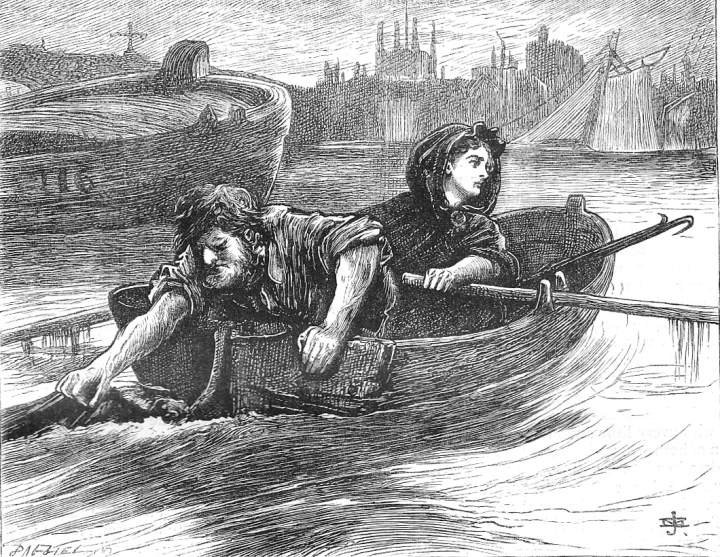
I need an inquest on said drowned girl; this is where the British Newspaper Archive comes in. There are drowned girls aplenty in London in the decade 1840-49. Poor things, dragged from the Thames, the Regent’s Canal, the Surrey Canal, the New River, the Serpentine, the lake in Regent’s Park, from under Waterloo Bridge – a favourite spot for those seduced and abandoned girls. There they lie stretched out on muddy shores and banks, their bonnets askew, one boot missing, or both, their faces pale like Millais’ Ophelia, or more likely, bloated and bruised, or half-eaten by decomposition – or rats. Their bodies sometimes float, buoyed up by petticoats – the effect of air retained by the clothes, or the presence of gases. Sometimes a thin hand grasps a clump of weed which, according to Professor Taylor, indicates that the victim went into the water alive. Did she fall or was she pushed? Suicide, most often.

I find the case of the suicide of two young sisters dragged from a Leeds canal in April 1847, tied together by a handkerchief. The handkerchief is pitiable somehow, and memorable. Dickens must have read of that case for he uses the same circumstance in Our Mutual Friend. Something of a thrill in contemplating that, but I need only one girl.

I need an unknown drowned girl, unclaimed, buried at the expense of the parish, and forgotten. Somewhere in a village, a mother wonders about her lost child. She will never know what became of her ruined darling. The Morning Post in February 1842 explains: ‘In London the bodies are taken to any obscure vault, public house, or police office. The Coroner directs the parish to advertise the body, often in vain.’

I find several cases of unidentified females in the newspaper archive. In July 1841, according to The Morning Advertiser, a young woman was pulled from the London Dock. She was never identified. I am intrigued by the report’s dark observation that ‘No one could walk into that water by accident.’ Unknown, too, is the identity of the ‘fine-made ’young woman taken from the Serpentine in October 1845 and deposited at St George’s Workhouse. Yet she has a distinctive mole on her left cheek, dark hair and hazel eyes. Surely somebody missed her. Seduced and abandoned, perhaps, like poor Eliza Luke found in the New River in April 1844.

However, this is a crime story, so, naturally, I need a drowned, unknown, murdered girl. This is more difficult. Such is the damage done by the water, or the bridge, or the rocks of some lonely reach that it is often impossible to find enough evidence of murder. However, there is the case of Eliza Rayment found in the River Thames in October 1847. There is a deep cut under her chin. Four inches in length, an inch in depth, so reports Mr Bain, the surgeon, at the inquest, and there are ‘two arteries divided’. The wound might have been inflicted by the deceased, but ‘a person using the right hand would naturally make an incision on the left hand side.’ Eliza Rayment was right-handed. Mr Bain attributes death to the loss of blood from the wound. Poor Emma Ashburnham who was formerly Emma Meyer had once lived ‘in some splendour’ in York Road under the protection of ‘a gentleman of fortune’, but it is not known how she came to be in the river at Waterloo Bridge with a deep and ugly stab wound in her side.

Blood brings me to Ellen Tyrell and her nose. Ellen was found in the Surrey Canal in August 1845. Mr John Hawkins, the surgeon, finds an abrasion on the right side of the nose, but from the decomposition of the body he is unable to distinguish any other external marks of violence. Given that she was seen in the company of a man, not her husband, the night before she disappeared, the inquest is adjourned for the purpose of producing further evidence.

Oh, Eliza Rayment, what a mystery, what a suggestive tale, a married woman whose whereabouts were unknown for some days before your death. Who were you with? Emma, who was that ‘gentleman of fortune’? Alas, neither of you is for me, and Ellen, your nose, telling though it is, does not serve my purpose. I am ‘Oh, that I had been content with a cut throat, or a stabbing, but, in the interests of my plot, the victim must be strangled or I must rewrite the whole damned thing.

There is evidence I do like: the 1847 case of the unknown drowned young woman wearing a false plait at the back of her hair; the one in 1842 in which an umbrella is found nearby, bearing on its ivory handle the initials ‘F.H.’ And I like especially, the single earring she is wearing. I have a fancy for a single ruby like a drop of blood in my victim’s ear.

I dig deep into the newspaper archives and I find it – just the one, and the indefatigable Mr Bain is on hand to assist. The body was found in October 1848 near Battersea Bridge, much decomposed, appearing to have been in the water some time. Nevertheless, Mr Bain finds evidence of a ligature encircling the neck, though what this might have been he cannot say.

It is quite enough for me. Possible death by strangulation.

Oh, all right, I admit it: the body was that of a sailor. But, it did happen. Evidence of a ligature was found. I’ll just have to put an ‘s’ before the ‘he’. No one will know.

‘F.H.’? Names: Fanny? Florence? Flora? Ah, here’s a name in the archives: ‘Harvest’. I have her: Flora Harvest, the Grim Reaper cometh.

The Murder of Patience Brooke by J. C . Briggs