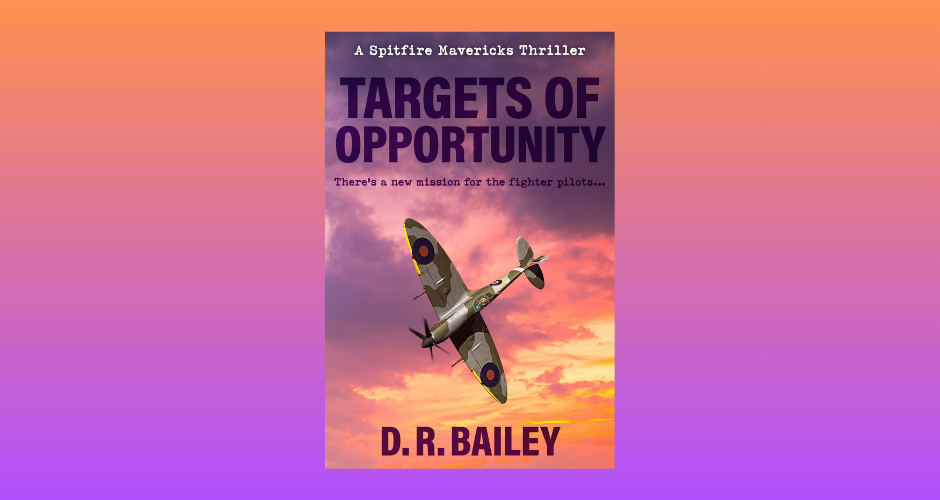
Congratulations to D. R. Bailey, whose thrilling wartime adventure, Targets of Opportunity, is out now!
Targets of Opportunity is the seventh book in the Spitfire Mavericks Thrillers series: action-packed aviation novels set during the Second World War and featuring a team of vigilante pilots.
Spring, 1943
Flight Lieutenant Angus Mackennelly and his squadron have been given a new mission. The Mavericks are to attack ‘Targets of Opportunity’ under the umbrella of Operation Wagtail.
The War Office wants to capitalise on the Germans’ defeat by the Russians at Stalingrad earlier in the year by harassing them in Northern France and the Low Countries.
Military targets are now on the table. The modus operandi will be to fly in, strafe the targets and get out all under the radar.
The first mission of Operation Wagtail goes ahead. But while the pilots are away, personal items go missing from the mess.
Angus is worried about a security breach.
Are his men under threat? Who is stealing from them?
And will the sense of mistrust interfere with the operations in the skies…?
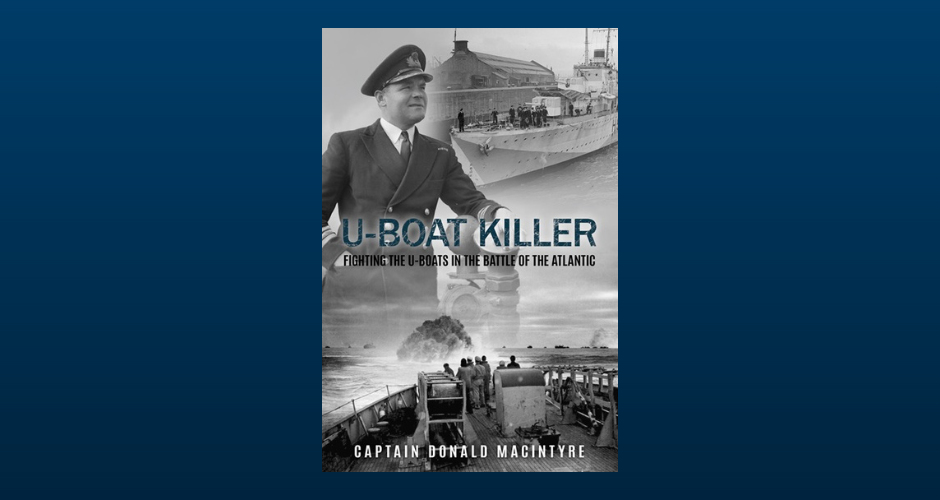
Between 1940 and 1944, Donald Macintyre was among the most successful submarine hunters in any Allied navy, transforming the Battle of the Atlantic with his successes against the U-boat menace. To commemorate the eightieth anniversary of the end of World War Two, Donald’s daughter, Dani, shares a personal memory from her father’s life after the conflict.
In 1960, when Dad was employed by MGM as Nautical Advisor on Mutiny on the Bounty starring Marlon Brando and Trevor Howard, he left my mother in charge of the pig farm. I can only suppose that she felt annoyed to be left with this responsibility, because she sold all the pigs and demanded a flight to California!
Dad complied, and I was able to join them for a fascinating holiday, mainly spent in Culver City’s MGM Studios every day. I watched the crew film scenes of a half replica of the Bounty on rollers, with wind and water machines simulating a storm on the high seas. To my joy I also spent time with the crew of Rawhide, a Western TV series. They made a fourteen-year-old girl feel very welcome!
If you have ever watched Mutiny on the Bounty, you might have noticed that in one scene Marlon Brando comes out of his cabin wearing a ridiculous red velvet smoking jacket. When Dad was asked to approve this costume change, he said it would never have been acceptable in those days. Hollywood being Hollywood thought it made handsome Marlon irresistible, so they kept it in. This made Dad wonder what he was being paid for, apart from sitting and playing cards with Gordon Jackson in Tahiti!
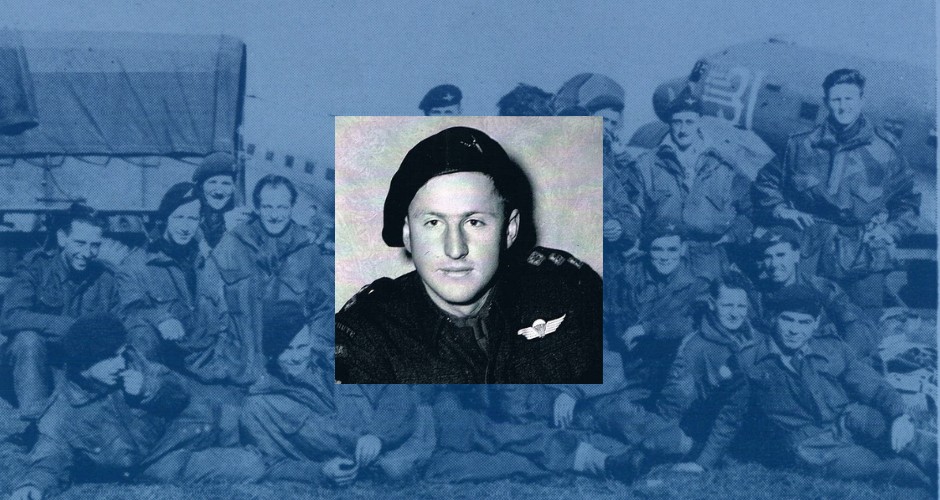
Canadian paratrooper Leo Heaps (1923–1995) was seconded to the British Army during the Second World War and participated in the Battle of Arnhem. He was captured by the Germans and upon his escape, his work with the Dutch Resistance to help rescue hundreds of Allied soldiers behind enemy lines resulted in his being awarded the Royal Military Cross for “outstanding gallantry”. To commemorate the eightieth anniversary of the end of the Second World War, Leo’s son Adrian reflects on his father’s life in 1945.
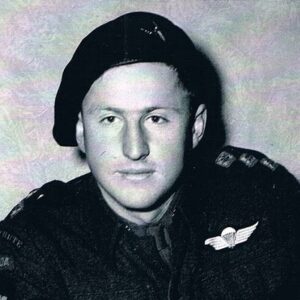
Leo Heaps
In 1945, Leo Heaps was just twenty-two, a young Canadian whose experiences in the Second World War shaped him into the complex figure I knew.
Born in Winnipeg in 1923, growing up as the son of Abraham Albert Heaps, a prominent Parliamentarian, wasn’t easy, but Leo forged his own path. Educated at Queen’s University, the University of California, and McGill, he was restless by 1944, bored with the Canadian Infantry Holding Unit. His commanders underestimated him, calling him “not of officer caliber, no initiative, not aggressive enough.” Sarcastic and defiant, he failed to qualify for the Infantry. His father urged him to work on his aunt’s farm, an exemption from service, but Leo sought action. He volunteered for the CANLOAN program, seconding Canadian officers to the British Army, a choice that plunged him into Operation Market Garden.
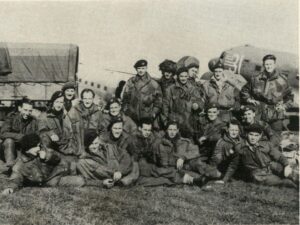
Leo (upper right) before his first jump into Arnhem
In September 1944, Leo joined the British 1st Airborne Division, commanding the 1st Parachute Battalion’s Transport — without ever having jumped before. He described his first drop on 17 September 1944 with vivid clarity: “I floated down gently from heaven at 1:30 p.m. on Sunday… The sun shone, the fields of Wolfheze were bathed in warm light and the green meadow bloomed with large bursts of yellow sunflowers.” That beauty was short-lived. The Battle of Arnhem, part of a failed plan to seize Rhine bridges, ended in defeat. Captured by the Germans, Leo didn’t stay a prisoner for long. With the help of the Dutch Resistance, he escaped, hiding in a chicken coop at Ennyshoeve. There, he met members of the Resistance risking their lives for Allied evaders.
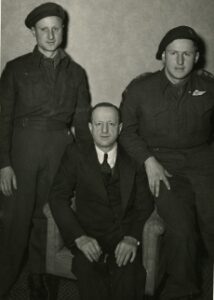
Leo with his father and brother David
His work with the Dutch Resistance earned him the Military Cross, a rare honour for a Canadian in British service. His brother, David, also received the Military Cross, making them the only Jewish brothers during the Second World War to win the decoration. Leo’s role in Operation Pegasus, the escape of over 100 Allied soldiers across the Rhine, was a triumph he chronicled in his book The Grey Goose of Arnhem. He called it “the most amazing mass escape of World War II.”
But some memories were harder to share. In April 1945, Leo was among the first to enter Bergen-Belsen concentration camp after the Germans fled, leaving behind a typhoid outbreak and unimaginable suffering. As a Jewish soldier, the sight of skeletal survivors, the stench of death, and the chaos of the camp struck him profoundly. In Escape from Arnhem (1945) he described the eerie silence broken by the groans of the starving, the piles of unburied bodies, and the desperate eyes of those clinging to life. The scale of the horror overwhelmed him. He rarely spoke of Belsen, but when he did, his voice was subdued. I can picture him there, a young man of twenty-two, confronting a darkness that no one could fully process.
Leo with his father following his decoration
By May 1945, Leo was no longer the kid who frustrated his commanders, but a decorated veteran, a survivor of capture, combat, and collaborator with the Dutch underground. However, the war left its mark on Leo in what we now recognise as PTSD. The loss of friends killed by the Germans ushered a quiet guilt for those surviving when so many didn’t. Yet Leo channelled his unease into action, as if movement could keep the ghosts at bay. His writing, his adventures, his relentless drive — they were, in part, his way of coping with a war that never fully left him.
In 1994, my son and I accompanied Leo to Arnhem for the fiftieth anniversary, as one of forty Canadian veterans. I often wonder what he felt in those sunflower fields, thinking of his lost comrades and his own life’s pursuits. Some of these feelings can be found in his records and letters in the Ontario (Canada) Jewish Archives, which offer a glimpse of the man and the many moments beyond his stories.
Leo died in 1995, leaving a legacy I’m still unravelling. In 1945, he emerged from the war not just as a survivor but as a storyteller who gave voice to the unsung. His books are a testament to a war that left its scars, but also of the man who became my father.
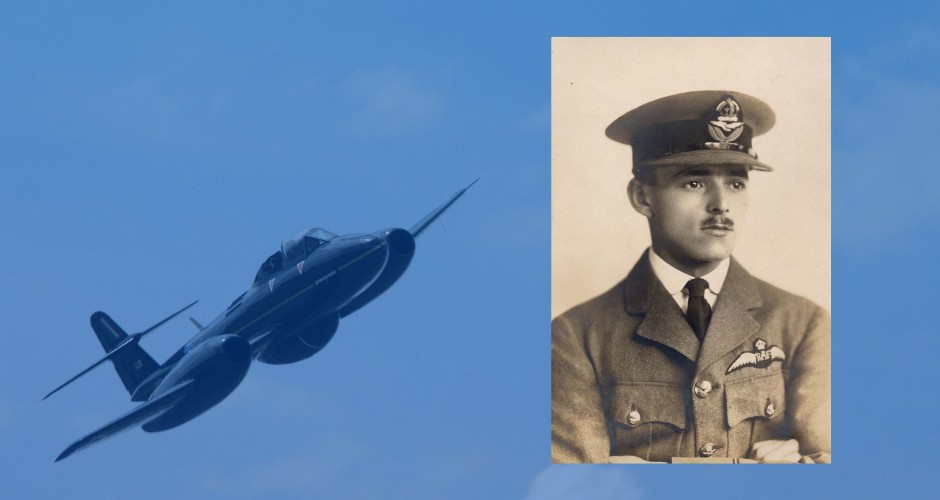
Air Commodore Roderick Chisholm, CBE, DSO, DFC & Bar (1911–1994), author of Cover of Darkness, was a night fighter pilot, flying ace and a highly decorated British airman of the Second World War. To commemorate the eightieth anniversary of the end of the Second World War, his son Julian reflects on his father’s life in 1945.
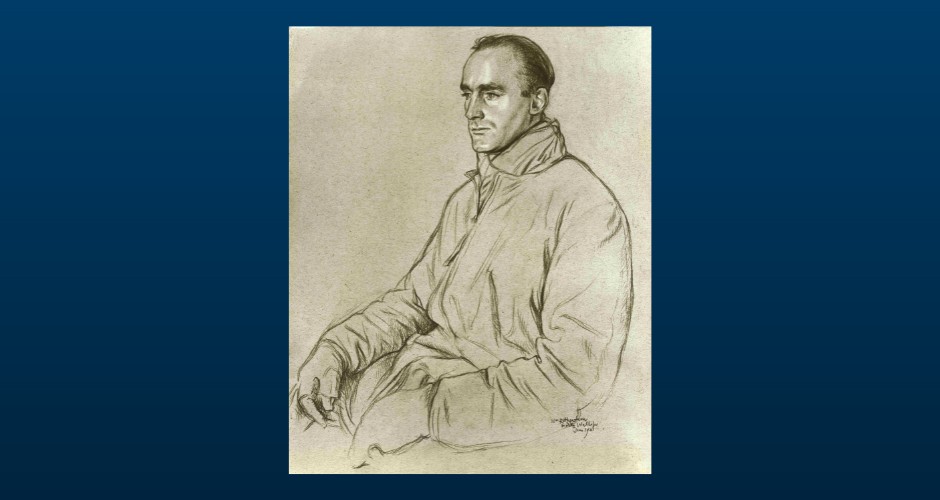
Roderick Aeneas Chisholm by Sir William Rothenstein. Image used with permission from Museums Sheffield
In 1930 Roderick Chisholm joined 604 Squadron of the Royal Auxiliary Air Force. He learnt to fly and was commissioned as an officer. He left the squadron in 1935 when his work took him to Iran. Before rejoining his squadron in late June 1940, he took a refresher course to become a night fighter pilot and fly the squadron’s Blenheims. During the war, while flying Beaufighters and Mosquitos, he shot down nine enemy aircraft with the assistance of his airborne observers and the ground controllers, he commanded the Night Fighter Interception Unit at Ford, and was the second-in-command of Bomber Command’s 100 Group, which was charged with defending RAF bombers over enemy territory. He recorded his wartime experiences in Cover of Darkness, which was first published in 1953.
Immediately after hostilities ended, Roderick led a team of twelve charged with gaining as much intelligence as possible about the impact of 100 Group’s radar-assisted night fighters, Mosquitos, and Radio Counter Measures. The team did their work at the final base of the Luftwaffe in Schleswig, just before it was disbanded and its personnel transferred to POW camps. They carried out interrogations of Luftwaffe night fighter commanders and pilots, observers, flight controllers and technicians, held technical discussions, and examined the vast number of German aircraft parked on the airfields. The team gained confirmation of the effectiveness of 100 Group’s efforts, and had the satisfaction that as a result RAF losses were significantly reduced. The Mosquito had an awesome reputation amongst the German airmen.
Major Schnauffer was one of the pilots whose interrogation Roderick witnessed. Schnauffer was a brave and skilful night fighter pilot who was credited with shooting down no less than 124 bombers in defence of his country. He wore uniform, and on the last day the Germans were allowed to wear medals, he wore the highest order of the Iron Cross around his neck. The exchanges with the Germans were generally civilised and friendly, but my father could not ignore that they were Nazis, and that nearby were camps for Russian prisoners living in ghastly conditions, and mini-Belsens for Jews and other displaced persons.
Roderick’s mission complete, he flew back to Norfolk. While doing so, he envisioned a future Europe in which frontiers would mean no more and individual nationalities were less important, as per the multi-national squadrons of the Battle of Britain. After the collapse of France in 1940, British, French, Belgian, Czech, Polish and other nationalities had flown in harmony in polyglot fighter squadrons. Their aims were identical, and their understanding effective thanks to the basic English of the radio. Sadly, later, as national squadrons were formed, national identities asserted themselves and the unity achieved in the Battle of Britain became compromised.
In September 1939 the twenty-year-old John Wooldridge, then a Sergeant Pilot, took part in the British air raid on Kiel, the first raid of World War Two. Having brought his damaged aircraft home safely, he was awarded the Distinguished Flying Medal. Commissioned in August 1940, he rapidly rose to the rank of Flight Commander, flying Lancasters as a Flight Lieutenant. In the middle of 1942, for his part in the 1,000-bomber raid on Cologne, he was awarded the Distinguished Flying Cross.By the end of the War, he had flown 97 missions over enemy territory. To commemorate the eightieth anniversary of the end of World War Two, John’s daughter and son, Susan and Hugh, share their memories of him below.
John Wooldridge
On 9th and 10th May 1944, our father, Wing Commander John Wooldridge DSO, DFC*, DFM, returning from New York where his music was being performed at Carnegie Hall, flew over the Atlantic in a Mosquito, taking off from Goose Bay, Canada and landing six and a half hours later in Ballykelly, Northern Ireland. In so doing, he broke the then speed record for crossing the Atlantic.
The Air Ministry, unsure what to do with this daring twenty-five-year-old, told him to lie low but, within a couple of days, they’d been outflanked by the Press and the story was all over the newspapers. As our father writes in his diary for Sunday 14th May: Ye gods, what a splash! Headlines, pictures…
Meanwhile, on Monday 15th May in a London hairdresser, our mother, the distinguished British actress Margaretta Scott, was having her hair done. Whilst under the dryer, she read the story in the London Evening Standard of this amazing trans-Atlantic flight. But what really caught her eye was that the pilot was also a composer of serious music, who had composed a work for Narrator and Orchestra called The Constellations.
‘That’s my boy!’ she cried, as Sir Henry Wood had recently asked her to find a new work for Narrator and Orchestra for his upcoming Promenade Concerts, and she felt that The Constellations might be just the job.
Our mother immediately approached the Air Ministry, but they refused to give out the personal details of the record-breaking flyer.
The story would have ended there if, a couple of days later, at Denham Film Studios where she was making the film Fanny by Gaslight, our mother had not given a lift to a film publicist who, on their journey back to London, had boasted that he’d just been given a camembert cheese flown across the Atlantic by a friend, one John Wooldridge.
‘Bring him to tea!’ she cried. And the next Sunday, there was our father on her doorstep — and that was it! For the next fourteen years until our father’s sudden death in a car crash in 1958, our mother and father were as inseparable as their young family and busy work schedules would allow.
In the 1950s, Margaretta Scott continued to star in plays and films whilst John Wooldridge wrote his music and plays and films. One of his most important films was the 1953 film starring Dirk Bogarde, Appointment in London, about a Royal Air Force Bomber Command squadron, for which he wrote both the screenplay and the music score. To this day it continues to be screened to great acclaim and serves as a memorial to Bomber Command by one of their own.
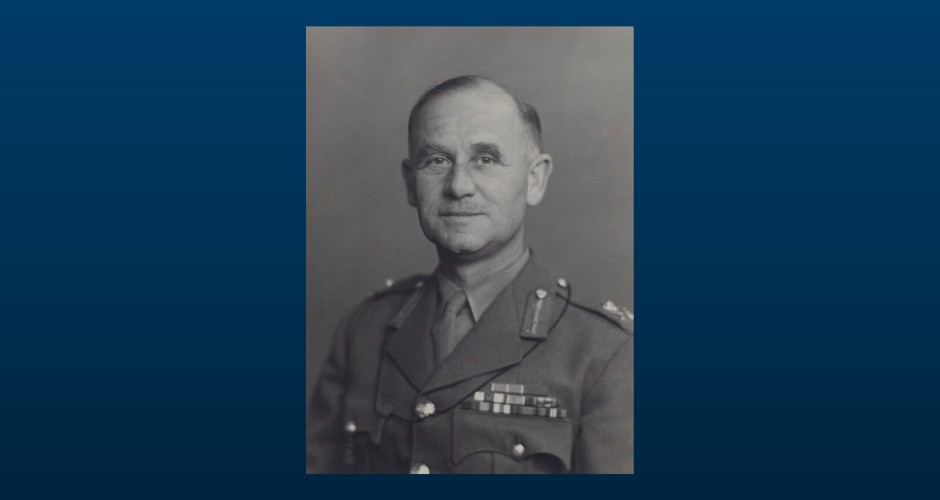
Major-General Hubert Essame, CBE, DSO, MC (1896–1976) was a British Army officer who fought in the First and Second World Wars. Following his retirement from the army, Hubert lectured in military history at King’s College London, and published several books and articles. He was also an advisor to television producers for military programmes. To commemorate the eightieth anniversary of the end of the Second World War, his granddaughter Antonia shares her memories of him below.
Hubert Essame
Brigadier, later Major-General, Hubert Essame led 214 Independent Infantry Brigade, part of 43rd Wessex Division, in the capture of Mont Pincon, the key to Normandy, as well as of Hill 112, the successful yet most costly single battalion action of the Overlord campaign.
He was a sharp-witted and determined man remembered by the actor and raconteur Dirk Bogarde, his one-time liaison officer, for his “brilliant blue eyes and tongue like a whip”. He had a caustic sense of humour and was a formidable leader from the front.
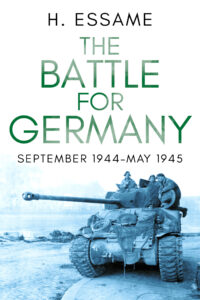
Soon after the war, Hubert wrote the Division’s official history, The 43rd Wessex Division at War, 1944-45, and later Battle for Normandy, Normandy Bridgehead, The Battle for Germany, and a biography of General Patton. His perspective as a leader of troops into battle, alongside his use of a wide-ranging variety of sources as a historian, makes for a great read even for those who know about Operation Overlord.
His 214 Independent Infantry Brigade, which together with 129 and 130 Brigade and their supporting arms formed Major General Ivor Thomas’s 43rd Wessex Division, were in turn part of the XXX Corps commanded by Lieutenant-General Sir Brian Horrocks all the way from Normandy to Bremerhaven.
The Wessex Division story spans the stormy Overlord crossing and later the crucial Battle for Hill 112. This point south-west of Caen was defined by Eberbach, commander of Panzer Group West, as the “pivotal point of the whole position” and it saw the first of the grim battles of attrition immediately following Caen’s fall. The battle involved heavy casualties and tested the 43rd Division against some of the most seasoned German divisions, well dug in and skilfully hidden.
Road and rail lines lay at right angles to the direction of advance. The bocage of tiny, often boggy fields with sunken lanes and thick hedges reduced visibility for artillery and impeded all movement. And it was high summer. Hubert describes vividly how he crawled forward in the August heat to assess Mont Pincon’s southern slopes before its eventual capture by the Division and 8th Armoured Brigade.
Hubert was a writer whose extraordinarily immediate account includes, for example, the information he gained from German prisoners, subsequent revelations about Hitler’s orders to his generals, and his own point of view at the head of 214 Brigade. His perspective sheds light on some of the huge challenges of the campaign, such as that of establishing a key bridgehead over the Seine at Vernon despite the civilian population’s determination to celebrate as though the campaign was already won.
214 Brigade fought on through northern France and the Netherlands, including Operation Market Garden, and were among the first Allied troops to enter Germany. They played a key part in the turning of the tide in the Reichswald. I am proud that ‘Brigadier Twinkletoes’ was my grandfather and attempt to read across from his high standards of resolve and determination to the greyer demands of the here and now.
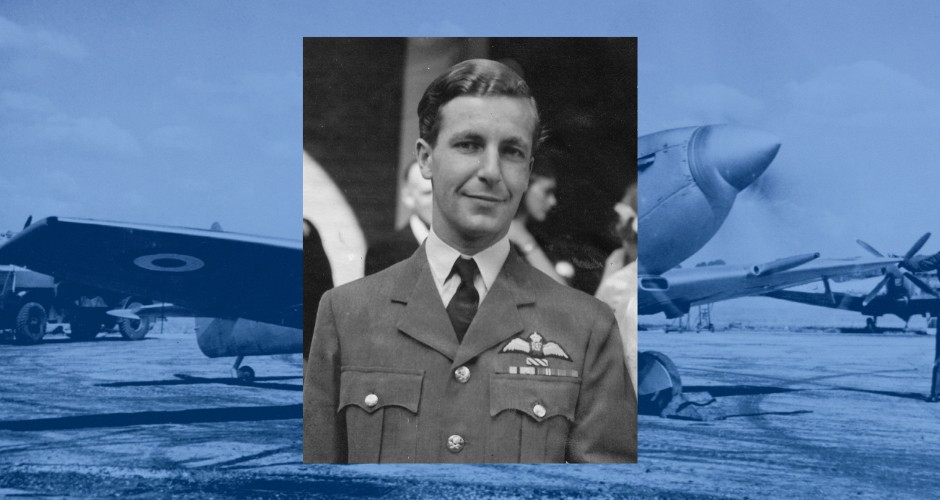
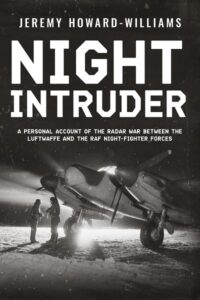
Jeremy Howard-Williams DFC (1922–1995), author of Night Intruder, had a distinguished career in the RAF as a night-fighter pilot during the Second World War and was awarded the Distinguished Flying Cross for gallantry. To commemorate the eightieth anniversary of the end of the Second World War, Jeremy’s son, Anthony Inglis Howard-Williams, reflects on the arrival of peace in 1945 and how it influenced his father’s life.
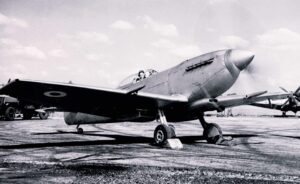
Jeremy Howard-Williams warming up the engines of a clipped wing Spitfire
When peace came to Europe in May 1945, Flight Lieutenant Jeremy Howard-Williams DFC was stationed at HQ, 11 Group Uxbridge. Three days before Germany’s unconditional surrender, a party was held to celebrate peace. Jeremy and his brother Peter did so by marching a guest — Flight Lieutenant Andrew from RAF Intelligence — between them up and down an anteroom. The junior flight lieutenant just happened to have been their pre-war boarding school housemaster, and the brothers had found it too good an opportunity to miss. When, years later, he was asked how the lieutenant had taken the ribbing, Jeremy replied, “with remarkable good humour!”
Jeremy at his wedding in 1951
Like so many in 1945, Jeremy was headed for an uncertain future. With peace came the pressing question: what happens now? For most, life outside of the forces beckoned. With millions demobilising, the assimilation of those who had been at war back into civilian society became one of the new post-war government’s biggest challenges. For those who did not want to leave the forces came a different challenge. With Jeremy’s father a retired RAF pilot, Peter a Battle of Britain day-fighter pilot and Jeremy a night-fighter pilot with the Fighter Interception Unit — an elite force at the forefront of the RAF’s early experiments with radar equipment — both brothers understandably wished to remain serving.
With the Royal Air Force downsizing, deployment meant less flying — not a very exciting prospect for a twenty-three-year-old war veteran. Jeremy had specifically joined the RAF in order to fly when the Nazis had tried to seize control of Western Europe. However, in the new modern era of the jet engine, aircraft were flying ever faster and higher. Now that was exciting!
In the end, both brothers remained in the RAF. Jeremy was first posted in an admin job to Singapore during the Malayan Emergency, where he met his wife, uniting two distinguished RAF families. He later worked as an assistant air attaché in the Paris and Berlin embassies. He did fly during these postings, but mainly a desk. He resigned in 1957.
Ultimately, Jeremy’s parents divorced and his father remarried into the Ratsey family, where Jeremy became sales manager for the famous sail-making firm Ratsey & Lapthorn in Cowes on the Isle of Wight. After leaving the company, he wrote many authoritative books on sailing, as well as Night Intruder, republished by Sapere Books, a personal account of his wartime service as a pilot and the radar war between the RAF and Luftwaffe night-fighter forces.
Sir Frank Whittle, author of Jet: The Story of a Pioneer, was a Royal Air Force pilot and aviation engineer known as the inventor of the jet engine. He obtained his first patent for a turbo-jet engine in 1930, and in 1936 co-founded Power Jets Ltd. In May 1941, his engine was fitted to a Gloster E.28/39 airframe — the plane’s maiden flight from RAF Cranwell in Lincolnshire heralded the beginning of the jet age. Frank retired from the RAF in 1948 with the rank of air commodore, and that same year he was knighted. He was awarded the Order of Merit in 1986. To commemorate the eightieth anniversary of the end of World War Two, his son Ian reflects on Sir Frank’s life in 1945.
Frank as a junior officer in 1929, when he proposed the turbojet
My father’s company, Power Jets, was nationalised in 1944. From then until 1946, he was on the board of the government company that emerged under a slightly different name. At the time, he was working on the design for the aft-fan engine that also incorporated the after-burner system he had patented in 1936 — the modified W2/700. This was expected to propel the experimental Miles aircraft (M52) intended to be the first in the world to go supersonic. He was also working on the development of what would have been the world’s first hi-bypass turbo-fan engine — the LR1. Both projects were cancelled by the government in 1946 — as was the M52. These decisions resulted in Frank resigning from the board and putting himself in the hands of the RAF to do whatever they would wish him to do.
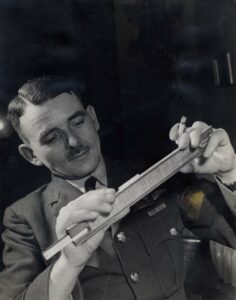
Frank holding his slide rule
1945 was a year of change for my father. He was still a serving officer in the RAF, but Power Jets had become publicly owned and entirely dependent on government funding. He found himself subject to the needs of the large independent aero-engine manufacturers who objected to a government company in competition. However, on three occasions he briefly got away from it all and flew the Meteor jet fighter. Apart from the Wright brothers, he was the first person to pilot an aeroplane powered by an engine of his own design. At other times, he found himself sent off to deliver lectures at various venues to describe the impact and differences when changing from piston engine/propeller propulsion to jet propulsion.
As a little boy, I remember him coming home after flying the Meteor along the high-speed run at Herne Bay. “How fast did you go, Daddy?” I asked. “Oh, about 450,” he replied. “Is that all?” I said with some disgust, and turned away to do whatever it was that I was doing. I had expected him to tell me 600 miles per hour. When I asked him about this, many years later, he said he was quite crestfallen by my reaction. He also explained that, as he was flying at about 50 feet above the surface of the sea, he really was unable to pay much attention to his airspeed indicator — his attention was focussed on keeping the aeroplane steady and level. And anyway, he would have been speaking of knots, not mph!
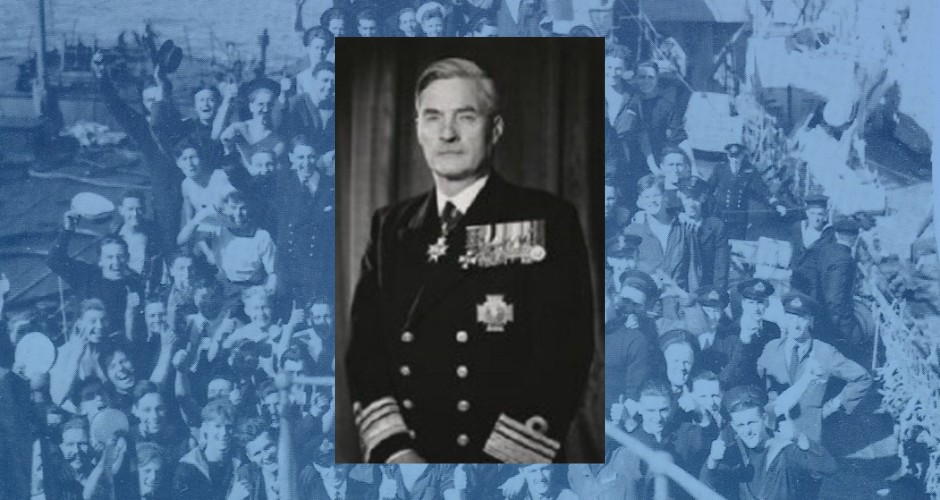
Sir Peter Gretton DSO** OBE DSC (1912–1992) was an officer in the Royal Navy. He was active in the Battle of the Atlantic during the Second World War, and was a successful convoy escort commander. He eventually rose to become Fifth Sea Lord and retired as a Vice-Admiral before entering university life as a bursar and academic.To commemorate the eightieth anniversary of the end of World War Two, Sir Peter’s son, Vice-Admiral Mike Gretton, shares his memories of him below.
Lieutenant Commander Peter Gretton with the Ship’s Company of HMS Wolverine
On 8 May 1945 — Victory in Europe Day — Peter Gretton was thirty-three years old and utterly exhausted. He had been continuously in seagoing appointments since the outbreak of war in September 1939. He had married Wren Judy Du Vivier in 1943 during a short break between convoys, and they had had their first child, Anne, who was not yet one year old. They were renting a flat in Kensington so that he could readily get to work: his job at the time was in the Joint Planning Staff in the Cabinet Office working on strategic plans to end the war in Europe and then in the Far East — not exactly a rest cure.
Peter had served continuously in seagoing ships from September 1939 until he came ashore in March 1944 — still only thirty-one years old. He had served in five ships during that time, starting as a First Lieutenant, including HMS Cossack in which he was mentioned in Dispatches for his performance during the Second Battle of Narvik under the very demanding Captain Philip Vian VC. From February 1941, he was in command of destroyers, starting with HMS Sabre in which he was awarded an OBE, and then HMS Wolverine (March to November 1942) when his ship was an escort for Operation Pedestal, the relief of Malta. He was awarded his first DSO for ramming and sinking an Italian submarine at the expense of wrecking his bows and having to proceed astern to port at Gibraltar.
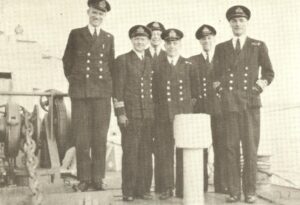
Commander Peter Gretton with the Commanding Officers of ships in B7 Escort Group
From there, he was recalled to the UK as a Commander to become the Senior Officer of Escort Group B7, to be based in Derry, and he initially embarked on HMS Duncan. The Escort Group supported Atlantic convoys for two years and five months. He was awarded the two bars to his DSO during that time, the first of which reflected the successful battle for convoy ONS5, which historians regard as the tipping point in Allied fortunes in the Atlantic convoy campaign.
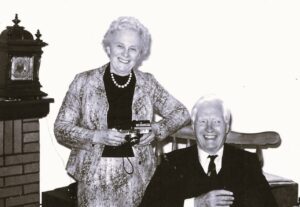
Peter with wife Judy in 1965
In March 1944, Peter dedicated himself to writing a new book — The Admiralty Convoy Instructions — based on his and others’ experience at war, with a readership in the Royal Navy, Royal Air Force and Merchant Navy. This became the bible for convoy protection and the same book, with minor amendments, was the basis of my own training as a naval officer in the 1970s.
Peter and my mother rejoiced exuberantly at the victory in Europe: he writes that they ‘walked up Picadilly and thence to St James’ Park … remarkable scenes’. They would have reflected proudly on their own contribution to the outcome: my father at sea and my mother as a Wren in the Western Approaches Tactical Unit (WATU), which developed and taught tactics for the Atlantic battle. I was born nine months after VE Day, in March 1946.
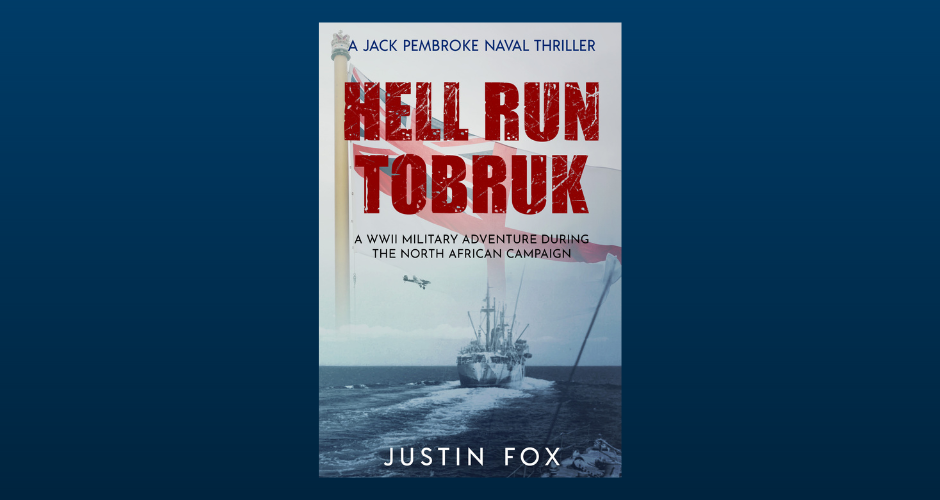
Congratulations to Justin Fox, whose thrilling military adventure, Hell Run Tobruk, is out now!
Hell Run Tobruk is the third book in the Jack Pembroke Naval Thriller series: authentic British Navy war stories set during the Second World War.
December, 1941
Lieutenant Jack Pembroke is ordered to join a convoy and sail his small escort ship, HMSAS Gannet, from the Royal Navy base in Simon’s Town, South Africa, to Egypt.
With the Mediterranean all but closed to maritime traffic, and Rommel’s forces rampaging through North Africa, it seems unlikely that Gannet will survive the coming battles.
Jack arrives in Alexandria and is soon thrust into the action, escorting ships running supplies to the beleaguered town of Tobruk in Libya.
With the pressure building and ships around him being sunk by enemy bombers, Jack must deal with his own PTSD while leading his men to safety.
And with Tobruk surrounded, about to fall to Axis forces, Gannet is still trapped in the port…
Can Jack lead his men to safety? Will he make it out of Tobruk in one piece?
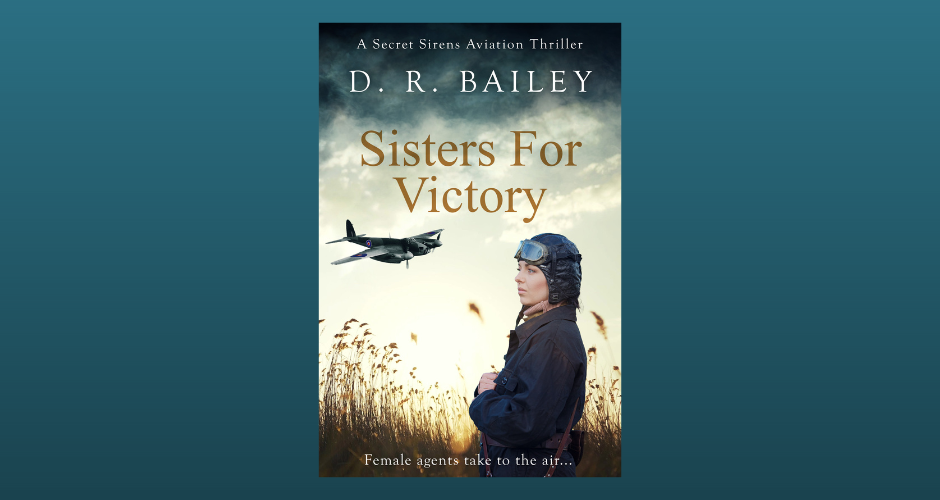
Congratulations to D. R. Bailey, whose thrilling aviation novel, Sisters For Victory, is published today!
Sisters For Victory is the first military adventure novel in the Secret Sirens Aviation Thrillers Series, heart-pounding Second World War escapades with strong female leads.
Autumn, 1942
With the reserves of male pilots ready for combat rapidly dwindling, England’s secret service decide to try something revolutionary. They are going to send female pilots into combat.
MI6 put Wing Commander James Donovan in charge of the ‘Sirens’. Outwardly, the women chosen appear to be assisting in the transporting of planes, but this is just a cover. In reality, they will be flying secret RAF combat missions into enemy territory.
Sisters Anna and Jennifer Nightingale are two of the early recruits into the Siren Squadron. They have grown up flying Tiger Moths as part of their father’s aerial display team, and now they need to get to grips with battle-ready Mosquitos.
Once trained, the Sirens are sent out on their first mission. But it soon becomes clear someone is sabotaging their aircraft.
Can the Nightingale sisters prove they deserve to fight alongside their male counterparts? Will they lead the way for women at war?
Or will the odds be too heavily stacked against them…?
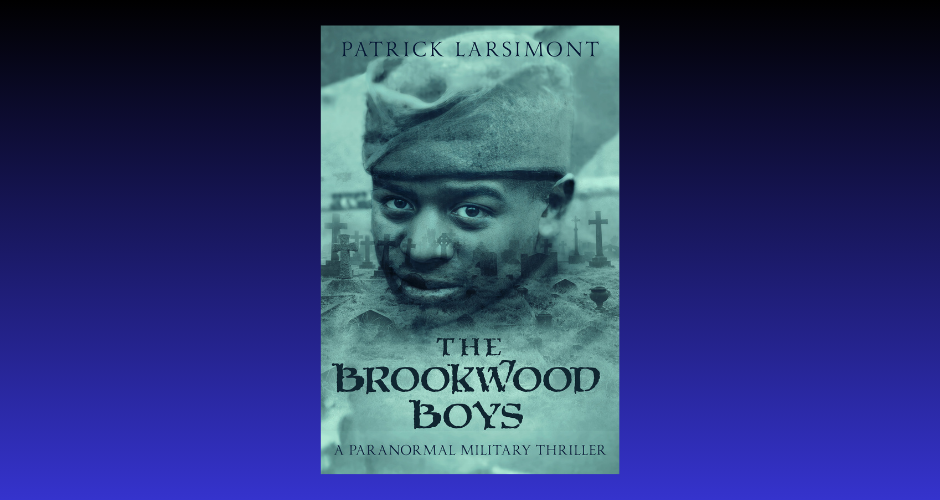
Congratulations to Patrick Larsimont, whose paranormal military thriller, The Brookwood Boys, is out now!
Surrey, England, 2019
Tennessee soldier Maurice ‘Mouse’ Forsyth has been watching over Brookwood Cemetery ever since his untimely death in 1917. For over a hundred lonely years, he has become the caretaker of lost souls, welcoming the good as well as the evil, the damaged, the mad and the bad.
But now something strange is happening. For the first time, Mouse seems to be able to communicate with the living. The head gardener’s teenage son, Luke, has seen him.
Overwhelmed, Mouse tries to find a way to communicate with him. But before he can, Luke’s friend Matilda – a sad girl who has often been seen alone in the graveyard – goes missing.
Mouse wants to help Luke, but he has never interfered with the world of the living before.
Leaning on the other spirits in the military cemetery, whose sad past lives are gradually revealed, Mouse is determined to find Matilda.
But the outcome may not be what he was hoping for…
Will Mouse find a way to speak to Luke? Can he help discover what happened to Matilda?
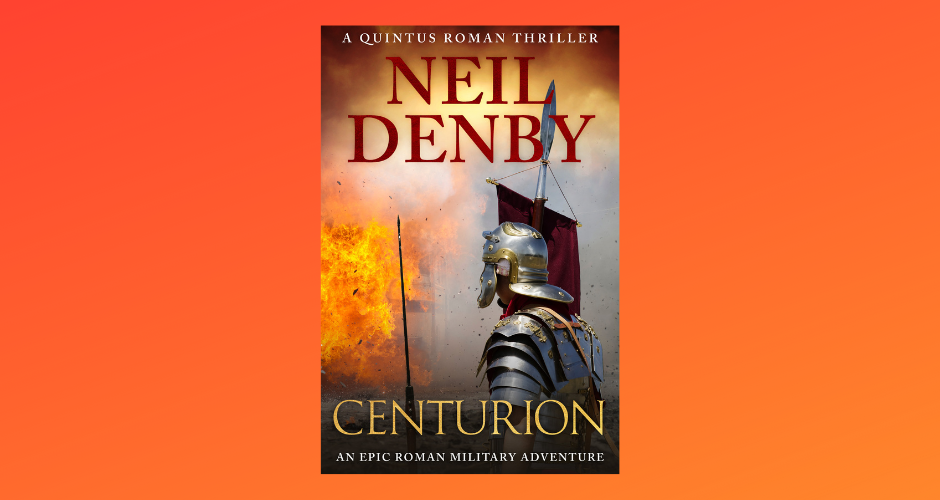
After wintering in Germania, Julius Quintus Quirinius is commanded to gather up the remains of his cohort and meet with General Drusus, who is marching with many legions west down the Rhine from the Alps.
But treacherous enemies and the fickle gods of the weather combine to slow them down. And a new force, led by a mysterious freedom fighter, is organising the local tribes against them.
Desertion plagues them and when the cohort commander is captured, Quintus and the other centurions have decisions to make.
They need to rescue their commander and destroy the fortress where he is being held, but they also need to lead the men to the Alpen passes that point to Rome and home.
Quintus has faith in his companions and knows they respect him in return. But he doesn’t want to test their loyalty by making an unpopular decision.
Can Quintus lead his cohort to victory – and their homeland?
Or will Rome once more remain beyond their reach…?
My writing has two modes, much like the clock, British Summer Time and Greenwich Mean Time. Living by the sea in Dorset, the weather rather sets the mood and often my productivity.
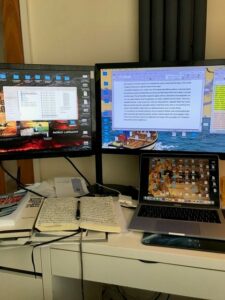
In the winter, when it’s darker, I get up early and write directly onto my computer. Earlier this year, I acquired two largish monitors, which I have side by side on a stand, below which I have my MacBook Pro. My desk is invariably covered in paper, notebooks and little bibelots that keep me interested, amused and inspired.
When I glance at the nearby window ledge, I see a toy metal Spitfire in desert camo with a spinning propellor, and a pair of painted tin soldiers (not by me), one a bagpiper in full regalia, the other a 1940s RAF pilot, inscribed on the bottom as ‘Hurricane Ace, Battle of Britain.’ Finally, there’s my grandfather’s little silver boar, a memento of his own service during the war. It bears the motto, ‘Résiste et Mords,’ which got him through many battles and the camps. He’s gone now, but just seeing that pig always rids me of any writer’s block, knowing full well that I’ve had it much easier than him.
In winter mode, I stare at a radiator and the world comes to me through my monitors, making me feel like some sort of chaotic air traffic controller. Heaven help the pilots in my care, although old Jox McNabb is holding his own. I generally aim for twelve hundred words a day and have a weekly target of at least five thousand. It’s a cadence I can manage and feeds my nature as an impatient man.
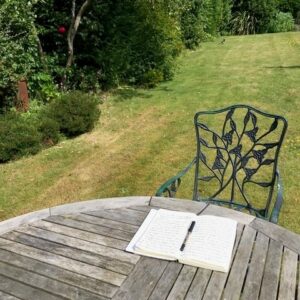
Patrick’s summer writing area
In the summertime, the process becomes two-staged. I write first in my notebook, in terrible doctor-style handwriting, sometimes so awful I can’t even decipher my own hieroglyphics. I can write anywhere — on the beach, at a coffeeshop (rarely) or in our garden (most often), and train journeys are good too. I don’t get too comfortable and like to just write, setting myself the target of twelve notebook pages per session. I then type up, embellish and edit whenever I fancy. Generally, I do about four drafts, plotting out a rough chapter breakdown at first, with two or three sentences for each. Invariably, that synopsis changes, with chapters budding off like yeast.
For inspiration, I depend on the internet and my constantly growing pile of to-be-read books, but often I just make stuff up. A lifetime of blagging it helps. When working on the laptop and monitors, the lure of ‘rabbit holes’ is great, and I can disappear for hours, but when grinding through with the notebook, I try to avoid that, although I do usually have my smartphone in my pocket.
If I did have a writing approach, it would probably be something like Nike’s ‘Just Do It’ (that’s the old adman in me), but ‘Résiste et Mords’ would probably do too.
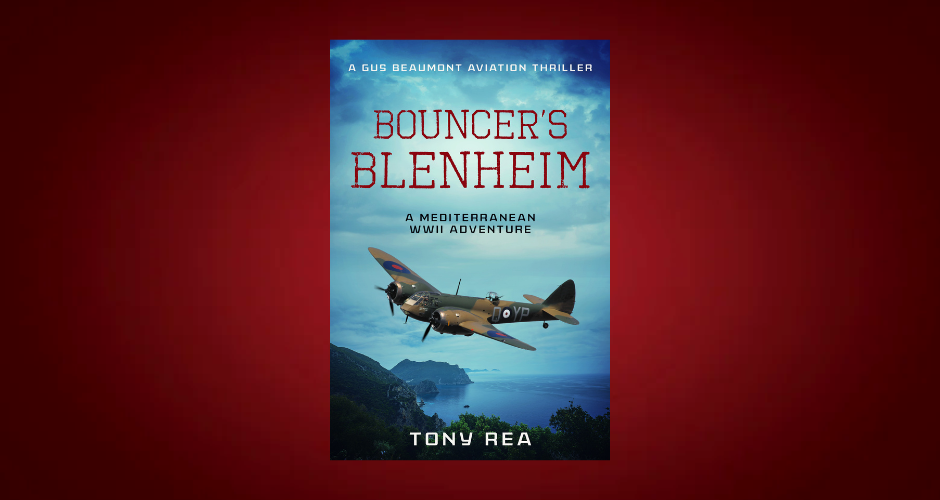
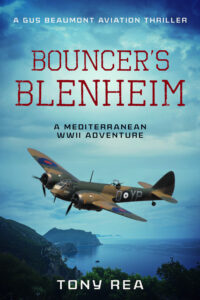
Congratulations to Tony Rea, whose thrilling fighter pilot adventure, Bouncer’s Blenheim, is published today!
Bouncer’s Blenheim is the second book in the Gus Beaumont Aviation Thrillers series: action-packed military novels set during the Second World War.
Europe, 1940
After surviving the Battle of Britain, fighter pilot Gus ‘Bouncer’ Beaumont has been promoted to Flying Officer and is posted to a Spitfire reconnaissance squadron.
That is, until Wing Commander Peacock creates another mission for him.
A new top-secret unit called the Special Operations Executive has been formed to gather intelligence on the enemy. And Gus is ordered infiltrate the Greek Resistance and establish their political affiliation.
Mussolini’s army have occupied Greece but the locals have been fighting back. The actions of the civilians seem promising and British Intelligence want to know where the Greeks’ allegiance lies.
To have a chance of success, Gus needs to ditch his plane into the sea and get picked up by the Resistance fighters.
But that is easier said than done … if you want to survive the crash.
Will Gus make it to Corfu in one piece? Can he persuade the Resistance fighters to confide in him?
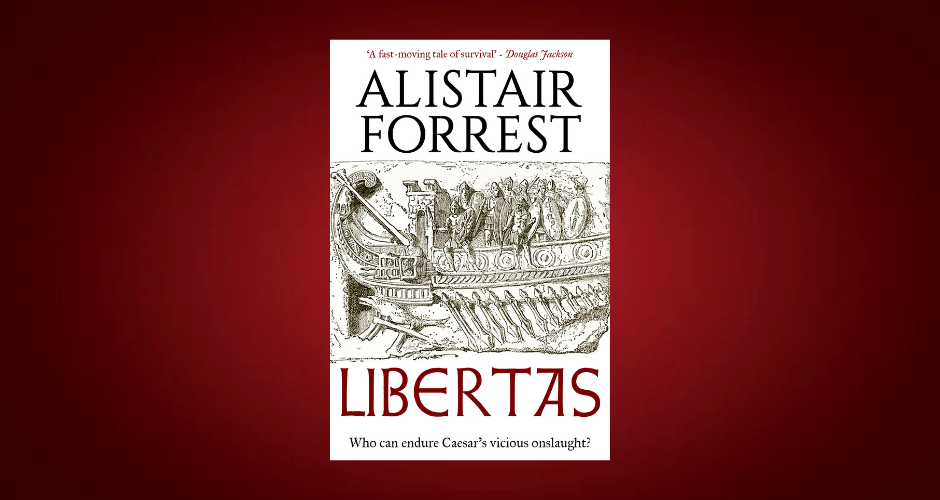
Congratulations to Alistair Forrest, whose action-packed Roman adventure, Libertas, is out now!
Hispania Ulterior, 51 BC
The son of a baker, young Melqart has lived all his life in Munda — an idyllic mountain town untouched by the troubles of Rome.
But when General Pompey sends his sons, Gnaeus and Sextus, to create strongholds and raise new legions, the citizens of Munda find themselves pulled into Rome’s conflicts. Recognising Melqart’s talents as an engineer and strategist, Sextus soon recruits him to his cause.
As tensions between Pompey and his political rival, Julius Caesar, reach breaking point, it seems that Munda is set to become a battleground.
And as darkness begins to fall over his beloved homeland, Melqart must summon all of his courage and ingenuity to save his community from destruction…
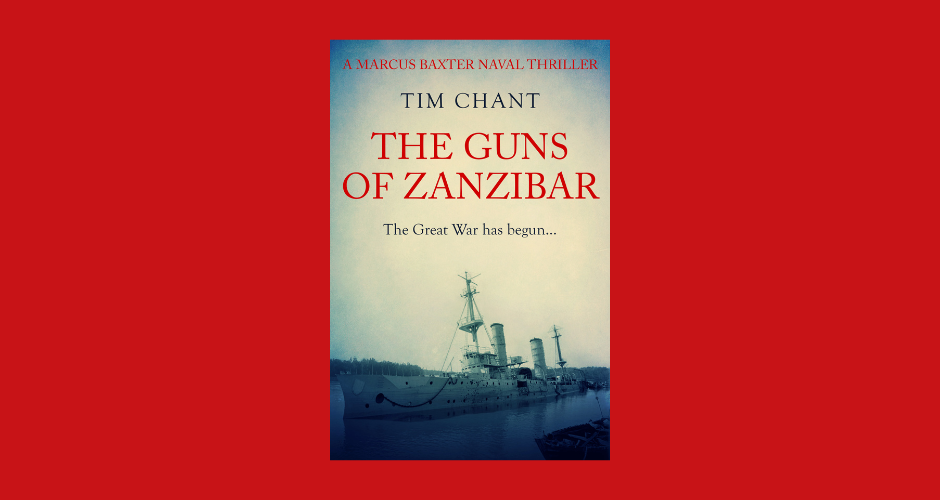
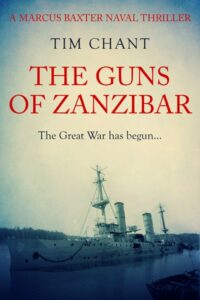
Congratulations to Tim Chant, whose gripping naval adventure, The Guns of Zanzibar, is out now!
The Guns of Zanzibar is the fourth book in the Marcus Baxter naval thriller series: action-packed historical adventures following former Royal Navy officer Marcus Baxter during the early 1900s and through the first world war.
August, 1914
Lieutenant Marcus Baxter has been sent from cold, grey London to the tropical climes of Zanzibar in East Africa on the pretence of carrying out a survey on the local naval station.
In reality, the Royal Navy’s Intelligence Division have sent Baxter to find out if one of their ex-members, Mr Arbuthnott is now working for a potentially hostile foreign power and sharing British secrets.
Baxter is under strict orders not to reveal his true mission to anyone in the small naval contingent he’s been sent to, which makes executing his orders complicated.
He leaves the British protectorate of Zanzibar and crosses the water to the German-occupied port of Dar Es-Salaam to try and subtly gain intelligence.
But once he arrives, he is certain he is being followed.
Returning to Zanzibar, he discovers that the Austrian Archduke Franz Ferdinand has been shot, escalating tensions between the British and German forces and making Baxter’s mission more urgent.
Where is Arbuthnott? Is he betraying the British?
Can Baxter complete his mission before his shadowy stalker catches up with him…?
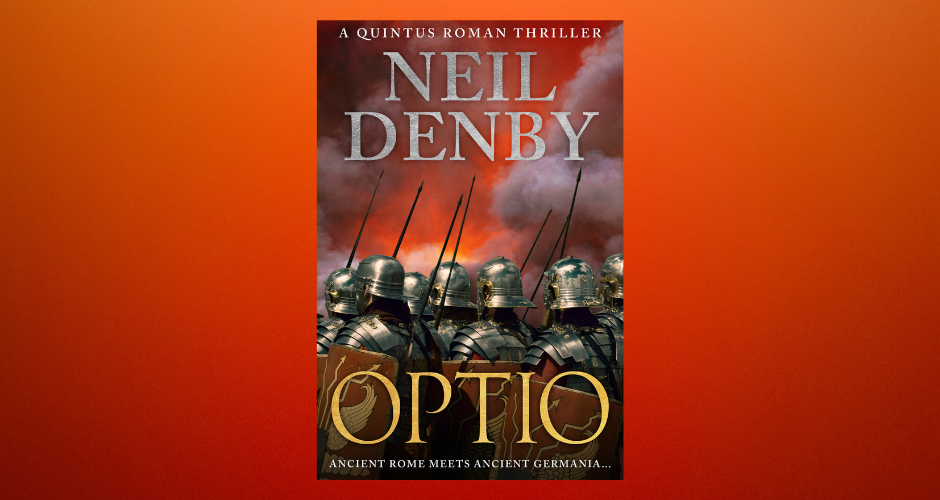
Congratulations to Neil Denby, whose absorbing Roman adventure, Optio, is out now!
Optio is the third book in the Quintus Roman Thrillers series: action-packed, authentic historical military adventures set in Ancient Rome.
Julius Quintus Quirinius, Decanus of his contubernium, has failed in his mission to secure a bridgehead in Britannia for the emperor Augustus.
Despite their failure, they have collected valuable intelligence from the British tribes that they are keen to share with Augustus, hoping that will restore their reputation.
Together with his rescued comrades, Quintus flees the misted isle of the enemy and begins the long and treacherous journey home.
Once they locate the remnants of their cohort, Quintus is promoted to Optio and tasked with leading his men against rebel Germanic tribes.
Success could mean a fast route back to Rome and the favour of the emperor. But failure means an almost certain death.
When disaster strikes, can Quintus rescue the honour of Rome and lead the cohort to safety?
Or will the odds once more refuse to fall in their favour…?
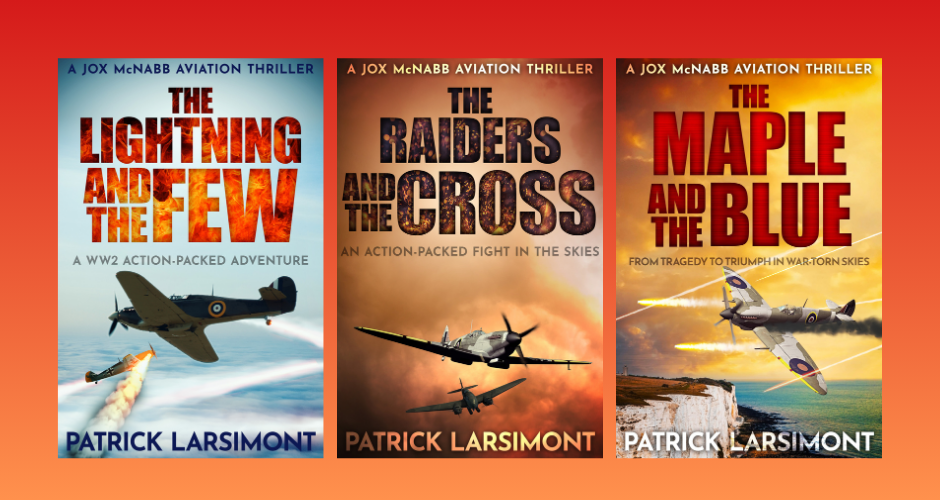
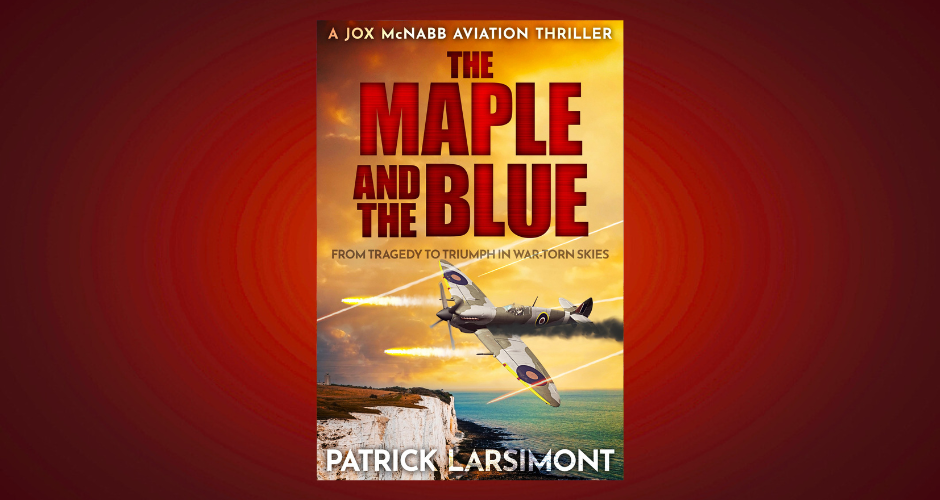
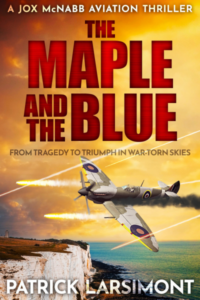
Congratulations to Patrick Larsimont, whose gripping aviation adventure, The Maple and the Blue, is published today!
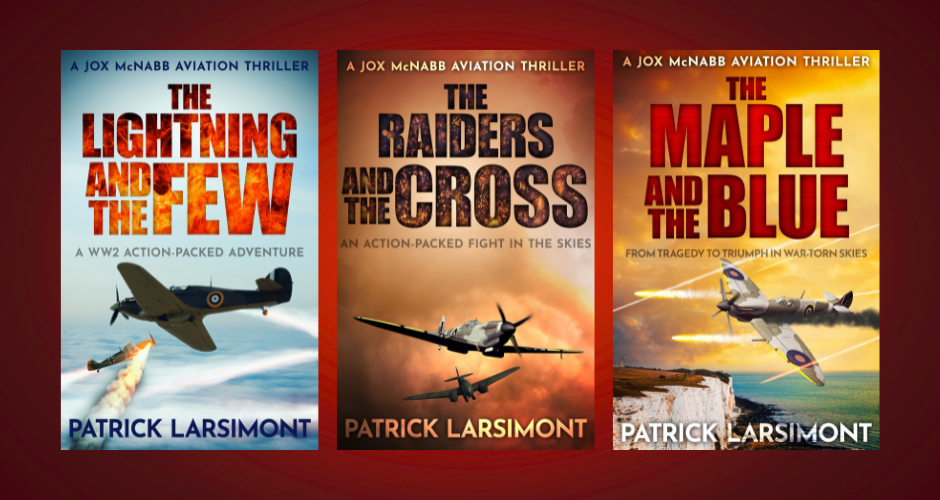
The Maple and the Blue is the third book in the Jox McNabb Aviation Thrillers series: action-packed, authentic historical adventures following a young RAF pilot during the Second World War.
Spring, 1942
The Allies and Fighter Command have gone on the offensive. The French town of Dieppe is selected for the first major assault on the European continent.
But Jox McNabb and No.111 Squadron start to feel like they are being lured into a trap.
And their new leader is acting unpredictably, making them worried that he can’t be trusted.
As the largest air armada since the Battle of Britain prepares for the operation, Jox suspects their squadron leader is using the men for his own vanity and ambition.
And if the Dieppe raid goes wrong could it prove to be a devastating sacrifice.
Can Jox lead his men to victory? Will the ambitious operation be a success? Or will the squadron face disaster…?
My novels are set in the period just before the rise of the great names of Napoleon and Nelson, and after the stormy days of the French revolution in 1789 and the terror that followed, with the execution of the King and Queen of France and the declaration of a Republic. Great Britain was at war with France from that time, and my first novel started with Britain’s most significant involvement on the continent to date: its support for a force of exiled French landed by the British navy on the Brittany coast at Quiberon.
This small army, clad in red British uniforms and carrying British weapons, formed an uneasy alliance with the remarkable Breton insurrection known as the Chouans, a name that may have come from their mimicry of the call of an owl. Brittany was divided in its loyalties, with the Chouans looking back nostalgically to the monarchy and the Catholic Church, while many in the towns supported the new Republic and its freedoms from the old regime. Like all civil wars, the Chouan revolt was marked by outbursts of great cruelty, with much proceeding in secrecy and poorly armed peasant fighters slipping back into the forests, or raiding unexpectedly in towns.
Since the Middle Ages, the English had been allied with Brittany against the power of France. As one who is half Breton and half English, my hero Justin Wentworth had no need to question his loyalties when going undercover in Brittany to liaise with the rebels on behalf of the British commanders at Quiberon. Justin’s Breton mother Sempronie brought the manor of Kergohan into the family via her marriage to his father, who for his part inherited the manor of Chittesleigh, north of Dartmoor. Underpinning all of the novels is this continuing connection of the Wentworth family with Brittany and with Devon in England, one which involves them in the lives and fates of those who live at Kergohan and Chittesleigh.
Yet for all the historical background against which they play out, I see the novels in personal terms, with ambition, greed, deceit, loyalty, honour and love as major motives in the lives of the characters, whether French Republicans, former slaves from the Caribbean, Breton farmers and villagers or English gentry, soldiers, Quakers or actresses. That is why it may be best to see these as romantic historical novels, since romance need not be confined exclusively to salons, drawing rooms and assemblies — of which there are still many to be found in the shifting scenes that make up these stories.
The Maple and the Blue sees Jox McNabb and his comrades of No. 111 Squadron, the Treble Ones, prepare and train for Operation Jubilee, the raid on the French seaside town of Dieppe in Normandy. It would be the first major Allied assault on the European continent, spearheaded by Canadian ground forces, but it also promised to be the largest air battle since the Battle of Britain.
When writing Jox’s adventures, I like to include some of the real characters, locations and events that I uncover during the course of my research into the period. I hope by doing so I provide a convincing evocation of the time, but also share the stories of people, locations and events on the very edge of living memory.
Here are three examples from my next book:
During the training phase before Operation Jubilee, Jox and his commanding officer are invited to a party near Biggin Hill at a large villa called The Red House. This was the home of Moira and Sheila Macneal, six-foot twin sisters known as the Belles of Biggin Hill. Wealthy socialites whose father was known as the Black Knight, they hosted celebrated parties for ‘The Few’ during the Battle of Britain and afterwards. Suffice to say, Jox attracts the interest of one of them and he finds her to be as formidable an adversary as any he’s met up in the skies.
During this time, Jox also drops in for a drink at the celebrated Battle of Britain pub, the White Hart in Brasted. On the wall in the bar is the famous blackboard covered with the signatures of many legendary aces including Sailor Malan, Al Deere, Colin Gray, Johnny Kent and Johnnie Johnson.
Image courtesy of Dougal Fisken
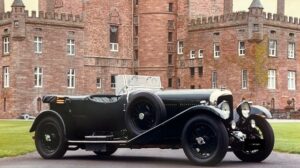
Later on in the story, Jox and his Norwegian comrade (spoiler alert), Axel Fisken, find themselves stranded on the ground near the Dieppe Pourville Golf Club, one of the oldest golf courses in France. Somehow, they manage to find an escape vehicle, which turns out to be a beautiful 1929 Bentley Speed Six tourer, like the one which won the Le Mans twenty-four hours in 1930. As it happens, my own good friend, Dougal Fisken’s family own this one pictured, and so provide the inspiration for the tale.
This and many other personalities, factoids and anecdotes litter my stories, and I hope you enjoy discovering them as much as I enjoy finding a place for them in Jox McNabb’s tale. Jox’s war is just getting started, so I hope you’ll join me for his forthcoming adventures.
We are delighted to announce that the first two books in Neil Denby’s action-packed military adventure series, the Quintus Roman Thrillers, will be released as audiobooks by Tantor Media.
The books follow a solider, Julius Quintus Quirinius, as he fights for survival in the brutal Roman army.
In Neil’s words:
“It has been a delight to work with the supportive publishing team at Sapere, who have helped to hone my writing to the level where Tantor Media bought the audiobook rights. I was excited to choose Matthew Lloyd Davies as an authentic voice for the first two books. Matthew is an actor and director with a long and distinguished career, including regular appearances with the Royal Shakespeare Company.
“The first book, Legionary, is the story of a common soldier and his close comrades stationed in Hispania during the first years of the Principate. Together they suffer punishments, fight battles and discover secrets that could prove useful to the Empire. Against the odds, they strive to maintain dignity and, above all, honour. The second book, Decanus, relates their further adventures with the tribes of the mysterious island of Britannia, after they are shipwrecked on its shores.
“The new deal puts Legionary and Decanus in distinguished company indeed. Matthew has narrated greats like Aldous Huxley, Robert Louis Stevenson and HG Wells, along with dozens of modern authors. The audiobooks will be released in early 2024.”
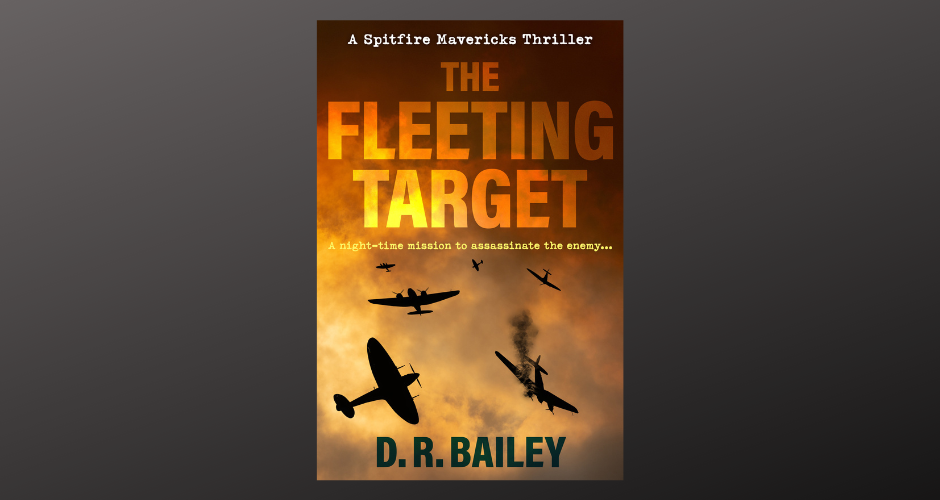
Congratulations to D. R. Bailey, whose gripping aviation novel, The Fleeting Target, is out now!
The Fleeting Target is the third book in the Spitfire Mavericks Thrillers series: action-packed aviation adventures set during the second world war and featuring a team of vigilante pilots.
1941
Flying Officer Angus Mackennelly is flying over Northern France when his tank is holed and he’s forced to crash-land.
Luckily, he is picked up by the French Resistance before the enemy can get to him and, after a tense few days moving between safe houses, he escapes back to Blighty.
Reunited with his squadron, Angus expects to return to flying duties. However, Squadron Leader Bentley informs him that he’s not going to be flying sorties. He is singled out to lead a top-secret mission.
The special mission is to conduct a low flying night operation with six blacked out Spitfires to strafe a convoy carrying a top general from the German High Command and assassinate him.
Training quickly commences but a spate of unexpected enemy fighter attacks leads the team to suspect that a spy is trying to leak details of the upcoming mission to the Germans.
Angus is put on the case to squirrel out the informer and protect the rest of the men from the enemy within.
Will Angus succeed in his secret mission? Can he identify the mole?
Or will the lives of all the men in Maverick Squadron be compromised…?
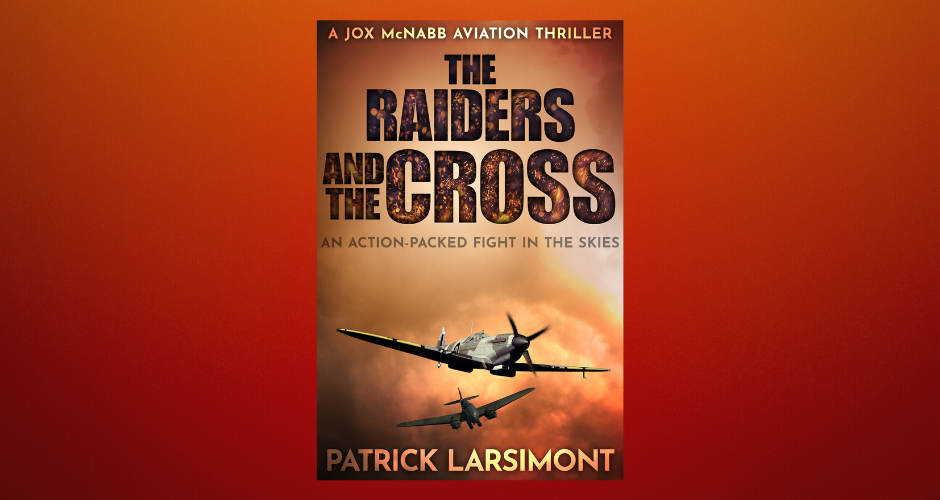
Congratulations to Patrick Larsimont, whose thrilling World War II adventure, The Raiders and the Cross, is out now!
The Raiders and the Cross is the second book in the Jox McNabb Aviation Thrillers series: action-packed, authentic historical adventures following a young RAF pilot during the Second World War.
Winter, 1940
Enemy raiders are bombing Britain’s cities relentlessly. Casualties are high and morale is at an all-time low.
Jox McNabb and the rest of No.111 Squadron train to become night fighters to take on the raiders inflicting such carnage on Britain’s cities.
But then tragedy strikes and Jox is devastated by the loss of those close to him.
Scarred physically and emotionally, he recovers slowly. Seeking a fresh start, he volunteers to serve in the turbulent skies of besieged Malta.
But this new location quickly becomes just as dangerous as the last.
Can Jox forget the tragedy that haunts him? Will he survive the murderous assault of the Luftwaffe?
And can a desperate Malta withstand the relentless onslaught?
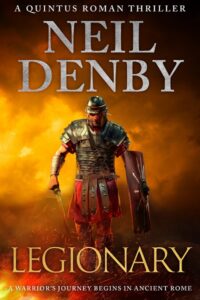
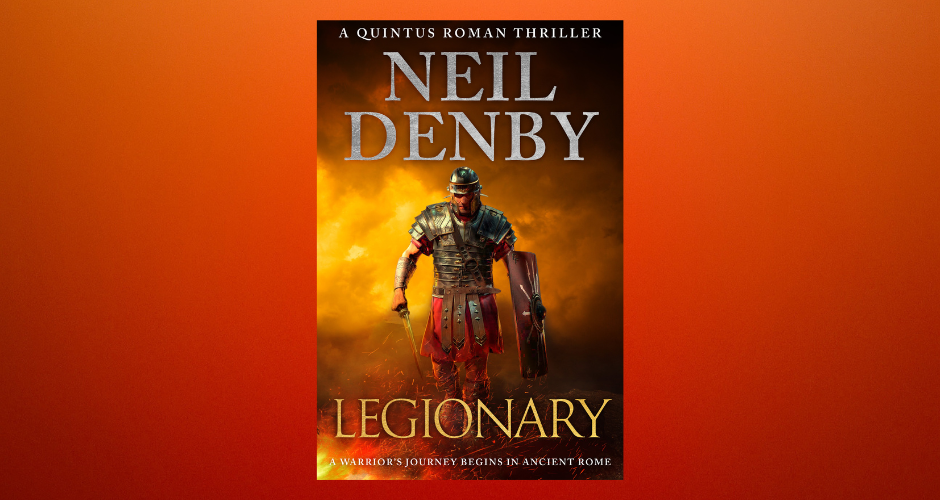
Congratulations to Neil Denby, whose action-packed military adventure, Legionary, is out now! Legionary is the first book in the Quintus Roman Thrillers series.
17 BC
Julius Quintus Quirinius, like many citizens in the years after Rome’s civil wars, must volunteer with the Roman army or be sold into slavery.
Keen to prove his worth, he becomes a member of the IXth Legion, but after only six months his cohort suffer a brutal defeat, the result of stupidity and cowardice.
Cowardice in a legionary carries a heavy punishment: the sentence of decimation – to live or die at the whim of the gods with the unlucky ones clubbed to death by their fellow soldiers.
Ursus, the man killed in Quintus’ group, lays a heavy charge on the youth, asking him to look after the remaining men and to take care of his family back in Rome.
Keen to fulfil Ursus’ last wishes, Quintus helps lead his cohort south to defeat the tribesmen skulking in the mountains in the hope that the IXth legion’s reputation will be restored.
But if they win the fight, their reward may not be the prize they had hoped for… And it soon seems as if returning to Rome is further out of reach than ever…
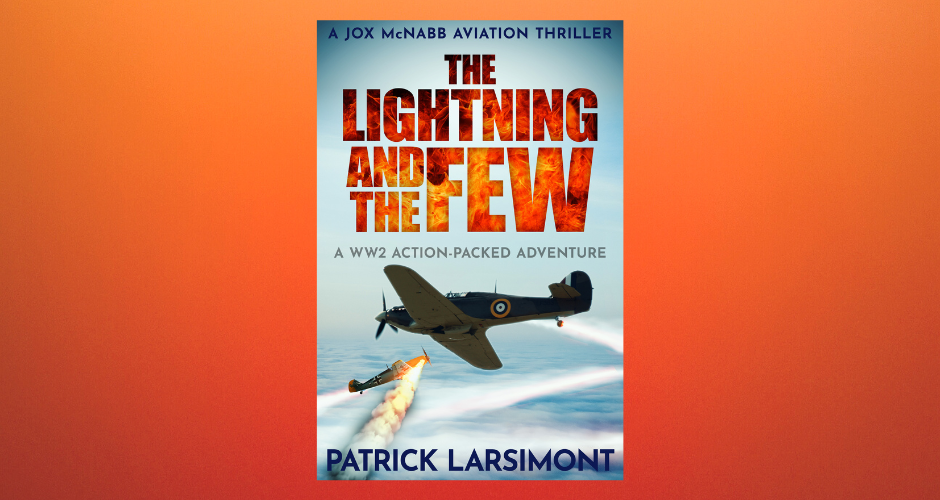
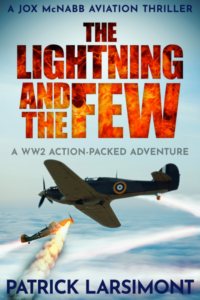
Congratulations to Patrick Larsimont, whose thrilling wartime adventure, The Lightning and the Few, is published today!
The Lightning and the Fewis the first book in the Jox McNabb Aviation Thrillers series: action-packed, authentic historical adventures following a RAF pilot during the second world war.
Scotland, 1939
When Jox McNabb is expelled from school he is forced to look to his future.
Inspired by the sight of a Hurricane flying over him, he becomes determined to join the RAF.
And after basic training, Jox is posted to RAF Montrose with the growing group of other recruits he has met along the way.
Battling the bleak Scottish elements and finding themselves immediately thrown in at the deep end, the lads struggle to keep up with the training.
Many are deemed unfit for service, and after tragedy strikes, Jox questions if he’s got what it takes.
Can Jox earn his wings to face Blitzkrieg and defend his country in its hour of need? Does he have the courage and skill to become one of The Few? Will he beat the odds to survive his first battle?