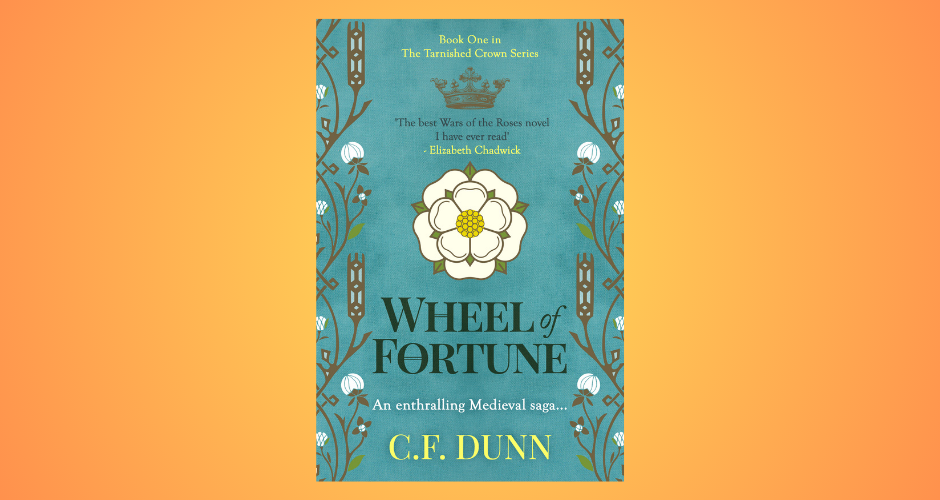
Congratulations to C. F. Dunn, whose thrilling War of the Roses saga, Wheel of Fortune, is out now!
Wheel of Fortune is the first book in the Tarnished Crown series: historical novels set in medieval Europe.
1469, England
For almost ten years, attractive and charismatic Edward IV has ruled with the Earl of Warwick’s support, but now rebellion threatens England’s fragile peace.
With the Midlands in uproar, King Edward wants peace in the shires and the last thing he needs is potential trouble in the form of an unwed heiress.
But, strong-willed and single-minded, Isobel Fenton is determined that nothing will separate her from her beloved manor of Beaumancote, even if she does have to marry to stay there.
Isobel is unaware of the importance she and her land represent, nor of the agenda of the formidable Earl in whose care she finds herself.
And as unrest boils into war, she is drawn into the very heart of the conflict.
Can Isobel escape from the web in which she is trapped? Will she find a way to decide her own fate?
Or will the Wheel of Fortune fail to turn in her favour…?
We invent friends in our heads, decide how they speak, what they wear, where they go, then spend countless hours conversing with them. No two writers share the same head-friends, oddly, despite running in the same social circles. Neither do any two writers develop a story the same way.
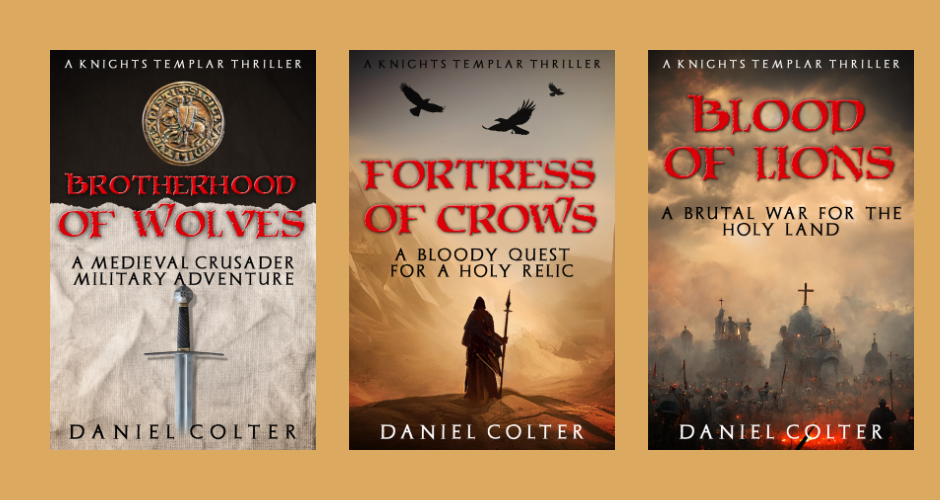
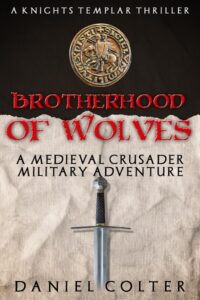
Specific routines keep us on track, or don’t (looking at you, internet), and each work proceeds at its own pace. Most writers are one of two species: a plotter or a pantser. A plotter maps out each scene, chapter, and verse before putting fingers to keyboard. Pantsers fly by the seat of their pants, beginning with an idea, then writing towards a vaguely defined ending. I mapped out my first novel, Brotherhood of Wolves, but tossed the map aside by chapter 3. I found pantsing more rewarding, and still do, because much of the fun (and frustration) is writing myself into a corner and finding a path out.
My novels are historical fiction, where history provides setting, culture, and place. History can also frame the plot. Story is given precedent over history, however, because the goal is to entertain, not to educate. One or more characters are historical persons and the fictional protagonist lives within their orbit. Historical fiction should stay true to history and the fiction takes flight where history grows murky — which it usually does, especially the further back in time one travels. The murk is where the fun begins, in my opinion, and its where the what if fleshes out the story, where the pantser finds out what happens to his head-friends.
Writers are also strange creatures.
Some writers have habits, like a dog that circles exactly three and a half times before lying down, and these rituals are intended to fuel creativity. Isabel Allende started her first novel on January 8, 1981, and that day became a ceremonial start date for all her subsequent works. The poet Friedrich Schiller kept rotten apples in his desk and, when his mind needed a jolt, he would give one a sniff.
My writing rituals are more mundane and less … smelly. I start with two (not one, not three) cups of coffee. I keep a stuffie of Curious George on my desk, in honour of Curious George Rides a Bike, the first book I read cover-to-cover. I say hello to George each morning.
Ritual also comes from my father. He was a painter and writer and used a second-hand desk as his art space. I acquired that desk, set to rehabbing it, but foolishly sanded the top to expose wood veneer over composite. I left his dried paint splashes along the edges, though, and I touch them when I write. They make me think of him, and thinking of him puts me in a creative mood. I told him I had begun writing historical fiction, his favourite genre, but he passed away before reading Brotherhood of Wolves. I often wonder what he would think of my series, and suspect he would be pleased (except for the part where I ruined his desk).
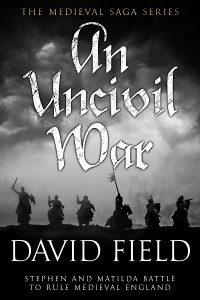
Congratulations to David Field, whose dramatic medieval thriller, An Uncivil War, is published today!
England, 1120
When Henry I dies with no legitimate male heir, the nation is thrown into chaos.
The two rivals for the crown are Henry’s daughter Matilda and his nephew Stephen of Blois, both of whom are determined to emerge victorious.
A bitter struggle ensues which threatens to reduce England to a barren wasteland and many ordinary people find themselves torn apart from each other in the confusion of deciding which side to fight for.
One of those caught up in the fray is young soldier Richard Walsingham who is fighting alongside Stephen. But his sister Elinor is employed as a companion to Matilda.
As the family members come to terms with being on opposite sides of a treacherous dynastic conflict a new contender for the throne enters the picture…
Which of the rivals will emerge triumphant? Can the nation be pieced back together again?
Or will more than lives be lost in this uncivil war…?

 My writing rituals are more mundane and less … smelly. I start with two (not one, not three) cups of coffee. I keep a stuffie of Curious George on my desk, in honour of Curious George Rides a Bike, the first book I read cover-to-cover. I say hello to George each morning.