Where My Inspiration Comes From by Alistair Forrest

In this behind-the-scenes blog series, Sapere Books authors offer an intriguing insight into how, where and why they write.

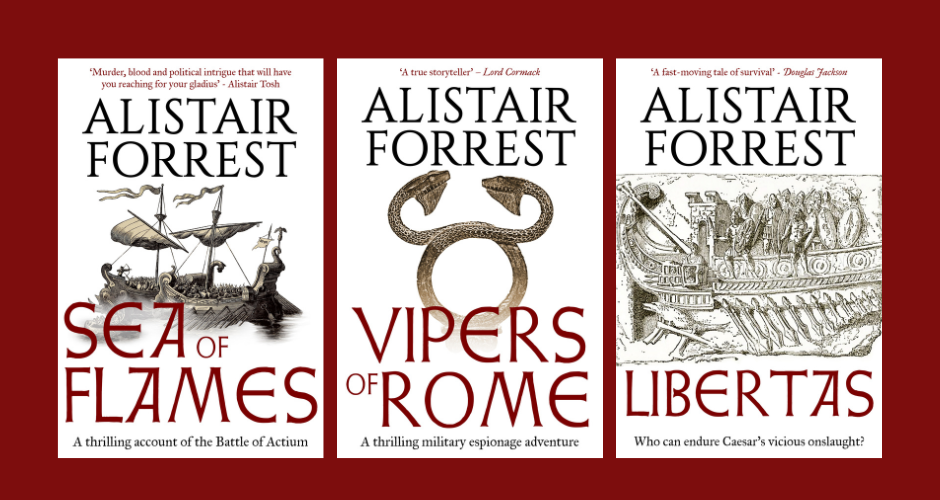
Today, we are delighted to spotlight Alistair Forrest, author of Sea of Flames, Libertas and Vipers of Rome.

For some authors, inspiration is a flash of instant eureka. For me, it’s been more like evolution.
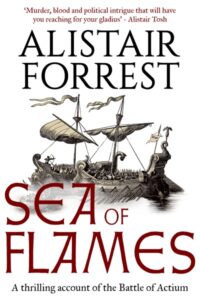
I had never intended to write historical novels centred on the late Roman Republic, but it became inevitable when I moved to Spain with my wife, two-fifths of our children and assorted pets.

Our new home had been built slap bang in the middle of an ancient battlefield. More about that later.

For me, inspiration began in an English lesson at boarding school. One day, evening prep was to write an essay on Macbeth and I hadn’t got a clue how to answer the question. So I flipped to the cover of my textbook, which featured an image of Dunsinane Castle and the encroaching Birnam Wood.

I used my embryonic creative writing skills to describe the scene and thus avoid answering the question, hoping my talent would impress the English teacher, Patrick Cormack.

He wasn’t impressed. He called out my feeble effort in front of Class 4R, announcing that my work was too descriptive, and I wanted the ground to open up and swallow me. But the truth is, I really enjoyed writing that essay.
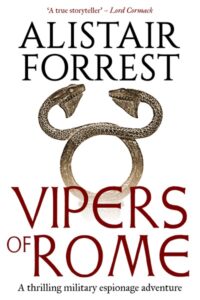
If I had ever summoned the courage to discuss career options with him, he would have said ‘Go and be an accountant’ or something like that. But while he became a politician with a knighthood and later Lord Cormack, I became a humble journalist. Yes, I could write.

Years later, on the publication of my first novel, Libertas, Lord Cormack was kind enough to give me an endorsement. “Forrest has the gift of a true storyteller,” he said, with a hint of a chuckle in his email.

My journalism career provided further inspiration. As a pimply cub reporter on the South Wales Echo, the terrifying news editor would peer down the vast newsroom to see who was slacking. The ‘punishment’ was to be handed the latest novel supplied by a hopeful publisher and told to review it by the next day. This happened to me frequently, and I never objected.

Among the many was Gateway to the Gods by Mary Teresa Ronalds, a magical excursion into the ancient world of Babylonia. It clicked for me, because as a child and teenager, I had lived in three Middle Eastern countries. From that moment, I wanted nothing more than to be a writer of ancient stories.

Leap forward decades, and that move to Spain. My wife and I chose a house amid well-tended olive groves in an upland valley opposite Monda (ancient Munda), a charming village in the Sierra de las Nieves Natural Park, not far inland from Marbella.

And it didn’t take long to discover that Julius Caesar had marched his crack legions through our garden.

I started writing Libertas, revelling in the scenery and culture, and imagining what the community might have been like when Caesar came.

I developed the theme of an indigenous people who were creative and inventive in their own right. They understood herbcraft and lacked nothing for a full, healthy life.

The hero in Libertas is not a warrior but a thinker. He is appalled at the horror that Rome brings to his hometown.

Living in the same community as my protagonist, separated by centuries in which nothing much happened between Caesar and Franco, enabled me to add colour and feeling to my imagined community of bakers, brewers and cheesemakers.

Happily I can refer to a comment by the Historical Novel Society’s reviewer: “Forrest makes us care about Munda. He captures the tragedy of a people dragged into the horror of a vicious war brought about by circumstances over which they had no control and could hardly understand.”

Such a contrast to my teacher’s comment on my Macbeth essay. But let’s face it, his comment was where inspiration began for me.
Congratulations to Alistair Forrest!

Congratulations to 

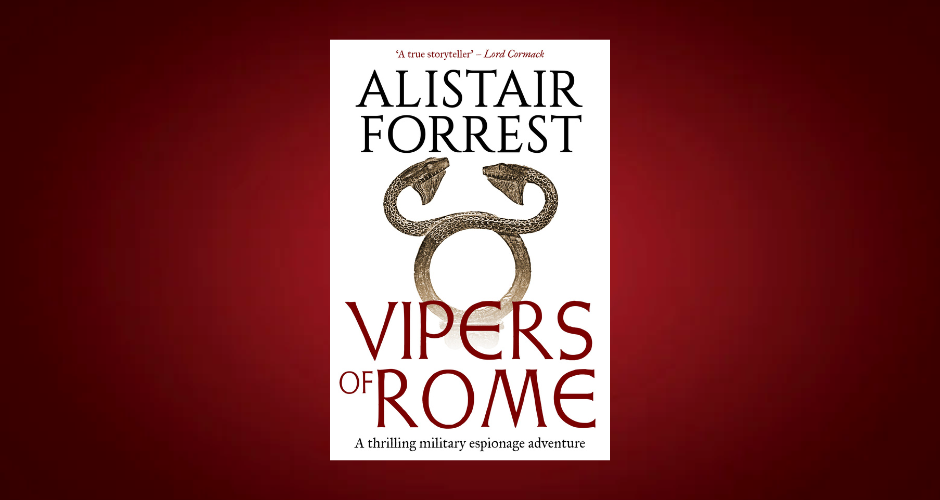
42BC

Two years on from Julius Caesar’s assassination, his successors still crave vengeance. The massed legions of the new Caesar, Octavian, and Mark Antony face off against Cassius and Brutus at Phillipi.

Leading the charge for New Rome are primus pilus Titus Villius Macer and his optio, Crispus.

Their heroics come to the attention of Octavian’s spymaster, Marcus Vipsanius Agrippa, who recruits them for his Viper network of spies.

Their mission: Return to Titus’s native Sicilia to gather intelligence on its current ruler, Sextus Pompey.

But when Titus and Crispus arrive in Sicilia, they find much has changed while they’ve been fighting with the Fifth Legion.

The woman Titus came home to marry has grown cold and he must face up to domestic troubles while trying to help Agrippa restore Sicilia to Roman rule.

Suspecting a plot to assassinate Rome’s new rulers, Titus will face savage sea warfare against the local pirate fleet.

Can he uncover the deadly plot? Will he save another Caesar from assassination?

And can he save his family from the ravages of war…?

Congratulations to Adele Jordan!

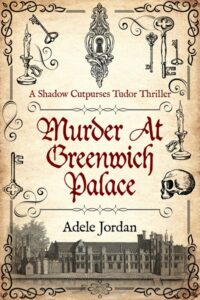
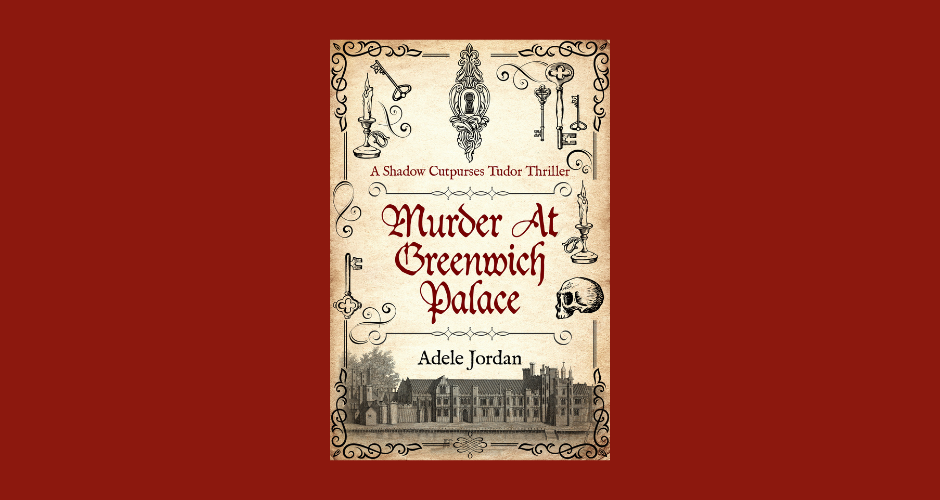
Congratulations to Adele Jordan, whose nail-biting historical thriller, Murder At Greenwich Palace, is published today!

Murder At Greenwich Palace is the first book in the Shadow Cutpurses Tudor Thriller Series. It is an espionage adventure set during King Henry VIII’s reign in England with a feisty female lead.

1536, London

Mother and daughter ‘shadow cutpurse’ team, Emlyn and Gwynnie have been stealing to survive for years, but they are ready to make their big break and escape a life of crime forever.

While Emlyn distracts the guards at Greenwich Palace, Gwynnie sneaks inside, searching for the royal jewels that will set them up for life.

But Gwynnie is disturbed in the act and whilst hiding, she sees something she can never unsee.

A man is murdered in front of her.

Gwynnie flees the crime scene but extreme flooding blocks her escape from the palace grounds.

And with the break-in discovered, suspicion for the murder is placed on the thieves.

If Gwynnie admits to what she has seen, she could find herself executed for a crime she didn’t commit.

Can Gwynnie find a way to reveal what she saw? Will she manage to find her way to freedom?

Or will her a career as a cutpurse end in death…?

A Snare of Deceit is Out Now

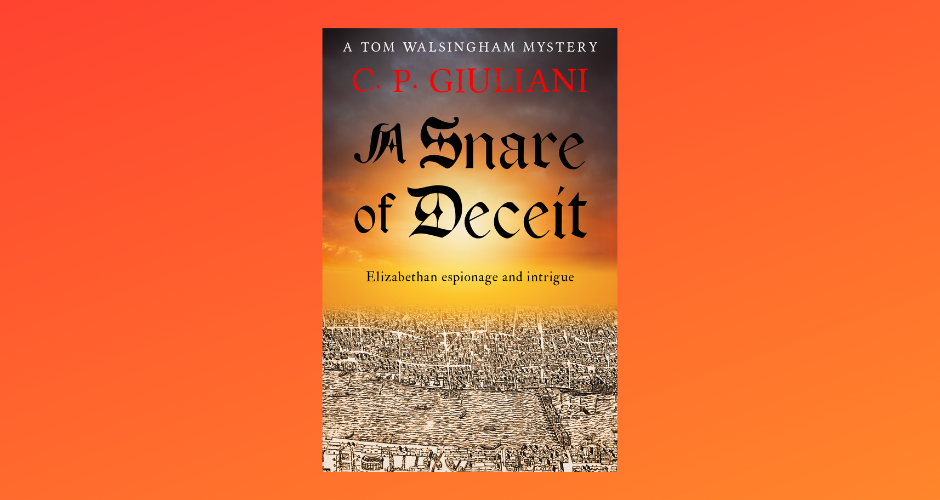
Congratulations to C. P. Giuliani, whose gripping espionage thriller, A Snare of Deceit, is out now!

A Snare of Deceit is a page-turning adventure set during the Elizabethan era in Tudor England. It is the fifth book in The Tom Walsingham Mysteries series.

London, 1587

A new year is being celebrated at Greenwich Palace, but not everyone is in the mood for rejoicing.

Mary Stuart, the imprisoned Queen of Scots has been officially declared a traitor. But Queen Elizabeth is reluctant to sign the death warrant and her mood has been downcast, even in the middle of the festivities.

And the night is soured further when one of the performers is found dead in the tiltyard.

The show must go on, but Tom Walsingham, spying for his cousin Sir Francis, stays behind to investigate. The dead man was no ordinary player, but a man called Jack Perkin, who Tom knew was meant to be passing information to the queen’s confidants about a plot against her life.

With Perkin’s death unlikely to be an accident, Tom feels the danger of the murderous plot escalating out of control. And the player was killed before he could pass on his warning.

But that would place the murderer at court. And dangerously close to the queen…

Can Tom find the killer? Will he uncover the deadly plot?

Or will the web of deceit close in on him…?

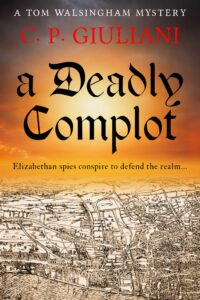
A Deadly Complot is Published Today

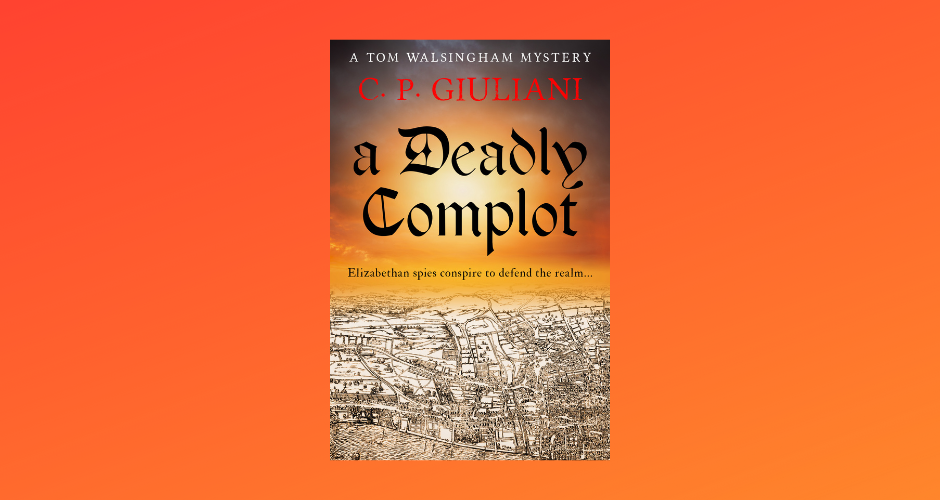
Congratulations to C. P. Giuliani, whose deadly espionage adventure, A Deadly Complot, is published today!

A Deadly Complot is the fourth book in The Tom Walsingham Mysteries series.

England, 1586

Tom Walsingham has been tasked with keeping watch over the network of spies recruited by his spymaster cousin, Sir Francis Walsingham.

After intercepting a series of letters sent to and from Chartley Castle, where Mary Queen of Scots has been imprisoned, the spies have infiltrated a ring of Catholic plotters. Led by the zealous Anthony Babington, the conspirators plan to murder Queen Elizabeth and replace her with Mary, thus restoring Catholicism to the realm.

With most of the plotters under careful observation, the spies have only to wait for the right moment to have them arrested. However, when one of the spies’ couriers — Isaac Finch — is murdered, it seems that Babington’s conspirators may suspect that they have informers in their midst.

Fearing that Finch may have been forced to reveal the spies’ plans, Tom vows to find out who killed him.

As he follows the sinister trail, Tom discovers that there is no shortage of people who may have wished Finch harm. And with the queen and the realm under threat, the pressure is on to solve the mystery before any more of Sir Francis’s recruits are lost…

Have Sir Francis’s spies been discovered? Is there a traitor in their midst?

And can Tom unravel the courier’s fate before Babington’s plotters act on their treasonous scheme…?

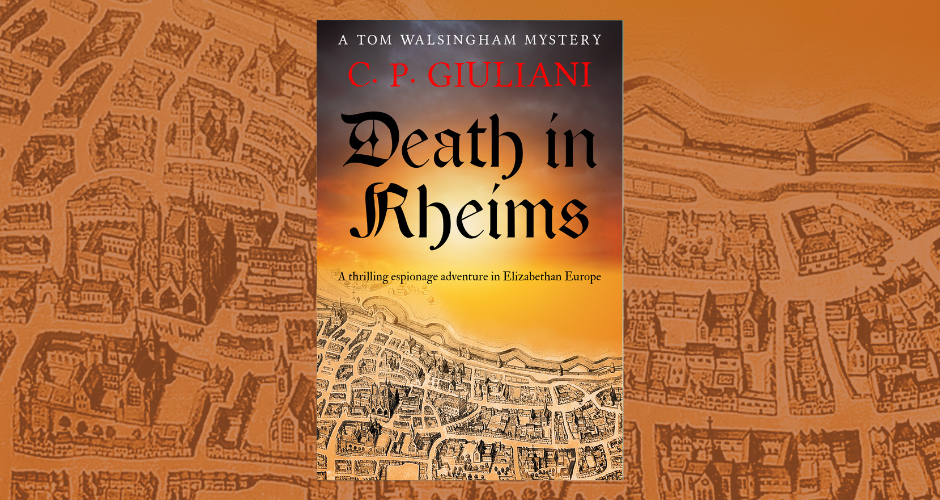
Death in Rheims is Out Now

Congratulations to C. P. Giuliani, whose absorbing espionage adventure, Death in Rheims, is published today!

Death in Rheims is the third book in the Tom Walsingham Mysteries series: spy thrillers set during the Elizabethan era in Tudor Europe.

France, 1585

Tom Walsingham has been sent to France by his spymaster cousin, Sir Francis.

One of Sir Francis’s French informers has recently died in suspicious circumstances and Tom has been dispatched to investigate the death.

The dead man’s daughter is sure her father’s death was quite natural – but this doesn’t mean there aren’t strange circumstances surrounding it.

The informer lived in Rheims, close to a local English college where Catholic exiles are known to train for forbidden priesthood, and Sir Francis’s current plant at the college – a fiery young poet named Kit Marley – claims at least one of the young men has been murdered.

With yet another bout of civil war looming over France, and everyone pursuing their own agenda, Tom has his work cut for him, with plenty of aliases, betrayals and lies to disentangle.

And with relations still tense between the French and English, he must be careful not to betray his true identity and end up as the next victim…

Was the English informer targeted? Is there a serial killer at large?

And can Tom prevent any more deaths in Rheims…?