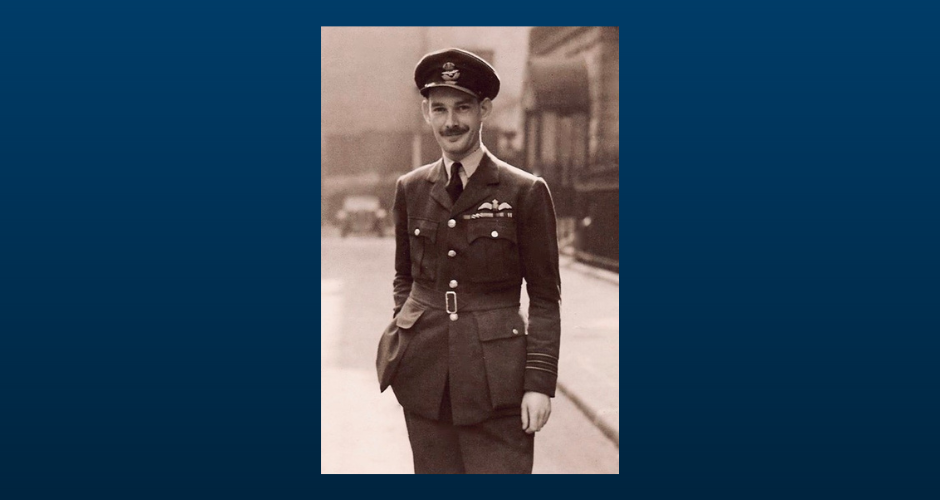
Remembering John Wooldridge

In September 1939 the twenty-year-old John Wooldridge, then a Sergeant Pilot, took part in the British air raid on Kiel, the first raid of World War Two.  Having brought his damaged aircraft home safely, he was awarded the Distinguished Flying Medal.  Commissioned in August 1940, he rapidly rose to the rank of Flight Commander, flying Lancasters as a Flight Lieutenant.  In the middle of 1942, for his part in the 1,000-bomber raid on Cologne, he was awarded the Distinguished Flying Cross.  By the end of the War, he had flown 97 missions over enemy territory.  To commemorate the eightieth anniversary of the end of World War Two, John’s daughter and son, Susan and Hugh, share their memories of him below.
John Wooldridge

On 9th and 10th May 1944, our father, Wing Commander John Wooldridge DSO, DFC*, DFM, returning from New York where his music was being performed at Carnegie Hall, flew over the Atlantic in a Mosquito, taking off from Goose Bay, Canada and landing six and a half hours later in Ballykelly, Northern Ireland.  In so doing, he broke the then speed record for crossing the Atlantic.

The Air Ministry, unsure what to do with this daring twenty-five-year-old, told him to lie low but, within a couple of days, they’d been outflanked by the Press and the story was all over the newspapers.  As our father writes in his diary for Sunday 14th May: Ye gods, what a splash! Headlines, pictures…

Meanwhile, on Monday 15th May in a London hairdresser, our mother, the distinguished British actress Margaretta Scott, was having her hair done.  Whilst under the dryer, she read the story in the London Evening Standard of this amazing trans-Atlantic flight.  But what really caught her eye was that the pilot was also a composer of serious music, who had composed a work for Narrator and Orchestra called The Constellations.

‘That’s my boy!’ she cried, as Sir Henry Wood had recently asked her to find a new work for Narrator and Orchestra for his upcoming Promenade Concerts, and she felt that The Constellations might be just the job.

Our mother immediately approached the Air Ministry, but they refused to give out the personal details of the record-breaking flyer.

The story would have ended there if, a couple of days later, at Denham Film Studios where she was making the film Fanny by Gaslight, our mother had not given a lift to a film publicist who, on their journey back to London, had boasted that he’d just been given a camembert cheese flown across the Atlantic by a friend, one John Wooldridge.

‘Bring him to tea!’ she cried.  And the next Sunday, there was our father on her doorstep — and that was it!  For the next fourteen years until our father’s sudden death in a car crash in 1958, our mother and father were as inseparable as their young family and busy work schedules would allow.

In the 1950s, Margaretta Scott continued to star in plays and films whilst John Wooldridge wrote his music and plays and films.  One of his most important films was the 1953 film starring Dirk Bogarde, Appointment in London, about a Royal Air Force Bomber Command squadron, for which he wrote both the screenplay and the music score.  To this day it continues to be screened to great acclaim and serves as a memorial to Bomber Command by one of their own.

By John Wooldridge:
Low Attack

Sapere Books Sign a New Plantagenet Series by David Field

Following the success of his many historical series, including The Bailiff Mountsorrel Tudor Mysteries and The Medieval Saga Series, we are delighted to announce that we have signed a new series focusing on the Plantagenet dynasty by David Field.

In David’s words:

“It’s so good to be in a relationship with a publisher who likes what you write, and encourages you to write more of it. A marriage made in typescript, so to speak.

“Some years ago, Publishing Director Amy Durant liked my idea of viewing English history through the eyes of ordinary folk, beginning with the conquest of England by William of Normandy in 1066. This became The Medieval Saga Series, which followed the fortunes of several fictional families over two hundred years, ending with the death of Simon de Montfort in 1265.

“I had also written a Tudor series for Sapere that began with the life of Henry VII, who became king in 1485, and ended with the reign of Elizabeth I. As I looked wistfully at the remaining gap of over two hundred years, I couldn’t help wanting to write about that period. ‘Go for it’ was Amy’s response, and The Plantagenet Series was born. It will span from 1265 to 1485, and will involve later generations of the fictional family that readers first met in 1066. When completed, Sapere will have published a novel of mine featuring every English ruler from Harold Godwinson to Elizabeth I. That’s what I call an enduring marriage!”

Tudor Law and Order by David Field

David Field is the author of numerous historical series, including the Bailiff Mountsorrel Tudor Mystery Series: private investigation crime novels set during the reign of Elizabeth I and beyond.

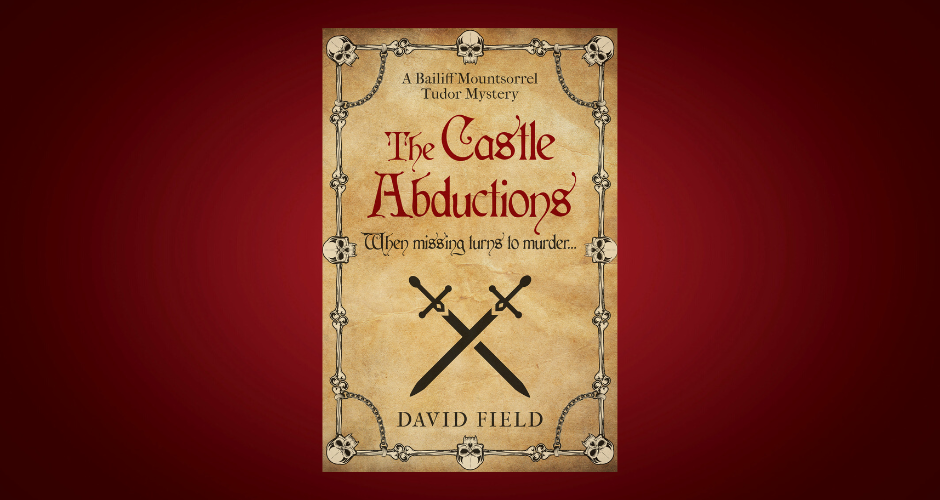
My new series features the exploits of two sheriffs’ bailiffs during the Tudor and later the Stuart eras. For me it was a labour of love because it involved researching the history of Nottingham, where I was born and raised during the immediate post-war years.

In my novels, Edward Mountsorrel and Francis Barton are colleagues in adjoining jurisdictions who have become close friends. Their work involves enforcing the law and investigating crime, under the direction of their respective employers, the Sheriff of Nottinghamshire and the Sheriff of Nottingham. The fact that there are two separate sheriffs, one for the county and the other for the town, arises from a quirk of Nottingham’s history that also explodes one of the elements of the legend of Robin Hood, Nottingham’s most famous alleged resident.

A central character in the Robin Hood myth is the dastardly Sheriff of Nottingham, but the truth is that he did not exist until 1449, at least two hundred years after Robin is said to have lurked in Sherwood Forest, to the north of the town. A charter in that year, granted by Henry VI, made Nottingham its own county, with its own sheriff and its own jurisdiction, not to mention its own courthouse. And therein lies another set of intriguing and quirky facts.

While the town continued to conduct its legal affairs in the old Guildhall in Weekday Cross, the county needed a place to do the same, conveniently located within the town itself. It therefore constructed what for many years was known as the Shire Hall, sitting proudly in the middle of one of the town’s most affluent streets, High Pavement. It was a small chunk of the county located within the town, and given that the boundary line ran through the centre of the original courtroom, the judge could be found seated in the town while the prisoner before him was located in the county. This august building is now the National Justice Museum, a popular destination for tourists.

Hopefully this will make up for several guaranteed disappointments for any tourist visiting Nottingham hoping to step into the Medieval world of Robin Hood. The city does indeed possess a castle, which features heavily in the first book in my forthcoming series, but the current edifice is now in its third manifestation. The original eleventh-century version constructed on the orders of William the Conqueror was destroyed at the behest of its own governor, Colonel John Hutchinson, at the end of the English Civil War, before Oliver Cromwell could get his hands on it. The reconstruction was then burned down by a mob during the Reform Bill Riots of 1831, and the current building — which is now a civic museum that houses old bicycles, coin collections and Japanese armour — became little better than a middle-class boarding house of dull Victorian architecture before being bought up for a song by the embarrassed city fathers.

At least the vandals couldn’t do much to diminish the grandeur of the rock on which the castle stands, a block of sandstone rising for one hundred and thirty feet above ground level. This is full of caves and passages where previous generations cut their way through the soft stone in order to create dwellings that were converted into dungeons when the castle was first constructed. At its foot sits a vintage hostelry, now known as The Ye Olde Trip to Jerusalem, that was once the castle’s in-house brewery before it became an alehouse, linked to the castle above by a series of tunnels through the sandstone. This alehouse would have been there during the time in which my novels are set, so I’ve made use of it in the first instalment, in which young women are abducted from there.

I enjoyed researching the history of my birthplace, and I think it shows in my new series, which hopefully captures the rough-and-tumble nature of law enforcement in a Tudor township.

Beyond The Setting Sun is Out Now

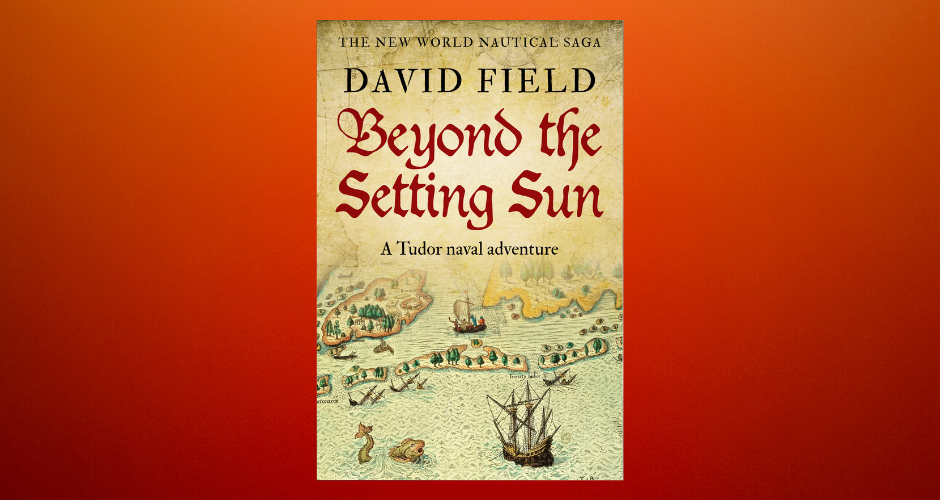
Congratulations to David Field, whose thrilling maritime adventure, Beyond The Setting Sun, is published today!

Beyond The Setting Sun is the second Tudor novel in The New World Nautical Saga Series – historical adventures set during the reign of Elizabeth I and beyond.

England, 1580

Walter Raleigh dreams of the unknown lands that lie over the distant western horizon. He had grown up believing that if you journey too far you risk falling off the side of the earth. But now, intrepid mariners are telling stories of new lands, blessed with limitless riches that await those bold enough to claim them.

Raleigh’s patron, Queen Elizabeth is easily seduced by the prospect of amassing a great fortune for her war chest and agrees to finance his quest.

But the seas are unpredictable, and when his first attempt fails, he fears his adventuring days may be over.

Weaving tales of the legendary land of El Dorado, city of gold, Raleigh successfully persuades Elizabeth to grant him a charter to explore a passage through the Americas to the South Seas.

And this time, he successfully sets up a colony in the New World.

Virginia is born, in honour of the great monarch who sanctioned its creation.

But what dangers are waiting the intrepid settlers? Will they find themselves in a new heaven – or a fresh Hell?