Remembering Jeremy Howard-Williams

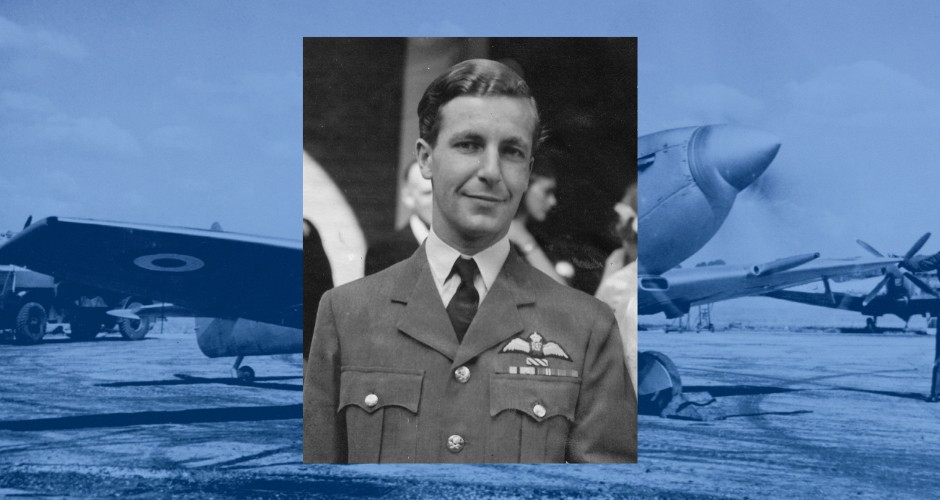
Jeremy Howard-Williams DFC (1922–1995), author of Night Intruder, had a distinguished career in the RAF as a night-fighter pilot during the Second World War and was awarded the Distinguished Flying Cross for gallantry. To commemorate the eightieth anniversary of the end of the Second World War, Jeremy’s son, Anthony Inglis Howard-Williams, reflects on the arrival of peace in 1945 and how it influenced his father’s life.
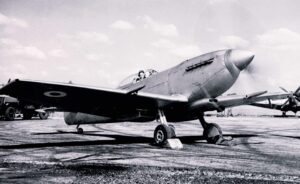
Jeremy Howard-Williams warming up the engines of a clipped wing Spitfire

When peace came to Europe in May 1945, Flight Lieutenant Jeremy Howard-Williams DFC was stationed at HQ, 11 Group Uxbridge. Three days before Germany’s unconditional surrender, a party was held to celebrate peace. Jeremy and his brother Peter did so by marching a guest — Flight Lieutenant Andrew from RAF Intelligence — between them up and down an anteroom. The junior flight lieutenant just happened to have been their pre-war boarding school housemaster, and the brothers had found it too good an opportunity to miss. When, years later, he was asked how the lieutenant had taken the ribbing, Jeremy replied, “with remarkable good humour!”
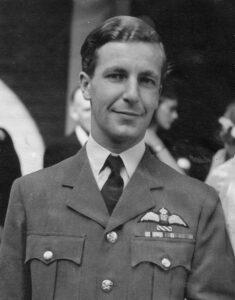
Jeremy at his wedding in 1951

Like so many in 1945, Jeremy was headed for an uncertain future. With peace  came the pressing question: what happens now? For most, life outside of the  forces beckoned. With millions demobilising, the assimilation of those who had been at war back into civilian society became one of the new post-war government’s biggest challenges. For those who did not want to leave the forces came a different challenge. With Jeremy’s father a retired RAF pilot, Peter a Battle of Britain day-fighter pilot and Jeremy a night-fighter pilot with the Fighter Interception Unit — an elite force at the forefront of the RAF’s early experiments with radar equipment — both brothers understandably wished to remain serving.

With the Royal Air Force downsizing, deployment meant less flying — not a very exciting prospect for a twenty-three-year-old war veteran. Jeremy had specifically joined the RAF in order to fly when the Nazis had tried to seize control of Western Europe. However, in the new modern era of the jet engine, aircraft were flying ever faster and higher. Now that was exciting!
In the end, both brothers remained in the RAF. Jeremy was first posted in an admin job to Singapore during the Malayan Emergency, where he met his wife, uniting two distinguished RAF families. He later worked as an assistant air attaché in the Paris and Berlin embassies. He did fly during these postings, but mainly a desk. He resigned in 1957.

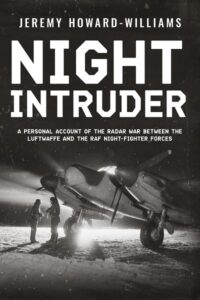
Ultimately, Jeremy’s parents divorced and his father remarried into the Ratsey family, where Jeremy became sales manager for the famous sail-making firm Ratsey & Lapthorn in Cowes on the Isle of Wight. After leaving the company, he wrote many authoritative books on sailing, as well as Night Intruder, republished by Sapere Books, a personal account of his wartime service as a pilot and the radar war between the RAF and Luftwaffe night-fighter forces.
Remembering Sir Frank Whittle

Sir Frank Whittle, author of Jet: The Story of a Pioneer, was a Royal Air Force pilot and aviation engineer known as the inventor of the jet engine. He obtained his first patent for a turbo-jet engine in 1930, and in 1936 co-founded Power Jets Ltd. In May 1941, his engine was fitted to a Gloster E.28/39 airframe — the plane’s maiden flight from RAF Cranwell in Lincolnshire heralded the beginning of the jet age. Frank retired from the RAF in 1948 with the rank of air commodore, and that same year he was knighted. He was awarded the Order of Merit in 1986. To commemorate the eightieth anniversary of the end of World War Two, his son Ian reflects on Sir Frank’s life in 1945.

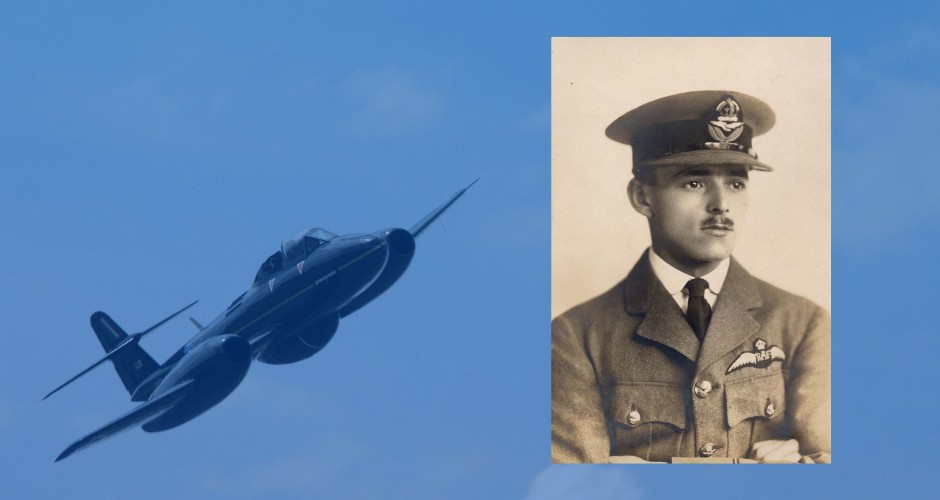
Frank as a junior officer  in 1929, when he proposed the turbojet

My father’s company, Power Jets, was nationalised in 1944. From then until 1946, he was on the board of the government company that emerged under a slightly different name. At the time, he was working on the design for the aft-fan engine that also incorporated the after-burner system he had patented in 1936 — the modified W2/700. This was expected to propel the experimental Miles aircraft (M52) intended to be the first in the world to go supersonic. He was also working on the development of what would have been the world’s first hi-bypass turbo-fan engine — the LR1. Both projects were cancelled by the government in 1946 — as was the M52. These decisions resulted in Frank resigning from the board and putting himself in the hands of the RAF to do whatever they would wish him to do.

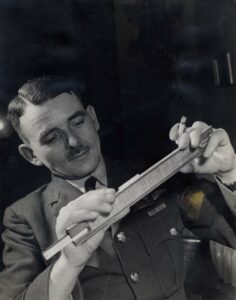
Frank holding his slide rule

1945 was a year of change for my father. He was still a serving officer in the RAF, but Power  Jets had become publicly owned and entirely dependent on government funding. He found himself subject to the needs of the large independent aero-engine manufacturers who objected to a government company in competition. However, on three occasions he briefly got away from it  all and flew the Meteor jet fighter. Apart from the Wright brothers, he was the first person to pilot an aeroplane powered by an engine of his own design. At other times, he found himself sent off to deliver lectures at various venues to describe the impact and differences when changing from piston engine/propeller propulsion to jet propulsion.

As a little boy, I remember him coming home after flying the Meteor along the high-speed run at Herne Bay. “How fast did you go, Daddy?” I asked. “Oh, about 450,” he replied. “Is that all?” I said with some disgust, and turned away to do whatever it was that I was doing. I had  expected him to  tell me 600 miles per hour. When I asked him about this, many years later, he said he was quite crestfallen by my reaction. He also explained that, as he was flying at about 50 feet above the surface of the sea, he really was unable to pay much attention to his airspeed indicator — his attention was focussed on keeping the aeroplane steady and level. And anyway, he would have been speaking of knots, not mph!

Featured image credit: Photo of Gloster Meteor by Alexis Threlfall on Unsplash.

Sisters For Victory is Published Today

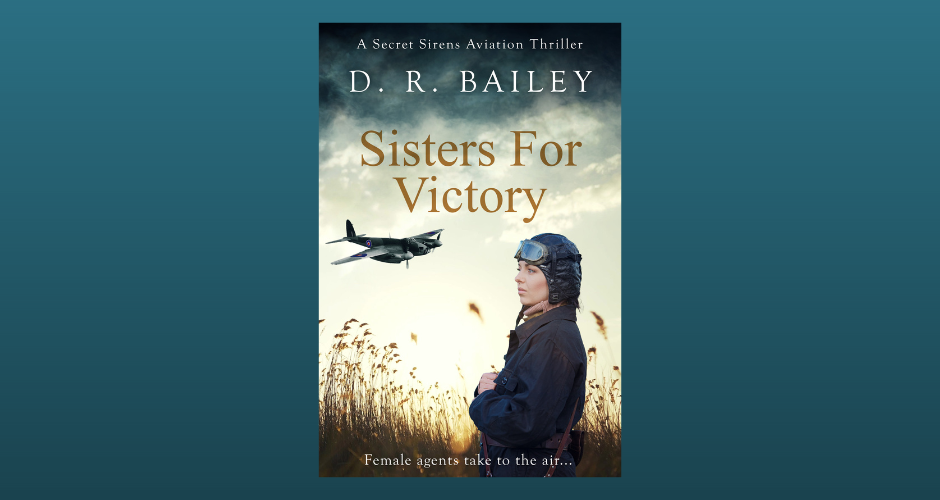
Congratulations to D. R. Bailey, whose thrilling aviation novel, Sisters For Victory, is published today!

Sisters For Victory is the first military adventure novel in the Secret Sirens Aviation Thrillers Series, heart-pounding Second World War escapades with strong female leads.

Autumn, 1942

With the reserves of male pilots ready for combat rapidly dwindling, England’s secret service decide to try something revolutionary. They are going to send female pilots into combat.

MI6 put Wing Commander James Donovan in charge of the ‘Sirens’. Outwardly, the women chosen appear to be assisting in the transporting of planes, but this is just a cover. In reality, they will be flying secret RAF combat missions into enemy territory.

Sisters Anna and Jennifer Nightingale are two of the early recruits into the Siren Squadron. They have grown up flying Tiger Moths as part of their father’s aerial display team, and now they need to get to grips with battle-ready Mosquitos.

Once trained, the Sirens are sent out on their first mission. But it soon becomes clear someone is sabotaging their aircraft.

Can the Nightingale sisters prove they deserve to fight alongside their male counterparts? Will they lead the way for women at war?

Or will the odds be too heavily stacked against them…?

Congratulations to Tony Rea!

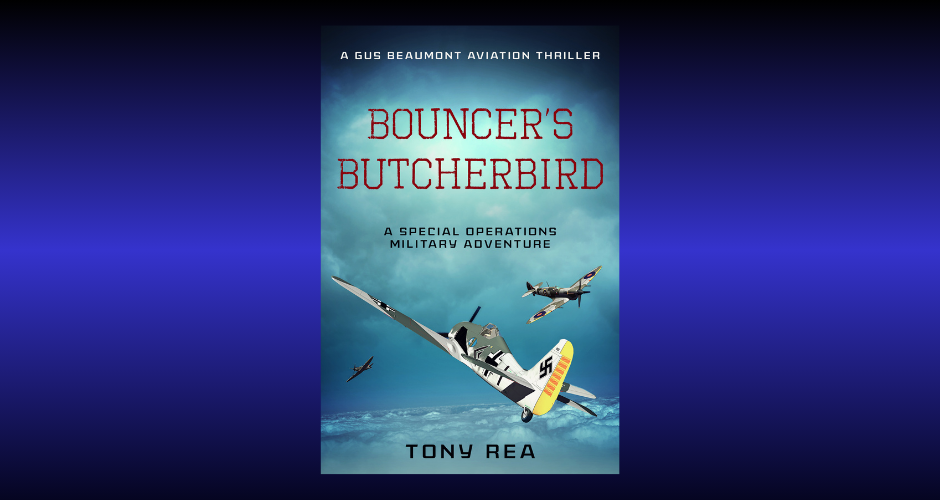
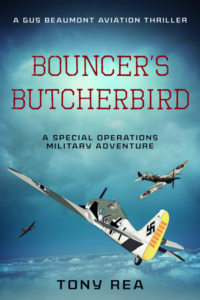
Congratulations to Tony Rea, whose action-packed military adventure, Bouncer’s Butcherbird, is out now!

Bouncer’s Butcherbird is the third book in the Gus Beaumont Aviation Thrillers series: aviation novels set during the Second World War.

England, 1941

Recently returned from the Mediterranean theatre, fighter pilot Gus ‘Bouncer’ Beamont is promoted and offered a posting to a secret Special Operations Executive outfit that flies dangerous night missions over occupied France.

After training, Gus leads Polish SOE mission, Operation Lódź. But the operation is a disaster, as German troops were waiting for the agents to parachute in.

The Poles place the blame on London, insisting there is a traitor at large.

And when Gus’s plane is intercepted by German’s during another mission, he thinks they might be right.

To escape, Gus is forced to crash land in Occupied France where he is picked up members of the French Resistance.

But will they be able to get him to safety?

Who is tipping the Germans off? Is it someone high up in charge of special operations?

And can Gus survive long enough to find out…?

Bouncer’s Blenheim is Published Today

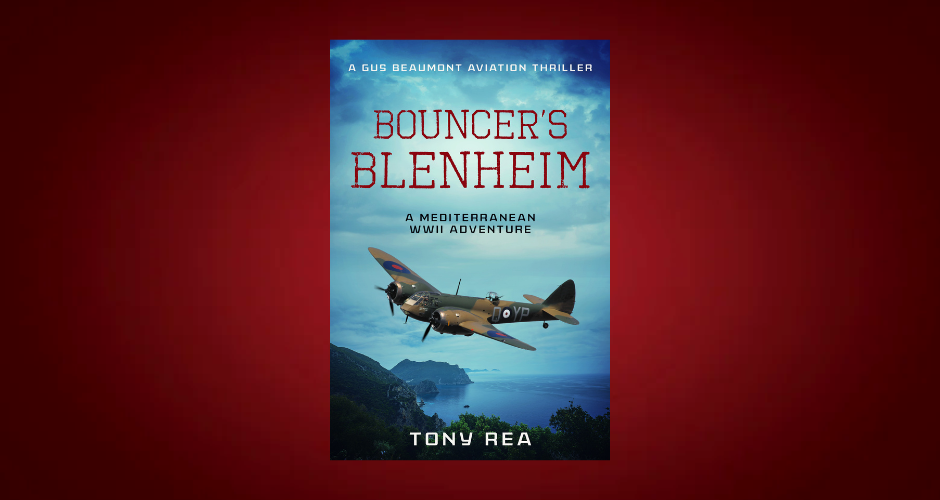
Congratulations to Tony Rea, whose thrilling fighter pilot adventure, Bouncer’s Blenheim, is published today!

Bouncer’s Blenheim is the second book in the Gus Beaumont Aviation Thrillers series: action-packed military novels set during the Second World War.

Europe, 1940

After surviving the Battle of Britain, fighter pilot Gus ‘Bouncer’ Beaumont has been promoted to Flying Officer and is posted to a Spitfire reconnaissance squadron.

That is, until Wing Commander Peacock creates another mission for him.

A new top-secret unit called the Special Operations Executive has been formed to gather intelligence on the enemy. And Gus is ordered infiltrate the Greek Resistance and establish their political affiliation.

Mussolini’s army have occupied Greece but the locals have been fighting back. The actions of the civilians seem promising and British Intelligence want to know where the Greeks’ allegiance lies.

To have a chance of success, Gus needs to ditch his plane into the sea and get picked up by the Resistance fighters.

But that is easier said than done … if you want to survive the crash.

Will Gus make it to Corfu in one piece? Can he persuade the Resistance fighters to confide in him?

And can he successfully evade the Italian army…?

The Real-life Inspiration behind The Maple and the Blue by Patrick Larsimont

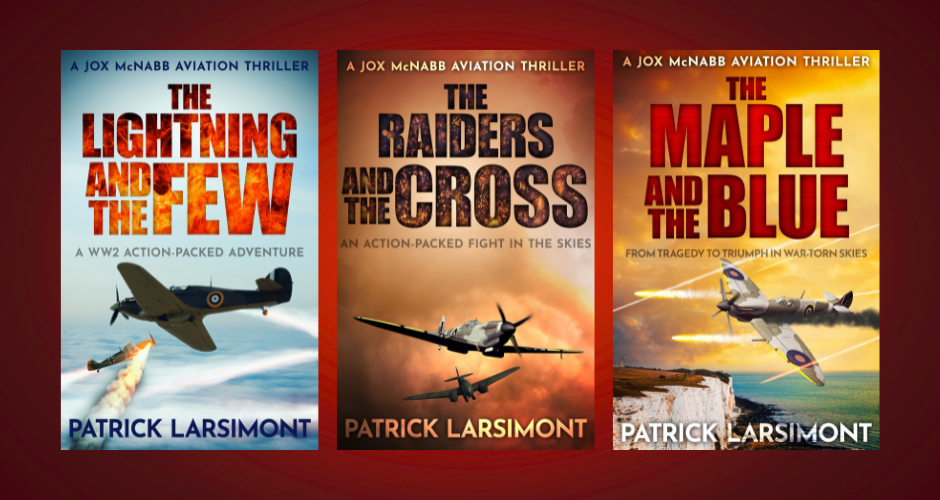
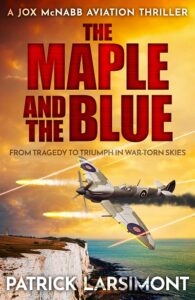
Patrick Larsimont is the author of The Maple and the Blue, the third instalment of Jox McNabb Aviation Thrillers series: action-packed historical adventures following a young RAF pilot during the Second World War.

The Maple and the Blue sees Jox McNabb and his comrades of No. 111 Squadron, the Treble Ones, prepare and train for Operation Jubilee, the raid on the French seaside town of Dieppe in Normandy. It would be the first major Allied assault on the European continent, spearheaded by Canadian ground forces, but it also promised to be the largest air battle since the Battle of Britain.

When writing Jox’s adventures, I like to include some of the real characters, locations and events that I uncover during the course of my research into the period. I hope by doing so I provide a convincing evocation of the time, but also share the stories of people, locations and events on the very edge of living memory.

Here are three examples from my next book:

During the training phase before Operation Jubilee, Jox and his commanding officer are invited to a party near Biggin Hill at a large villa called The Red House. This was the home of Moira and Sheila Macneal, six-foot twin sisters known as the Belles of Biggin Hill. Wealthy socialites whose father was known as the Black Knight, they hosted celebrated parties for ‘The Few’ during the Battle of Britain and afterwards.  Suffice to say, Jox attracts the interest of one of them and he finds her to be as formidable an adversary as any he’s met up in the skies.

During this time, Jox also drops in for a drink at the celebrated Battle of Britain pub, the White Hart in Brasted. On the wall in the bar is the famous blackboard covered with the signatures of many legendary aces including Sailor Malan, Al Deere, Colin Gray, Johnny Kent and Johnnie Johnson.

Image courtesy of Dougal Fisken

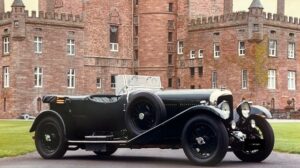
Later on in the story, Jox and his Norwegian comrade (spoiler alert), Axel Fisken, find themselves stranded on the ground near the Dieppe Pourville Golf Club, one of the oldest golf courses in France. Somehow, they manage to find an escape vehicle, which turns out to be a beautiful 1929 Bentley Speed Six tourer, like the one which won the Le Mans twenty-four hours in 1930. As it happens, my own good friend, Dougal Fisken’s family own this one pictured, and so provide the inspiration for the tale.

This and many other personalities, factoids and anecdotes litter my stories, and I hope you enjoy discovering them as much as I enjoy finding a place for them in Jox McNabb’s tale. Jox’s war is just getting started, so I hope you’ll join me for his forthcoming adventures.