How I Write by Neil Denby

In this behind-the-scenes blog series, Sapere Books authors offer an intriguing insight into how, where and why they write.

Today, we are delighted to spotlight Neil Denby, author of the Quintus Roman Thriller series.

Inspiration can come at any time of the day or night, but I find that the small hours are awash with ideas — plot lines, character development, a resolution to a particularly tricky scenario — so it is important that I keep a notepad and pencil by the bed. It may be old-fashioned but it is also reliable and has the advantage of not involving bright screens.

Frustratingly, come morning, I cannot always decipher what I have written down, but sometimes there are gems. These may be character or plot evolution, or perhaps just phrases, but I know I would have forgotten them completely if I had not made a note.

While out walking — an excellent way to clear the brain of fog — I defer to modern technology and record voice notes on my mobile phone. The same principle applies — if there is no immediate record, the thoughts can be lost.

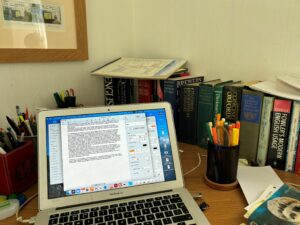
These brief lines are later transferred to a laptop. This is strategically placed in a corner of my study so that I am not distracted by the view outside the window. A row of reference books and one of my favourite possessions, an original Steve Bell cartoon, are all that I have for company. It also helps if I can visualise a character or a place, so I keep a sketchpad on my desk where I can create basic images — maps, plans, sometimes the progress of marches or battles. These drawings help to maintain consistency and authenticity.

This is my primary space, where the words are typed up. I add to them, enhance them, contextualise them, read them back. I often discover that I have used a particular word or phrase twice or more. Or if there is something I’m not sure about, I look it up. The reference books help to straighten out facts and also to find alternative words. Roget’s and Brewer’s and Fowler’s and Chambers provide a wealth of information unmatched by an American-leaning internet. I admit to slipping down rabbit holes of etymology and semantics, but find it strangely satisfying.

I always have to read what has been written, in context with the book so far. Traditionally that would have meant printing the manuscript out and sitting down with a pencil. Happily, that is no longer the case. Instead (thanks to everything going up into the Cloud) I can now read and review on my iPad. This means I can lounge in a chair, or sit outside, or read whilst travelling. So it is more a case of recreating the experience of the reader to see how and if things work.

Of course, there are edits, and actual printouts sometimes, but that is basically it: pencils and pads and technology.

Oh technology, where were you when I had all those essays to write at school?

Sapere Books Sign a New Tudor Series by Phillipa Vincent-Connolly

We are delighted to announce that we have signed a new dual timeline series set in the modern day and Tudor times by Phillipa Vincent-Connolly.

Told in authentic detail, the four-book series explores the intrigue and plots within King Henry VIII’s court. The books include ingenious twists on Boleyn family history, retold through a twenty-first-century history student’s eyes. The first instalment will be published later this year.

In Phillipa’s words:

“It’s very exciting to be working with Sapere Books on my first historical fiction series. The series is very special to me, as it includes appearances from some friends and colleagues of mine, who are featured as cameo characters from the modern day, with the history of the Tudor period also wound through, creating an exciting retelling of Anne Boleyn’s story. The narrative moves between the present day and the middle of Henry VIII’s reign.

“Set in South London and Queen Mary University of London, the first book follows an enthusiastic history undergraduate called Beth Wickers, who gets the shock of her life when her professor’s gold cypher ring opens up a mysterious portal that takes her to Tudor England and Hever Castle, where she becomes an integral part of Anne Boleyn’s life. She’s been warned not to meddle or risk changing history, but can she allow her dear friend to go on to become the second wife of King Henry VIII and to meet a horrific death? Can Beth save herself from the machinations of the Tudor Court, or will she meet the same fate as the queen to be? Only the ring has the answer.”

Amy Durant, publishing director of Sapere Books, commented: “I am thrilled to be working with Phillipa on these books, which breathe new life into the Tudor period. We are sure our readers are going to love the series!”


Click here to visit Phillipa’s website

Author Q&A with Michael Fowler

Hi Michael! Welcome to the Sapere Books blog!

We are very excited to be publishing your HUNTER KERR detective series. Could you tell us a bit about what first got you into writing?

I started at about the age of twelve, and it was a science fiction apocalyptic story, written in two exercise books from Woolworths.  I had an uncle, who was not only an avid reader but had a wonderful imagination, and as a teenager, I would spend many autumn and winter nights with him developing characters and drafting first chapters in front of a glowing coal fire with just a single table lamp burning. It made for a wonderful atmosphere and it was my uncle who introduced me to crime fiction.

Where and how do you like to write?

I have a study set out with everything I need. I start my day walking my dog on fields at the back of my home, and as I’m walking, I am working through what I will be writing when I return. I then hammer away at my keyboard for about five hours, doing some refining along the way, and then take my dog out for his second walk, reflect on the piece I have just written and do a mental edit. I’ll then return and make a few adjustments.

What part of the writing process do you find most difficult?

I am a constructive plotter, and so work out a beginning and end, and build in significant events in the middle, to drive the story. In my study I have a huge whiteboard, and I ‘run’ my stories as if they were a major incident (from my detective days), with photographs, timelines, and spider lines connecting characters to story, so I can keep track.

How much research do you normally do before you start writing?

Not a great deal. Because my crime novels are based very much on my previous career as a detective, I am drawing on those experiences.

How real do your characters become?

Many of my characters are based on people I know or have met, so it’s quite easy for them to own their story.

Do you ever feel guilty about killing off your characters?

Not the villains. As I have said above, they are generally based on the villains I have come across during my career and so I find bumping them off quite cathartic.  However, I have just killed off one of my leading detectives in my Hunter Kerr series and I had a great deal of angst about doing so.

What are you working on at the moment?

I am working on a new character who is a forensic psychologist in a psychological thriller, which is a huge shift for me as my previous novels are police procedurals.

What is your favourite book?

I am such an avid reader I don’t have a favourite book or character. However, there are a few recent reads that stand out among others, and they are: Into the Darkest Corner by Elizabeth Haynes; The Dry by Jane Harper; Her Every Fear by Peter Swanson; Fall from Grace by Tim Weaver, plus The Bone Field by Simon Kernick.

Which book do you wish you had written?

The Bone Collector by Jeffery Deaver – I love the unique element of a paraplegic crime scene examiner detecting a crime from his bed.

Tell us something surprising about you!

I am also an established artist. I have exhibited in London’s Mall Gallery with The Society of Marine Artists, The Society of Oil Painters and the British Federation of Artists. In 2009 I was awarded the SAA Professional Artist of the Year.


Michael Fowler is the author of the DS HUNTER KERR INVESTIGATIONS series.  

Click here to order HEART OF THE DEMON – the first book in the series – now!

COLD DEATH – the second book in the series – is available to pre-order.


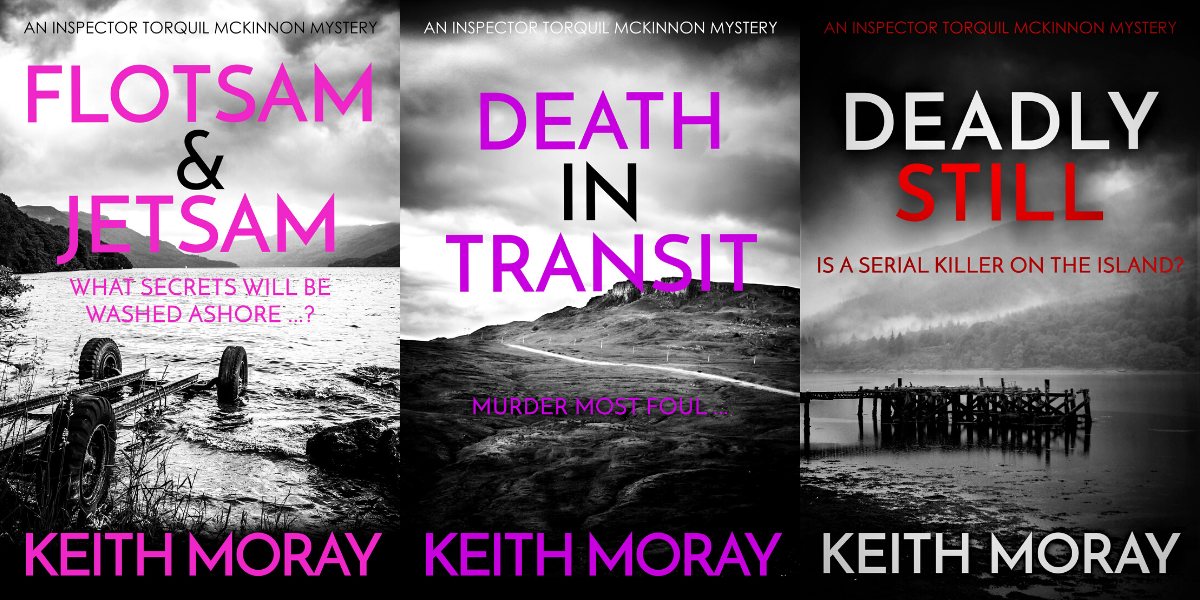
Author Q&A with Keith Moray

Hi Keith. Welcome to the Sapere Books blog!

Can you tell us a little bit about what first inspired you to write the Torquil McKinnon Investigations?

Well, I have been a crime fiction reader most of my life and always wanted to be a crime writer. I began writing children’s stories for The People’s Friend when I was a medical student at the University of Dundee. Then when I qualified, I wrote for the Kingston-upon-Hull’s dial-a-bedtime story service, until I had to give it up and focus on my medical practice. One of my forebears was a piper, and I thought that if I ever did write a crime novel it would have a piper in it. The germ of an idea was there.

A few years later I started having bagpipe lessons from a good friend and golf partner, who happened to be a retired pipe major. So, actually playing the pipes seemed to germinate the idea. Then we went on a family holiday to Tobermory in Mull and the whole thing seemed to unfold before me. A remote Outer Hebridean island with a primitive golf course and the smallest police force in the country, the Hebridean Constabulary. The ingredients were there, it just took a visit to a Highland Gathering on the mainland and I started to plot The Gathering Murders.  The characters grew on me and the series just developed.

What was your reason for creating the fictional island of West Uist instead of choosing a real Scottish location?

I suppose I just fell into it. I had written several westerns long before I ever went to the USA, so I just started writing, amalgamating my own memories into my own wee island in much the same way that I had created towns and counties in the Southwest of America. I wanted West Uist to be Scotland in miniature. This is why the terrain varies, there is a great variety of surnames (far greater than in the Outer Hebrides) and I have introduced a different theme with each novel.

What are your typical writing habits? Do you work on a set schedule each day? Do you plan thoroughly before you begin writing?

I am an opportunistic writer, so I write when I have done all of my essential chores for the day, such as looking after my small practice. I am also a medical journalist and have a written a weekly column in the local newspaper for 38 years, so I can identify with Calum Steele, the editor of the West Uist Chronicle. Because I used to write short children’s stories and now write a newspaper column, I tend to write in short segments. It has become part of my writing psyche. This suits my opportunistic method of working.

I carry a notebook everywhere and am forever jotting snippets down, to be incorporated later. I plot late at night in longhand. When I am actually writing then it will be on the computer, and that can be literally any part of the day.

I do plan it out and have never felt brave enough to just type and see where the story goes. I have  a method of writing a novel that seems to work for me. A crime novel has so many elements to it: main plot, subplots, clues and red herrings. I work out each chapter and have a fair idea of what has to happen in each one.

What part of the writing process do you find most difficult?

Plotting is never easy. I go around asking myself ‘what if?’ That’s why I need my notebook handy. I would say it is 80 per cent of the work in writing the novel.

When I am working on the plot, I often play the pipes like Torquil (except he is a virtuoso and I am so abysmal that I am forbidden from playing if there is anyone else in the house). And I also putt golf balls across the landing into my study or chip balls onto the settee. Strangely enough, it facilitates ideas.

In terms of the visceral structure of the novel when I actually write, the middle part is the hardest for me. The first part is scene setting, putting people in the right places and ensuring that the crime happens early on. The middle part is about planting the clues, the red herrings and keeping the subplots going without letting them take over. The end part I already know what should happen, so the middle is about ensuring that you have put everything in place so that you can build it up for the final denouement.

Do you always know ‘who done it’ before you start drafting each novel?

Yes, in virtually all of my books I know who, where, when and how. But, I have to admit that I have on one occasion changed my mind while well into the story. It seemed to work, but I’m saying no more!

The sixth book in the series is due out soon – will that be the end for Torquil, or do you have ideas for more mysteries?

Gosh, I am honestly not sure. I would like to think there will be more, but I am working on other projects at the moment, which I am excited about. Torquil may not have finished with me yet.

And finally – tell us something surprising about yourself!

One of my hobbies is conjuring and I am a paid up member of the International Brotherhood of Magicians.


Click here for more information on Keith Moray’s Torquil McKinnon Investigations series.

 THE DEADLY STILL, book five in the series, is available to preorder now.

GET THE DEADLY STILL HERE!

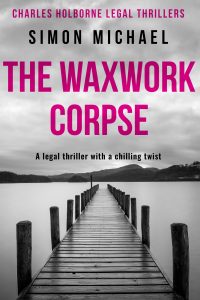
The Real Waxwork Corpse by Simon Michael

Simon Michael is the author of the Charles Holborne Legal Thrillers, set in the 1960s. The Waxwork Corpse is Book Five in the series.

Like all the books in the series, The Waxwork Corpse is based on real events and real cases but this one you may remember, because it made the headlines.

In 1984 a man was arrested in connection with the death of his wife, a body having been found in Wastwater, the deepest lake in England, almost a decade after she went missing, supposedly with her lover.

I learned of the case while waiting in a barristers’ robing room for a jury to return with a verdict. How the killer had dropped the body tied to a kerbstone, in the middle of the night, from an inflatable dinghy into the dark waters of Wastwater. How it had, in a one in a million mischance, landed on the ledge of an underwater pinnacle named Tiffin’s Rock. How, in another extraordinary twist of fate, the ledge was at the perfect depth for the water temperature to preserve the body (the tissues had become “adipose”, wax-like, and so remained recognisable so many years later). And how, extraordinarily, the police happened to be looking for a missing young woman in the same area shortly after an amateur diver first saw the body underwater.

It would, I knew, make a wonderful story, and some years later, following the killer’s conviction for manslaughter and his discharge from prison, I got in touch with his solicitors. Did they think the man would allow me to interview him with a view to writing the story, I asked? They replied in the affirmative and, to my complete astonishment, sent me the case papers, witness statements, photographs, pathology and scientific reports — the complete file.

By then the man was out of prison, running a small B&B in a remote part of England. I got in touch and asked if I could come to interview him, and he agreed. Perhaps rather thoughtlessly in retrospect, I decided that the trip offered the perfect opportunity to take my wife and new-born daughter for a short break away from London.

The plan was to drive from London on Friday afternoon and spend the weekend at the B&B. My wife could walk on the beach while I conducted the interview. However, what nobody predicted, including The Met Office, was that one of the worst storms of the century was due to strike Britain that day.

By dusk, tall vehicles on the motorway in front of us were blowing over. Power lines were brought down by uprooted trees, huge swathes of the countryside were plunged into complete darkness as the electricity supply failed and torrential rain was hurled from the skies. Traffic was guided off the motorway and down narrow country lanes, at one point even being directed over waterlogged fields.

We finally arrived at our destination, a small seaside town, several hours late and in pitch darkness. It was still pouring, the fierce winds howling through the deserted streets and whipping the rain almost horizontal. There was no electricity; even the traffic lights were out.

Eventually, we found the address. We climbed out of the car and, immediately drenched, stepped over dislodged branches and other detritus and ran up the path to the front door. We were exhausted and irritable, with a baby who’d been inconsolable for hours.

I knocked on what we hoped was our host’s front door. At first there was no answer, but then a flickering light swayed down the hallway towards the door. A huge shadow darkened the glass, and the door was opened by an extremely tall man holding a storm lantern.

It was a scene straight out of a horror movie. He offered us hot drinks but my wife, completely spooked by then, insisted we went straight to bed. We climbed the narrow stairs, tired and famished, and entered our dark bedroom. My wife barred the door with a chair.

The next day, the weather was improved and the power restored. I asked my questions about the case and the evidence and the killer’s motivation, while my wife took the baby for a walk on the beach. The interview went well, and it was agreed that I could use the story as long as the man’s identity was obscured to protect his children.

Halfway through I realised that the man sitting opposite me was admitting, completely calmly, that he killed his wife in a fit of uncontrolled anger.

That afternoon I reported some of what I was told to my wife. As I repeated the story and saw the growing horror on her face, it dawned on me that staying for the weekend in an isolated B&B with a man possessing such an uncontrolled temper that he could kill his wife with his bare hands, no longer seemed like such a good idea.

We left that afternoon.

If you want to find out what the killer’s real motivation was, and whether or not he was actually guilty of murder, you’ll have to read The Waxwork Corpse!


Order THE WAXWORK CORPSE here.

Or find out more about the Charles Holborne series here.

Introducing Josef Slonský by Graham Brack

Graham Brack is the author of the JOSEF SLONSKÝ INVESTIGATIONS series.

When I started writing the book that became Lying and Dying, I didn’t have a detective in mind. There would have to be one, of course, and because I wanted it to be realistic he would have to be part of a team, but the character of Slonský was not central to my thinking.

I can remember precisely when he appeared. My brother and I were at the National Theatre; during the interval I described the story, and together we arrived at the notion that a senior Czech detective must have worked under Communism and would therefore probably have some skeletons in his closet. Moreover, everyone he knew would have similar problems, so it would be understandable if he had little or no respect for anyone of his own vintage.

The world-weary detective is a lazy trope, so I made Slonský enthusiastic about his work. He loves his job. He believes it matters, and he has no patience with corrupt colleagues. And then it came to me that the biography I had proposed for him, in which he spent around half his career under Communism, and half after it, meant he must be coming up to retirement. That provided a rich vein of character analysis, because he dreads retirement; there is nothing else in his life, so he wants to go on as long as he can, and the fact that his bosses know that gives them the only hold they have over him.

Thus, Captain Lukas is able to get him to take a trainee officer, Jan Navrátil. Slonský has had partners before, but they quickly apply for transfers. Navrátil can’t do that. He is a fast-tracked police academy officer with a law degree, fierce intelligence, a strict moral code and an open and trusting nature. Slonský comes to realise that Navrátil is incorruptible and probably always will be, and that when he is gone Navrátil has the potential to reach the very top of the tree – provided he listens to Slonský’s sage advice. Shaping Navrátil’s police career will give Slonský the nearest thing he can have to a legacy. Later they are joined by a woman officer, Kristýna Peiperová, who doesn’t have a law degree but balances that by knowing much more about how the world works. Slonský enjoys training her too, and he honestly does not know which of them will get the top job first, but he doesn’t care. Male or female doesn’t matter; all he wants is someone who can bring about the clean, efficient police force he wanted to join.

I sat down to write one Saturday morning, and after a page or so the police car pulled up and Slonský climbed out. Battered, inelegant, disinclined to waste any effort, cunning, cynical and sharp-tongued, he appeared in my mind’s eye and somehow took over. A story in which he was a necessary figure but not the star was seized and made into a section of his biography. Whenever he walked into a scene, it livened up, and I found if I just listened to him he told me so much about himself.

He doesn’t eat well, but he eats a lot. He is a typical Czech, he believes, devoted to beer and sausages. He lives in a dingy one-room flat, so he spends most evenings in bars. He was married, but his wife left him, and he took it for granted that they were divorced, which proved not to be the case. He believes that nobody can work on an empty stomach, that you should never miss a chance to eat or pee (because you don’t know when the next one will come) and that not everything about the old days was bad.

His name was derived from the Czech word slon, meaning elephant. It seemed appropriate, given his size and his memory, and it was gratifyingly similar to the Czech surname Slánský.

After Lying and Dying was published, a woman wrote to me to say that Slonský was appallingly non-PC in his language but his instincts were good; he was meticulously fair, and therefore free from prejudices such as sexism and racism; and, she said, while she wouldn’t invite him to dinner, if she were ever murdered she would want him to be investigating her death. I think he would allow himself a smile if he heard that.

Click here to order LYING AND DYING now!

Author Q&A with Elizabeth Bailey

Hi Elizabeth! Welcome to the Sapere Books blog!

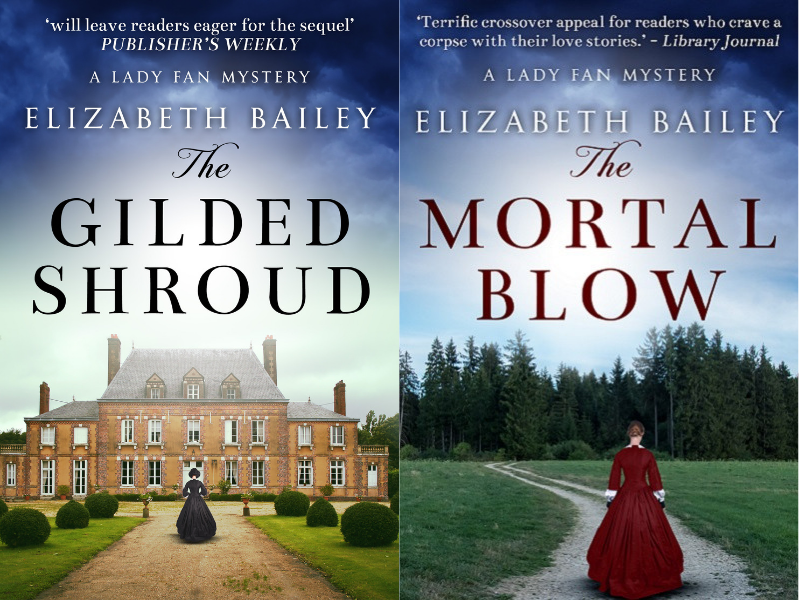
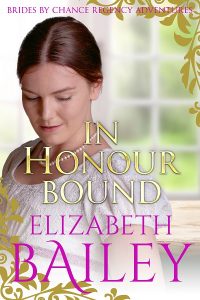
 Elizabeth Bailey is the author of THE LADY FAN MYSTERY SERIES – romantic Regency crime novels, and THE BRIDES BY CHANCE REGENCY ADVENTURE SERIES.

 Can you tell us a little a bit about what first got you interested in writing?

I can’t think of a time I didn’t write. I dabbled for most of my young and adult life, but I was in my thirties when I became a member of a co-operative writing group with the idea of sending out each other’s work. I wrote several short stories and then decided to write a historical romance, a genre I had been reading from a child beginning with the novels of Georgette Heyer. That book, though it never saw the light of day, was the turning point. I loved writing it and felt I had at last found my true metier. I’ve been writing fiction ever since.

Do you have set writing times?

Mostly I write my first draft early morning in bed after I’ve had my tea. If I can get between 500 to 1500 words written, I feel I’m making progress. I try to get it all down without research, leaving notes to myself within the text where I need more data. The murder or where it happens, I will usually check out before I start, unless I add something new and have to go and find out about it before I can get on. I can’t start at all until I have names of the main characters and a general idea of what is likely to happen in the first couple of chapters. I actually don’t usually know who the murderer is when I begin. Nothing like making life interesting for yourself!

Seeing as you write historical fiction, do you find you have to do a lot of research?

These days with many years of historicals of the same period behind me I am so familiar with the time that my research is mostly for specifics. I have many books collected over the years which furnish me with the detail I need. My main focus of research is in the area of the murder and the internet is a mine of information on the subject. You can find contemporary sources relating to anatomical matters, which means I can be as accurate as possible according to knowledge of the era. However, I do turn to current material for exact descriptions of what happens, for example, when someone is bludgeoned, knifed or otherwise injured. All of which is fascinating to read about.

What part of the writing process do you find most difficult?

Struggling through against the odds when life intervenes. This happens and you just have to deal with it. It’s virtually impossible in this day and age to shut yourself away in an ivory tower to get your first draft done. I wrote a short book in a week once on a holiday. Another time I forced through 5000 words a day to get a novel done. But it’s not optimum. It doesn’t allow time for the filtering process that builds the minutiae of the story and generates ideas you hadn’t thought of until some trigger sets them off. Working steadily every day seems to build a book better, but it does mean you are subject to interruptions and getting back into it after a break is the hardest thing of all.

Do you find your characters start to control their own storylines?

Yes, they become totally real, and some characters are completely independent and go off in unexpected directions. The thing is, you invest them with life and then they become real people (albeit in a sort of ghost form in your head). They start behaving according to their character and you might have no idea of who they really are until they do this. Ottilia is a case in point. She was supposed to be a retiring female, letting Francis take the lead. Not a bit of it. She marched into centre stage the minute I set her on the page and stayed there. In the book I’m currently writing, I had a peripheral character take off in much the same way and seize quite a chunk of the story from Ottilia. Experience has taught me to run with it. I have a great belief in the Inner Writer knowing a great deal more than I do about the developing story. It really is like being two people sometimes.

Do you ever feel guilty about killing off characters in your crime series?

Apart from the initial dead body, I hesitate. The first death is the spur for the story, so that’s all right. We usually don’t know that person. But it’s very hard to kill off someone who has become a character in their own right. But that’s good, I think. It transfers to my heroine, who is allowed to have an emotional reaction to such a death.

Do you find it hard to know when to end a story?

Usually the story comes to a natural conclusion. Then it’s just a matter of tying up loose ends and giving my lead characters a chance to mull and make decisions of their own. I like to keep the denouement fairly short. When the story is finished, that’s it. And there’s a maxim – always leave the reader wanting more. If you ice the cake too richly, they might be too satisfied to want another slice.

Which book by another author do you wish you had written?

Oh, that’s a tough one. For sheer quality perhaps, another long-time favourite, In This House of Brede by Rumer Godden. So subtle, engaging, insightful and just beautifully written. But then I would love to write like PG Wodehouse whose Jeeves and Bertie books I adore. I’ve had a go in a play I wrote for school when I was teaching drama, and I have a short story out in a similar style (To Catch a Thief). Or Terry Pratchett with such a discerning eye for the human condition.

Tell us something surprising about you!

When I was a teenager, I won two cups for target shooting with a 303 rifle. Now I couldn’t hit a haystack!

Author Q&A with Linda Statmann

When did you first start writing? Did a specific event encourage you to start?

When I was six years old, I saw a TV programme about the Blitz, which as you can imagine was pretty alarming. I wrote a poem about it.

How much research do you do?

I am fascinated with the Victorian era and do a lot of research to try and get the details right. I read contemporary newspapers and journal articles, biographies and medical works. I study maps, census returns, directories, legislation, photographs, and art. I have about a hundred books just on the history of spiritualism.

Tell us about where you write / your writing habits.

I work from home and have a room which is my office. I don’t work set hours; even when I am doing the household chores, my mind is still working on my latest project or planning a new one.

What part of the writing process do you find most difficult? Starting, knowing when you’ve done enough research, the ending?

When I begin a project, I know where I am starting from and where I will end up, but I have to link the two in a way that makes sense. Every time I pause in order to find that natural link, I have to remind myself that I found it last time. It’s worked so far.

How real do your characters become and do they ever seem to control their own storyline?

They feel very real to me, and because I let themes develop naturally in my mind often the characters do things that I hadn’t necessarily planned but emerge from their personalities and situations, so sometimes they do take me by surprise.

Do you ever feel guilty about killing off characters or do you relish it?

Neither, but it is sometimes sad. It’s very hard writing about a character who I know is about to become a murder victim.

Do you find it hard to know when to end a story?

No, I know when it feels right to me.

What are you working on?

I am editing a new volume in the Notable British Trials series about the trial of the Mannings in 1849. I am also developing the plot for the fifth Mina Scarletti book, to be entitled His Father’s Ghost.

What are you reading right now?

Munich by Robert Harris.

What is your favourite book? Who is your favourite character?

I have read thousands of books and it is impossible to pick one!

What book do you wish you had written?

See above.

Do you love any genres/books that are very different from what you write?

Most of my reading is non-fiction: history, biography, true crime, psychology. In crime fiction, I tend to read books with modern settings or if historical, a very different time period from the one I write about.

 Tell us something surprising about you!

I prefer pickles to sweets!

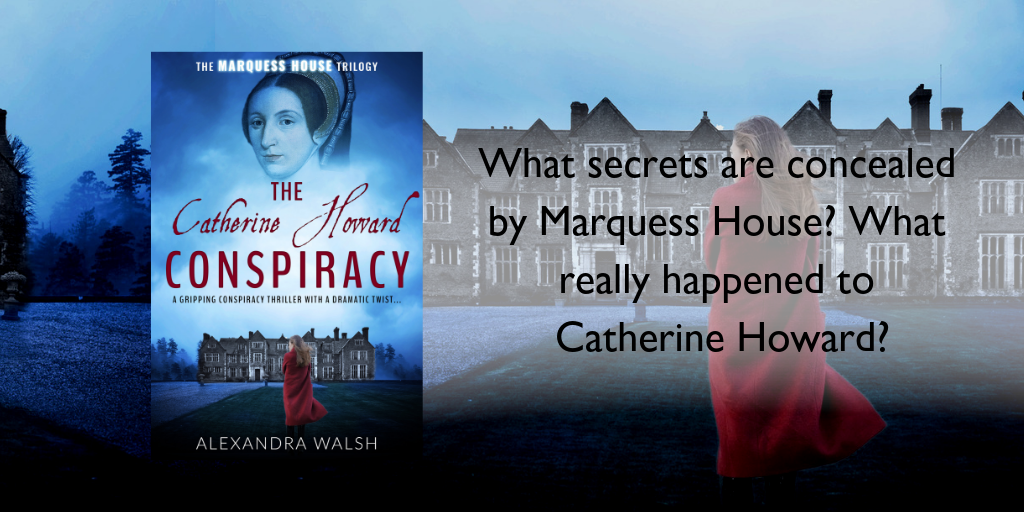
Author Q&A with Alexandra Walsh, author of The Catherine Howard Conspiracy

When did you first start writing? Did a specific event encourage you to start?

There has never been a time when I didn’t write. As a child, my idea of a perfect game was to tell a story to my teddies, then write it down. It was never a conscious decision, it was part of me then and it still is now.
How much research do you do?

It entirely depends on the story. For a while I wrote film scripts, mostly comedies, and they didn’t need any research. Likewise my first few attempts at novels (still languishing unpublished!). One story, The Music Makers took all its chapter heading from the wheel of the Major Arcana cards in the Tarot pack. Although I was a fairly proficient Tarot reader back then, I did research other, wider meanings, for the cards to add extra depth to the main character’s adventures.

The Marquess House Trilogy, which has a split timeline comprising of a present day strand and a historical section has taken years of research. Book one: The Catherine Howard Conspiracy was actually not my intended starting place. The big reveal that appears in book two: The Two Elizabeths was the kernel of the idea for this story and, over the years, I have written many different versions of it trying to make it work. However, none of them were quite right and after several years of juggling work, life and researching Elizabethan England I realised the only way I’d be able to capture this monster of a story on paper was to split it into three separate tales, rather than trying to cram it into one book. Three books, one for each piece of jewellery: two ruby rings and a silver locket.

It was actually devastating because it meant starting again from the beginning. In true frustrated writer style, rather than face this unhappy truth, I wrote a comedy instead, entitled The Patron Saint of Married Women, which was set in the present day and needed very little research. In. Your. Face. History.

In the end, I caved in and began researching Henry VIII’s fourth and fifth brides. I also made the alarming decision to dump my two main characters: Isabella and Oliver. I never liked them much anyway. The name Perdita had been running around my head for a while. From reading Dodie Smith’s One Hundred and One Dalmatians when I was younger, I knew it meant Little Lost One and somehow this seemed appropriate for my main character. Then one morning, I woke up with the question: “Who is Piper?” running around my head. Immediately, I knew she was Perdita’s twin sister and something clicked into place.

The very very first version of this story featured Isabella (now gone) mourning her twin sister who had died under mysterious circumstances on an archaeological dig after she had unearthed a silver locket. The idea was that she had been murdered by MI One Elite. Strangely, the nasty old Watchers were there from the beginning, as was Mary Fitzroy, James Rivers and Alistair Mackensie. Jerusalem was always around too, although it took me a while to settle on its true nature. Warren Dexter was another one who survived the character cull. However, it wasn’t until Perdita and Piper popped up that the story suddenly opened up before me. Then, Kit arrived. He had been through a number of names and he finally found an identity because I quite fancied Kit Harington who plays Jon Snow in Game of Thrones. Yes, it’s an embarrassing admission but he was the inspiration for Kit and once he had his name, the last piece of the puzzle was in place and the story flooded out.

I’ve long since moved past my toe-curling crush, though. Ahem.

Anyway, in answer to your question, at present, several months of research and writing of detailed timelines. By gathering all the information into one huge chart, it’s easier to write fluently and present a more rounded and believable version of my historical periods.

Tell us about where you write / your writing habits.

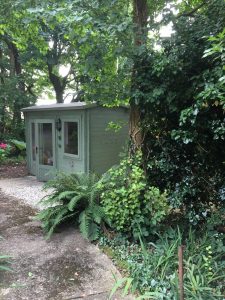
I have a purpose built writing hut in the garden with insulation and a heater. I write every day and, at the moment, am lucky enough to be able to treat it like my day-job.
What part of the writing process do you find most difficult? Starting, knowing when you’ve done enough research, the ending?

It varies. I love the lure of the blank page. Every piece of paper is an adventure waiting to unfold. Knowing when you’ve done enough research is a tricky one but there comes a point where you have to plunge in and see what happens. I don’t like writing endings, not because I don’t like them but because it means you’re saying goodbye to your characters.

How real do your characters become and do they ever seem to control their own storyline?

Very real. They all seem to end up taking over their own storylines. Sometimes, I even argue with them. Although perhaps I shouldn’t have admitted that…

Do you ever feel guilty about killing off characters or do you relish it?

Never! I worry about killing them off for different reasons. What about if I suddenly realise I need them again but they died in Chapter Four?!! EEEKKK!

Do you find it hard to know when to end a story?

Usually I know the end before I begin. The Marquess House trilogy has proved more troublesome though because in my head, it’s one long story, so realising I had to make three endings, instead of just the one at the very very end of book three, has taken a while to adjust to.

What are you working on?

Part three of The Marquess House trilogy. It’s working title was always Prince Oliver but I don’t think this works any more. The title will arrive when its ready.

What are you reading right now?

The Moon Sister by Lucinda Riley. It’s part five of her Seven Sisters series. I only recently discovered these books but I’m really enjoying them.

What is your favourite book? Who is your favourite character?

This is a tough one. How do you choose between so many friends? And also, do I go for something literary and make it look as though I’m very high brow or do I tell the truth?!

For a long time now, my favourite book has been Harry Potter and the Prisoner of Azkaban. I was going through quite a tough time when I began reading these books and, not only was Hogwarts a wonderful place to hide, I was awed by J K Rowling’s brilliance. Goblet of Fire had just been released, the films had been cast and the storm of Harry Potter was building. I never like making judgements on phenomena unless I’ve read/seen/visited them, so I bought the books. Philosopher’s Stone hooked me from page one. Chamber of Secrets worried me – who was Dobby? Was he good or bad? – but when I read the third book with its fabulous twist with Scabbers and the appearance of Sirius Black who had first been mentioned in chapter one of book one, I realised this was more than a series of children’s books. This was truly magical. I’ve asked for help at Hogwarts many times and it’s always been given.

My favourite character is Hermione Granger. Although Harry is pretty amazing too.

I also love Ballet Shoes by Noel Streatfeild and Moll Flanders by Daniel Defoe.

What book do you wish you had written?

Apart for the Harry Potter series? The God of Small Things by Arundhati Roy or The Passion by Jeanette Winterson.

Do you love any genres/books that are very different from what you write?

I try to read a broad cross-section of genres. If a story is well-written, it’ll grip you no matter what the genre. I try never to suffer from literary snobbery. Every book is worth trying, you may not make friends there but you don’t need to be rude!

Tell us something surprising about you!

I play musicals in the background while I write.
Find out all about Christine Evans

When did you first start writing? Did a specific event encourage you to start?

In the 1990s. I can’t be more specific as I went to several creative writing classes, usually with the same tutors. The class would start out well attended, then people gradually would drop out – usually in winter. Then the following year the funding would change and we’d start up again at a different venue. But I always persevered and about three or four of us went to the same classes, which I enjoyed very much. Finally one tutor suggested I sent off some of my stories to a magazine. The first one was rejected but the editor must have seen something in my writing and made some useful suggestions. So luckily my next one was accepted by Ireland’s Own. I still have the cover framed on my wall. It’s dated August 1999 and has the picture of a Connemara pony on the front.


How much research do you do?

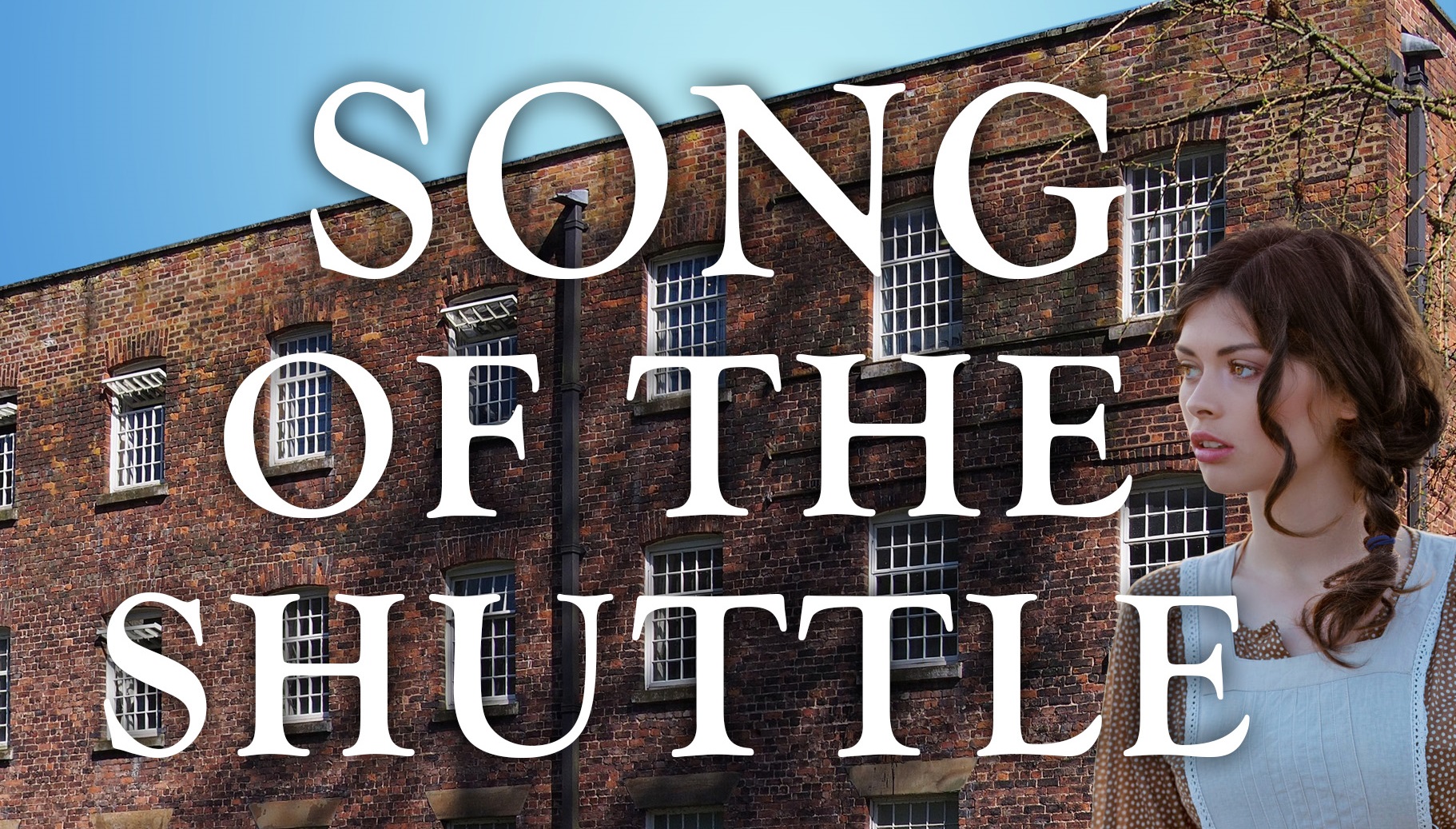
For Song of the Shuttle I went to Quarry Bank Mill, a working cotton mill near Manchester owned by the National Trust. The volunteer guide on duty was so helpful, explaining how the machines worked, then demonstrating them. He was really patient answering all my questions. From a large second hand book store in South Manchester I was lucky enough to find a book from the television series about the American Civil War shown back in the 1990s. It was packed with information and original photographs which was invaluable to my research. Other books like ‘The Hungry Mills’ and ‘Reveille in Washington’ helped enormously and also a map showing the major battles of the war.

For subsequent books I’ve turned to Victorian history which has always interested me. The internet is invaluable too. Where else could you discover the uniform that an American military hospital orderly wears?


Tell us about where you write / your writing habits.

I’ve set up office in a small bedroom since my son and daughter have left home. It overlooks the back garden and I can see the small birds bobbing about in the trees. I’m afraid I’m not an organised writer or set time each day for writing. I have a habit of waking up at an unearthly hour with an idea in my head and can’t get back to sleep until I’ve typed it out. I did try to write those ideas down on a pad by the bed but couldn’t read my writing in the morning. So I drag on a hairy old dressing gown – and tracky bottoms in winter – and sneak off into my office for an hour or so. Then I slip back into bed and sleep soundly.


What part of the writing process do you find most difficult? Starting, knowing when you’ve done enough research, the ending?

Most of my stories are written in my head long before they reach the page. Then when I have time I want to get down the information as quickly as possible. Of course I have to go through it all again and edit it. Sometimes I seem to write in Polish!  I’m not keen on editing and don’t like rewriting at all.


How real do your characters become and do they ever seem to control their own storyline?

My characters do seem to take on a life of their own and I instinctively know how they will act. This is a very perceptive question as many times my ideas and plots will change when faced with what a character would do.


Do you ever feel guilty about killing off characters or do you relish it?

I have sat and wept when one of my characters died. Normally it’s only the baddies that ‘get it’. I feel they get what they deserve.


What are you reading right now?

At the moment I’m reading a spy novel by John Le Carre and persevering with it. I get annoyed by the macho attitude of the men though! I have Lamentation by C. J. Sansom waiting in the wings. I love his Shardlake novels.


What is your favourite book? 

My favourite book is Jane Eyre. I’ve always loved it from being young when I had the Dean and Son version for young readers.

What book do you wish you had written?

Something brilliant like The Book Thief. I’ve recommended it to so many people and they’ve all enjoyed it.


Do you love any genres/books that are very different from what you write?

I have very eclectic taste. I really enjoy Terry Pratchett books. Patrick O’Brian’s seafaring novels are a favourite and also Lyndsay Davies’ Roman detective Falco. Although they are historical novels, they are very different from the romances that I’m writing.
Tell us something surprising about you!

I’ve had a painting exhibited in Manchester Art gallery. I won a competition where all the art classes round the city sent a painting that was inspired by one of the Gallery’s paintings. It was called ‘Things to Do’ and in one corner featured a cosy armchair, a book and a cup of tea. The rest of the canvas had an ironing board, a dirty frying pan, an un-ironed shirt and lots and lots of socks – black with a different coloured heel. None of the socks matched! The blurb was that I’d rather sit reading than doing all the chores. Along with a certificate I received a bag of art goodies. Unfortunately I don’t have time to go to any art classes nowadays.