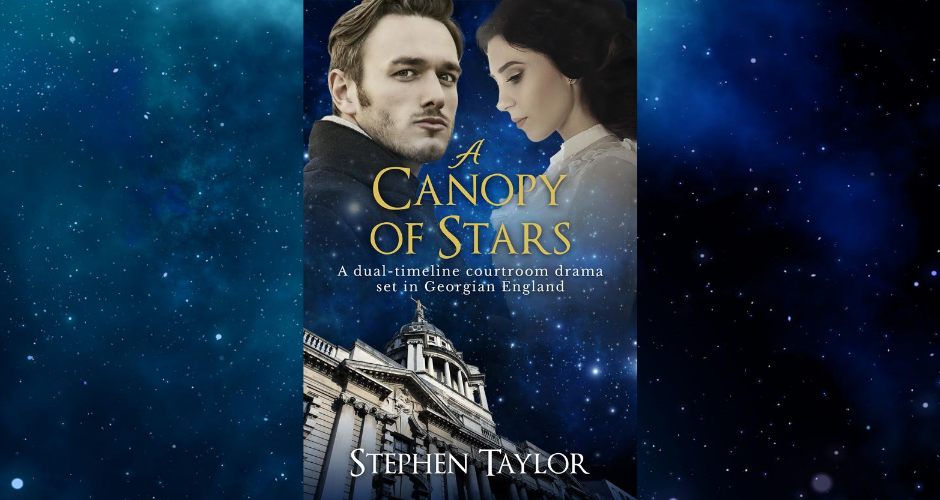
Researching for A CANOPY OF STARS by Stephen Taylor

Stephen Taylor is the author of A CANOPY OF STARS, a thrilling historical 19th century saga stretching from the legal courts of Georgian London to the Jewish ghetto in Frankfurt.

When I start to write a novel, the first thing I always do is open a document that I call ‘Conceptualising’. I put down my initial thoughts, sketch out a skeleton storyline. Then I start researching and populate this document with historical facts and ideas that I can use.

When I came to write A CANOPY OF STARS, my first port of call was a website — Punishment at the Old Bailey: Old Bailey Proceedings Online. Here I could view actual cases going back hundreds of years. I came across the trial of Peter Shalley (REF: T17900113-17) that took place in 1790. Shalley was a German immigrant who was accused of the theft of half a sheep’s carcass worth just 40 shillings. His story, through an interpreter, was that he was offered a shilling to carry the carcass to Oxford Road from a field outside London. When he said he didn’t know where Oxford Road was, the man said: ‘Don’t worry, I’ll walk behind you and each time you come to a junction, look behind you, and I’ll point which way to go.’ When he got to Oxford Road, the Watchman challenged him, and the other man ran away. To me, this was a reasonable defence — he had been duped.

But the system was stacked against him, for while he was an educated man, he was a Jewish immigrant and spoke little English; he was seen as just another piece of London’s low life to be dispatched by the hangman with little ceremony and no one to mourn him. Even the valuation of the sheep at exactly 40 shillings made it a felony (not a misdemeanour) and therefore punishable by death.

I found this disturbing; it may have been over two hundred years ago, but I was stung by the injustice of the case. I was upset; the wrong done to this man was so plain to see and became like a nagging toothache. So I resolved to restructure A CANOPY OF STARS; it would still be a Georgian courtroom drama, but — through the character David Neander — I would also write Peter’s own story as I saw it. Images danced in my mind; what sort of man was this Peter? Why had he left his native Germany; why had he come to England?

In England, this was a time of the enlightenment; there was a clamour for reform. Power, however, lay in the hands of the aristocratic landowners who viewed reform as a threat. In the German states, this was a time of nationalism, a distrust of all things un-German. This is the backdrop to David’s story. How did he navigate his way through it?


Click here to order A CANOPY OF STARS

Author Q&A with Stephen Taylor

Stephen Taylor is the author of A CANOPY OF STARS, a thrilling historical 19th century saga stretching from the legal courts of Georgian London to the Jewish ghetto in Frankfurt.

Hi Stephen! Welcome to the Sapere Books blog. Could you tell us a bit about what first got you into writing?

My addiction has been with me for over twenty years now. When I was younger, if somebody told me a good joke, when I retold it it was twice as long, embellished, the story enhanced, the characters fleshed out. With me, it was never just about and Englishmen, an Irishman, and a Scotsman. It was an Englishman in a bowler hat with a monocle, an Irishman in a donkey jacket with a pint of Guinness and a Scotsman in a kilt with a set of bagpipes (and yes I know that this is stereotypical).

Tell us about where you write and your writing habits.

I started by writing during my lunchtime at work, but now I write in my home office. I keep a working week, Monday to Friday and write for two and a half hours a day. I seem to need that discipline.

What part of the writing process do you find most difficult?

Probably research: it’s a double edged sword — part good, part tiresome. The rewrites are also tricky, as you can edit forever, endlessly trying to improve what you have written. I aim to stop after five rewrites.

Do your characters ever seem to control their own storyline?

The received wisdom is that you determine your storyline and not let your characters deviate from that. However, after I develop my characters, they tell me where they want to go, what they want to do. I follow them, and my stories are character led. I still have a structure in my mind — A to B, but the characters say how I get there.

Do you find it hard to know when to end a story?

Not usually. I have a prompt to myself that sits just below the line I am typing. It reminds me to keep some control over the characters.  It says: INTRIGUE — CONFLICT — CLIMAX — RESOLUTION. i.e:

Open with a big question or hook: INTRIGUE. Then you have the problems your hero is up against: CONFLICT. This builds to a CLIMAX. This is followed by the RESOLUTION.

What is your favourite book?

If you ask me this next week, you may get a different answer. I would say my favourite book is To Kill a Mockingbird by Harper Lee. My favourite character is Uriah Heep, from David Copperfield. Dickens’ image of him is wonderfully unpleasant — he’s so slimy.

What book do you wish you had written?

Anything by Norman Mailer. As a writer, he is so far above me. He’s much more than a storyteller.

Tell us something surprising about you.

I was brought up in Manchester, but I was born in Yorkshire. My mother traveled back to Yorkshire so that my birth there would give me residential status to play cricket for Yorkshire — nobody ever believes that, but I promise that it’s true. Unfortunately, it was a feat that I never achieved, the White Rose County being unappreciative of my cricketing skills.


Preorder A CANOPY OF STARS here!

Sign up to our newsletter for deals and new releases.